




In square $ ABCD $ , side $ AB $ has column vector $ \left( {\begin{array}{*{20}{c}}
2 \\
1
\end{array}} \right) $ . Find two possible column vectors for $ \overrightarrow {BC} $ .
Answer
 Verified
557.1k+ views
Hint: A column vector represents components of the vector written in a single column of a matrix. For a 2D vector two components of the vector are written. In this question we have been given a column vector for a side of a square. We have to find the possible column vectors for the adjacent side $ BC $ . We can use the conditions that the side $ BC $ will have the same length as side $ AB $ , and it will also be perpendicular to the side $ AB $ .
Complete step by step solution:
We have been the column vector of the side $ AB $ of a square $ ABCD $ . The column vector is given as $ \left( {\begin{array}{*{20}{c}}
2 \\
1
\end{array}} \right) $ .
We have to find two possible column vectors for the side $ \overrightarrow {BC} $ .
We can convert column vector in component form as,
$ \overrightarrow {AB} = \left( {\begin{array}{*{20}{c}}
2 \\
1
\end{array}} \right) = 2i + j $ , where $ i $ is the unit vector for x-axis and $ j $ is the unit vector for y-axis.
The magnitude or length of side $ AB $ is $ \left| {\overrightarrow {AB} } \right| = \sqrt {{2^2} + {1^2}} = \sqrt {4 + 1} = \sqrt 5 $
And the unit vector of side $ AB $ is $ \dfrac{{\overrightarrow {AB} }}{{\left| {\overrightarrow {AB} } \right|}} = \dfrac{{2i + j}}{{\sqrt 5 }} = \dfrac{2}{{\sqrt 5 }}i + \dfrac{1}{{\sqrt 5 }}j $
We can assume that the point $ A $ lies on the origin. Then we can get the point $ B $ as $ \left( {2,1} \right) $ .
We know that the scalar product of two perpendicular vectors is zero.
Let us assume a unit vector $ \dfrac{x}{{\sqrt {{x^2} + {y^2}} }}i + \dfrac{y}{{\sqrt {{x^2} + {y^2}} }}j $ that is perpendicular to side $ AB $ .
Two such unit vectors may exist which will result in two different squares as shown in the figure below,
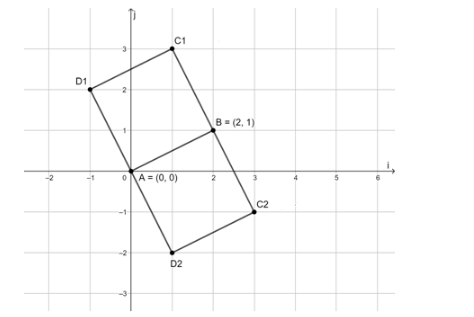
Since $ \dfrac{x}{{\sqrt {{x^2} + {y^2}} }}i + \dfrac{y}{{\sqrt {{x^2} + {y^2}} }}j $ is perpendicular to side $ AB $ , we have,
$
\left( {\dfrac{x}{{\sqrt {{x^2} + {y^2}} }}i + \dfrac{y}{{\sqrt {{x^2} + {y^2}} }}j} \right).\left( {\dfrac{2}{{\sqrt 5 }}i + \dfrac{1}{{\sqrt 5 }}j} \right) = 0 \\
\Rightarrow \dfrac{2}{{\sqrt 5 }}\dfrac{x}{{\sqrt {{x^2} + {y^2}} }} + \dfrac{1}{{\sqrt 5 }}\dfrac{y}{{\sqrt {{x^2} + {y^2}} }} = 0 \\
\Rightarrow 2x = - y \\
\Rightarrow x = - \dfrac{1}{2}y \;
$
We can assume $ y = 2 $ . Then $ x = - 1 $ .
We get a unit vector $ \dfrac{{ - 1}}{{\sqrt {{{\left( { - 1} \right)}^2} + {2^2}} }}i + \dfrac{2}{{\sqrt {{{\left( { - 1} \right)}^2} + {2^2}} }}j = - \dfrac{1}{{\sqrt 5 }}i + \dfrac{2}{{\sqrt 5 }}j $ that is perpendicular to side $ AB $ .
One possible vector for $ BC $ is represented by $ B{C_1} $ . The unit vector is $ - \dfrac{1}{{\sqrt 5 }}i + \dfrac{2}{{\sqrt 5 }}j $ and the magnitude is $ \sqrt 5 $ . Thus,
$ \overrightarrow {B{C_1}} = \sqrt 5 \left( { - \dfrac{1}{{\sqrt 5 }}i + \dfrac{2}{{\sqrt 5 }}j} \right) = - i + 2j $
The column vector for side $ B{C_1} $ is $ \left( {\begin{array}{*{20}{c}}
{ - 1} \\
2
\end{array}} \right) $ .
Again, we can assume $ y = - 2 $ . Then $ x = 1 $ .
We get another unit vector $ \dfrac{1}{{\sqrt {{{\left( { - 1} \right)}^2} + {2^2}} }}i + \dfrac{{ - 2}}{{\sqrt {{{\left( { - 1} \right)}^2} + {2^2}} }}j = \dfrac{1}{{\sqrt 5 }}i - \dfrac{2}{{\sqrt 5 }}j $ that is perpendicular to side $ AB $ .
Another possible vector for $ BC $ is represented by $ B{C_2} $ . The unit vector is $ \dfrac{1}{{\sqrt 5 }}i - \dfrac{2}{{\sqrt 5 }}j $ and the magnitude is $ \sqrt 5 $ . Thus,
$ \overrightarrow {B{C_2}} = \sqrt 5 \left( {\dfrac{1}{{\sqrt 5 }}i - \dfrac{2}{{\sqrt 5 }}j} \right) = i - 2j $
The column vector for side $ B{C_1} $ is $ \left( {\begin{array}{*{20}{c}}
1 \\
{ - 2}
\end{array}} \right) $ .
Hence, two possible column vectors for $ \overrightarrow {BC} $ are $ \left( {\begin{array}{*{20}{c}}
{ - 1} \\
2
\end{array}} \right) $ and $ \left( {\begin{array}{*{20}{c}}
1 \\
{ - 2}
\end{array}} \right) $ .
Note: We took squares on both sides of the given side $ AB $ as both are possible. For the side $ BC $ we have to ensure the conditions that it is perpendicular to side $ AB $ and has the same magnitude as side $ AB $ . We can see that in 2D only two values for $ BC $ would be possible. Also, we can find the point $ C $ as $ \overrightarrow C = \overrightarrow {BC} + \overrightarrow B $ .
Complete step by step solution:
We have been the column vector of the side $ AB $ of a square $ ABCD $ . The column vector is given as $ \left( {\begin{array}{*{20}{c}}
2 \\
1
\end{array}} \right) $ .
We have to find two possible column vectors for the side $ \overrightarrow {BC} $ .
We can convert column vector in component form as,
$ \overrightarrow {AB} = \left( {\begin{array}{*{20}{c}}
2 \\
1
\end{array}} \right) = 2i + j $ , where $ i $ is the unit vector for x-axis and $ j $ is the unit vector for y-axis.
The magnitude or length of side $ AB $ is $ \left| {\overrightarrow {AB} } \right| = \sqrt {{2^2} + {1^2}} = \sqrt {4 + 1} = \sqrt 5 $
And the unit vector of side $ AB $ is $ \dfrac{{\overrightarrow {AB} }}{{\left| {\overrightarrow {AB} } \right|}} = \dfrac{{2i + j}}{{\sqrt 5 }} = \dfrac{2}{{\sqrt 5 }}i + \dfrac{1}{{\sqrt 5 }}j $
We can assume that the point $ A $ lies on the origin. Then we can get the point $ B $ as $ \left( {2,1} \right) $ .
We know that the scalar product of two perpendicular vectors is zero.
Let us assume a unit vector $ \dfrac{x}{{\sqrt {{x^2} + {y^2}} }}i + \dfrac{y}{{\sqrt {{x^2} + {y^2}} }}j $ that is perpendicular to side $ AB $ .
Two such unit vectors may exist which will result in two different squares as shown in the figure below,
Since $ \dfrac{x}{{\sqrt {{x^2} + {y^2}} }}i + \dfrac{y}{{\sqrt {{x^2} + {y^2}} }}j $ is perpendicular to side $ AB $ , we have,
$
\left( {\dfrac{x}{{\sqrt {{x^2} + {y^2}} }}i + \dfrac{y}{{\sqrt {{x^2} + {y^2}} }}j} \right).\left( {\dfrac{2}{{\sqrt 5 }}i + \dfrac{1}{{\sqrt 5 }}j} \right) = 0 \\
\Rightarrow \dfrac{2}{{\sqrt 5 }}\dfrac{x}{{\sqrt {{x^2} + {y^2}} }} + \dfrac{1}{{\sqrt 5 }}\dfrac{y}{{\sqrt {{x^2} + {y^2}} }} = 0 \\
\Rightarrow 2x = - y \\
\Rightarrow x = - \dfrac{1}{2}y \;
$
We can assume $ y = 2 $ . Then $ x = - 1 $ .
We get a unit vector $ \dfrac{{ - 1}}{{\sqrt {{{\left( { - 1} \right)}^2} + {2^2}} }}i + \dfrac{2}{{\sqrt {{{\left( { - 1} \right)}^2} + {2^2}} }}j = - \dfrac{1}{{\sqrt 5 }}i + \dfrac{2}{{\sqrt 5 }}j $ that is perpendicular to side $ AB $ .
One possible vector for $ BC $ is represented by $ B{C_1} $ . The unit vector is $ - \dfrac{1}{{\sqrt 5 }}i + \dfrac{2}{{\sqrt 5 }}j $ and the magnitude is $ \sqrt 5 $ . Thus,
$ \overrightarrow {B{C_1}} = \sqrt 5 \left( { - \dfrac{1}{{\sqrt 5 }}i + \dfrac{2}{{\sqrt 5 }}j} \right) = - i + 2j $
The column vector for side $ B{C_1} $ is $ \left( {\begin{array}{*{20}{c}}
{ - 1} \\
2
\end{array}} \right) $ .
Again, we can assume $ y = - 2 $ . Then $ x = 1 $ .
We get another unit vector $ \dfrac{1}{{\sqrt {{{\left( { - 1} \right)}^2} + {2^2}} }}i + \dfrac{{ - 2}}{{\sqrt {{{\left( { - 1} \right)}^2} + {2^2}} }}j = \dfrac{1}{{\sqrt 5 }}i - \dfrac{2}{{\sqrt 5 }}j $ that is perpendicular to side $ AB $ .
Another possible vector for $ BC $ is represented by $ B{C_2} $ . The unit vector is $ \dfrac{1}{{\sqrt 5 }}i - \dfrac{2}{{\sqrt 5 }}j $ and the magnitude is $ \sqrt 5 $ . Thus,
$ \overrightarrow {B{C_2}} = \sqrt 5 \left( {\dfrac{1}{{\sqrt 5 }}i - \dfrac{2}{{\sqrt 5 }}j} \right) = i - 2j $
The column vector for side $ B{C_1} $ is $ \left( {\begin{array}{*{20}{c}}
1 \\
{ - 2}
\end{array}} \right) $ .
Hence, two possible column vectors for $ \overrightarrow {BC} $ are $ \left( {\begin{array}{*{20}{c}}
{ - 1} \\
2
\end{array}} \right) $ and $ \left( {\begin{array}{*{20}{c}}
1 \\
{ - 2}
\end{array}} \right) $ .
Note: We took squares on both sides of the given side $ AB $ as both are possible. For the side $ BC $ we have to ensure the conditions that it is perpendicular to side $ AB $ and has the same magnitude as side $ AB $ . We can see that in 2D only two values for $ BC $ would be possible. Also, we can find the point $ C $ as $ \overrightarrow C = \overrightarrow {BC} + \overrightarrow B $ .
Recently Updated Pages
Master Class 12 Business Studies: Engaging Questions & Answers for Success

Master Class 12 Biology: Engaging Questions & Answers for Success
Master Class 12 Chemistry: Engaging Questions & Answers for Success
Class 12 Question and Answer - Your Ultimate Solutions Guide
Master Class 11 Social Science: Engaging Questions & Answers for Success
Master Class 11 English: Engaging Questions & Answers for Success
Trending doubts
Which is more stable and why class 12 chemistry CBSE
What are the major means of transport Explain each class 12 social science CBSE
Give 10 examples of unisexual and bisexual flowers
Which one is the sweetest sugar a Glucose b Fructose class 12 biology CBSE
The first microscope was invented by A Leeuwenhoek class 12 biology CBSE
What is the Full Form of 1.DPT 2.DDT 3.BCG