




In semiconductor physics, what is meant by amplifier?
Answer
 Verified
662.7k+ views
Hint: A transistor has three doped regions and two junctions when its emitter-base junction is forward bias and collector-base junction is reverse biased, it works (in active region) as an amplifier. It is a current sensitive device.
Complete step by step answer:
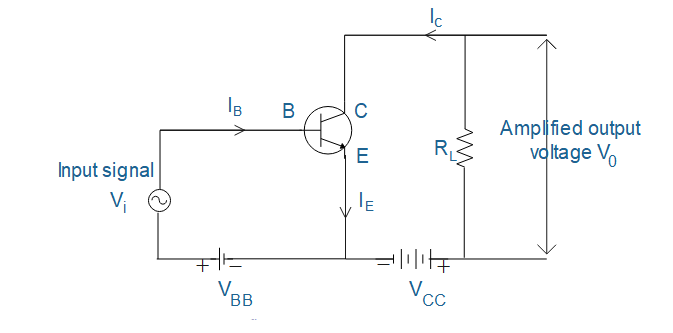
The amplifier is an electronic device which increases the strength of the weak signal. Amplifier magnifier or amplifies the voltage or current level of a weak signal. Most of the electronic equipment has an amplifier in one form or another. The transistor is a current sensitive device and it has large current gain $\beta $ when operated in an active region.
For a transistor to work as an amplifier, E-B junction should be forward biased and C-B junction should be reverse biased. The voltage source ${{V}_{BB}}\text{ and }{{V}_{CC}}$ provides the necessary bias. The signal voltage ${{V}_{i}}$ which is to be amplified, is applied between base and emitter. E amplified voltage ${{V}_{0}}$ gets developed across the load resistor ${{R}_{L}}$. When the input signal varies slightly, the base current varies which produces a large change in collector current. When this collector current flows through load resistance ${{R}_{L}}$, we get amplified voltage across ${{R}_{L}}\left( {{V}_{0}}=\vartriangle {{I}_{C}}.{{R}_{L}} \right)$
$\begin{align}
& i.e.{{V}_{0}}=\vartriangle {{I}_{C}}.{{R}_{L}} \\
& {{V}_{0}}=\beta \vartriangle {{I}_{B}}.{{R}_{L}}\because \vartriangle {{I}_{C}}=\beta \vartriangle {{I}_{B}} \\
\end{align}$
And we know that $\beta $ is current gain, which is always greater than $50$. By proper designing, $\text{(i}\text{.e}\text{. choosing }\beta \text{ and }{{\text{R}}_{L}})$ we can amplify the input signal by the desired amount. Amplifier voltage gain $\left( {{A}_{v}} \right)$ is defined as the ratio of the output voltage to the input voltage.
Note:
Common base amplifier produces voltage amplification but not current amplification. The amplified voltage is in phase with the input. Common emitter amplifier produces voltage as well as current amplification, but the amplified voltage is ${{180}^{0}}$ out of phase than the input voltage. For amplification action of a transistor, the emitter-base junction must be forward biased and collector-base junction must be reverse biased irrespective of the configuration of the transistor.
Complete step by step answer:
The amplifier is an electronic device which increases the strength of the weak signal. Amplifier magnifier or amplifies the voltage or current level of a weak signal. Most of the electronic equipment has an amplifier in one form or another. The transistor is a current sensitive device and it has large current gain $\beta $ when operated in an active region.
For a transistor to work as an amplifier, E-B junction should be forward biased and C-B junction should be reverse biased. The voltage source ${{V}_{BB}}\text{ and }{{V}_{CC}}$ provides the necessary bias. The signal voltage ${{V}_{i}}$ which is to be amplified, is applied between base and emitter. E amplified voltage ${{V}_{0}}$ gets developed across the load resistor ${{R}_{L}}$. When the input signal varies slightly, the base current varies which produces a large change in collector current. When this collector current flows through load resistance ${{R}_{L}}$, we get amplified voltage across ${{R}_{L}}\left( {{V}_{0}}=\vartriangle {{I}_{C}}.{{R}_{L}} \right)$
$\begin{align}
& i.e.{{V}_{0}}=\vartriangle {{I}_{C}}.{{R}_{L}} \\
& {{V}_{0}}=\beta \vartriangle {{I}_{B}}.{{R}_{L}}\because \vartriangle {{I}_{C}}=\beta \vartriangle {{I}_{B}} \\
\end{align}$
And we know that $\beta $ is current gain, which is always greater than $50$. By proper designing, $\text{(i}\text{.e}\text{. choosing }\beta \text{ and }{{\text{R}}_{L}})$ we can amplify the input signal by the desired amount. Amplifier voltage gain $\left( {{A}_{v}} \right)$ is defined as the ratio of the output voltage to the input voltage.
Note:
Common base amplifier produces voltage amplification but not current amplification. The amplified voltage is in phase with the input. Common emitter amplifier produces voltage as well as current amplification, but the amplified voltage is ${{180}^{0}}$ out of phase than the input voltage. For amplification action of a transistor, the emitter-base junction must be forward biased and collector-base junction must be reverse biased irrespective of the configuration of the transistor.
Recently Updated Pages
Which of the following graphs shows the variation of class 12 physics CBSE

Draw a labelled diagram of the human male reproductive class 12 biology CBSE
Describe the experiment to compare the emf of two cells class 12 physics CBSE
What is standard hydrogen electrode
What is conventional current and electric current class 12 physics CBSE
2Bromopentane is treated with an alcoholic KOH solution class 12 chemistry CBSE
Trending doubts
Which are the Top 10 Largest Countries of the World?
Differentiate between internal fertilization and external class 12 biology CBSE
What is the Full Form of 1.DPT 2.DDT 3.BCG
Differentiate between lanthanoids and actinoids class 12 chemistry CBSE
Sketch and label the Malpighian body class 12 biology CBSE
Why is the cell called the structural and functional class 12 biology CBSE