




In semiconductor diodes, the forward voltage is changed from 0.5V to 0.7V, then the forward current changes by 1mA. The forward resistance of the diode junction is:
$\begin{align}
& A.100\Omega \\
& B.50\Omega \\
& C.200\Omega \\
& D.250\Omega \\
\end{align}$
Answer
 Verified
622.5k+ views
Hint: Diode is a semiconductor device that can be operated on forward and reverse bias conditions. The resistance offered by the diode in forward bias condition is known as forward resistance and the resistance offered by the diode in reverse bias condition is known as reverse resistance. The forward bias resistance is just the ratio of forward voltage to forward current. Calculate the change in forward voltage and change in forward current. Using formula, $\text{R=}\dfrac{\Delta V}{\Delta I}$, calculate the forward resistance.
Formula used:
The forward resistance, $\text{R=}\dfrac{\Delta V}{\Delta I}$
Complete answer:
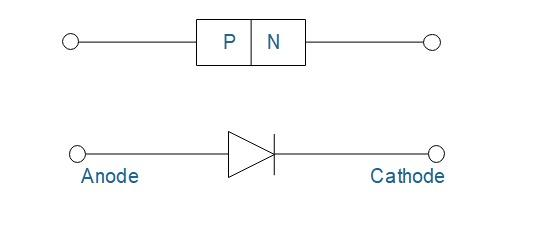
A diode is a two terminal semiconductor device which allows current only direction flowing through it. It is generally made up of silicon (Si) or germanium (Ge).
The diode can be operated in two modes, forward bias and reverse bias.
When anode of the diode (P type in diode) is connected to the positive terminal of the battery and cathode of the diode (N type in diode) is connected to the negative terminal of the battery then it is said to be in forward bias condition. When anode of the diode (P type in diode) is connected to the negative terminal of the battery and cathode of the diode (N type in diode) is connected to the positive terminal of the battery then it is said to be in reverse bias condition.
Diode allows current in forward bias condition only, thus offering very small resistance. In reverse bias condition it offers very high resistance, thus, ideally no current flows through it. Practically a very small current of the order of few $\mu A$ current flows through the diode due to minority charge carriers.
The resistance offered by the diode in forward bias condition is called forward resistance and it is given as
$\text{forward resistance=R=}\dfrac{\text{forward voltage}}{\text{forward current}}=\dfrac{\Delta V}{\Delta I}$
Given that, voltage changes from 0.5V to 0.7V
$\therefore \Delta V=0.7-0.5=0.2V$
Also, the current changes by 1mA
$\therefore \Delta I=1mA={{10}^{-3}}A$
Thus, forward resistance is
$R=\dfrac{0.2V}{{{10}^{-3}}A}=200\Omega $
Therefore, the forward resistance of the diode junction is $200\Omega $.
Answer- $C.200\Omega $
Note: The forward resistance is usually very small. The slope of the I-V graph of diode operating in forward condition is equal to the reciprocal of its forward resistance. Diodes are used in rectifier applications. It acts as a closed switch in forward bias condition and open switch in reverse bias condition.
Formula used:
The forward resistance, $\text{R=}\dfrac{\Delta V}{\Delta I}$
Complete answer:
A diode is a two terminal semiconductor device which allows current only direction flowing through it. It is generally made up of silicon (Si) or germanium (Ge).
The diode can be operated in two modes, forward bias and reverse bias.
When anode of the diode (P type in diode) is connected to the positive terminal of the battery and cathode of the diode (N type in diode) is connected to the negative terminal of the battery then it is said to be in forward bias condition. When anode of the diode (P type in diode) is connected to the negative terminal of the battery and cathode of the diode (N type in diode) is connected to the positive terminal of the battery then it is said to be in reverse bias condition.
Diode allows current in forward bias condition only, thus offering very small resistance. In reverse bias condition it offers very high resistance, thus, ideally no current flows through it. Practically a very small current of the order of few $\mu A$ current flows through the diode due to minority charge carriers.
The resistance offered by the diode in forward bias condition is called forward resistance and it is given as
$\text{forward resistance=R=}\dfrac{\text{forward voltage}}{\text{forward current}}=\dfrac{\Delta V}{\Delta I}$
Given that, voltage changes from 0.5V to 0.7V
$\therefore \Delta V=0.7-0.5=0.2V$
Also, the current changes by 1mA
$\therefore \Delta I=1mA={{10}^{-3}}A$
Thus, forward resistance is
$R=\dfrac{0.2V}{{{10}^{-3}}A}=200\Omega $
Therefore, the forward resistance of the diode junction is $200\Omega $.
Answer- $C.200\Omega $
Note: The forward resistance is usually very small. The slope of the I-V graph of diode operating in forward condition is equal to the reciprocal of its forward resistance. Diodes are used in rectifier applications. It acts as a closed switch in forward bias condition and open switch in reverse bias condition.
Recently Updated Pages
Master Class 12 Business Studies: Engaging Questions & Answers for Success

Master Class 12 Biology: Engaging Questions & Answers for Success
Master Class 12 Chemistry: Engaging Questions & Answers for Success
Class 12 Question and Answer - Your Ultimate Solutions Guide
Master Class 11 Social Science: Engaging Questions & Answers for Success
Master Class 11 English: Engaging Questions & Answers for Success
Trending doubts
Which are the Top 10 Largest Countries of the World?
Draw a labelled sketch of the human eye class 12 physics CBSE
Name the crygenes that control cotton bollworm and class 12 biology CBSE
Differentiate between homogeneous and heterogeneous class 12 chemistry CBSE
Ribosomal RNA is actively synthesised in A Nucleoplasm class 12 biology CBSE
How many molecules of ATP and NADPH are required information class 12 biology CBSE