




In sea anemone, symmetry is
(a)Radial
(b)Spherical
(c)Bilateral
(d)Absent
Answer
 Verified
662.1k+ views
Hint: Sea anemone is a cnidarian and sessile in nature i.e. it cannot move on its own. In this type of symmetry, identical parts are arranged in a circular fashion around a central axis.
Complete answer:
Sea Anemone possesses a radial symmetry due to its sessile nature. Radial symmetry attributes to the kind of symmetry that separates the body into two halves along any central axis. The type of symmetry is a basic category to classify organisms. The following types of symmetry are seen in the animal kingdom.
Radial Symmetry: It is the arrangement of body parts around a central axis or pieces in a pie. Radially symmetrical animals possess top and bottom surfaces, but no left and right sides, or front and back. The two halves of a radially symmetrical animal are called the oral side and aboral side. This type of symmetry is seen in the phylum Ctenophora (comb jellies) and Cnidaria (corals, sea anemones, and other jellies).
Bilateral symmetry: It requires the division of the animal through a median plane, resulting in right and left halves like in a butterfly, crab, or human body. Animals with bilateral symmetry possess a head and tail, front and back, and right and left sides. Seen in all true animals, except those with radial symmetry.
Asymmetry: In animals with asymmetry do not have a body plan symmetry. Only members of the phylum Porifera (sponges) show asymmetry. There are some fish species, such as flounder, that lack symmetry as adults.
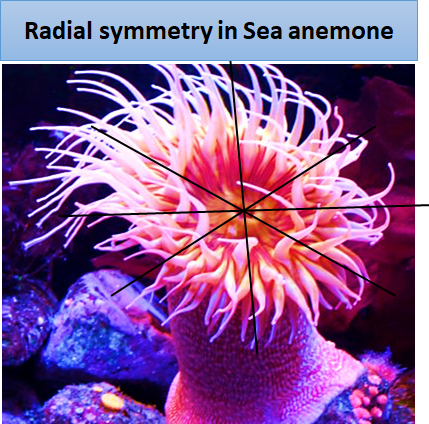
So, the correct answer is “Radial ”.
Note:
Animals with radial symmetry are aquatic. Most of them move very slowly. They depend on water flows to bring food to them. One benefit of possessing radial symmetry is that the animal can get food in any direction. More complex animals have bilateral symmetry. Sense organs around the front end help such animals find food. Bilateral symmetry also aids animals to evade enemies. Hence we can see that the complexity of organisms can be determined by their symmetry.
Complete answer:
Sea Anemone possesses a radial symmetry due to its sessile nature. Radial symmetry attributes to the kind of symmetry that separates the body into two halves along any central axis. The type of symmetry is a basic category to classify organisms. The following types of symmetry are seen in the animal kingdom.
Radial Symmetry: It is the arrangement of body parts around a central axis or pieces in a pie. Radially symmetrical animals possess top and bottom surfaces, but no left and right sides, or front and back. The two halves of a radially symmetrical animal are called the oral side and aboral side. This type of symmetry is seen in the phylum Ctenophora (comb jellies) and Cnidaria (corals, sea anemones, and other jellies).
Bilateral symmetry: It requires the division of the animal through a median plane, resulting in right and left halves like in a butterfly, crab, or human body. Animals with bilateral symmetry possess a head and tail, front and back, and right and left sides. Seen in all true animals, except those with radial symmetry.
Asymmetry: In animals with asymmetry do not have a body plan symmetry. Only members of the phylum Porifera (sponges) show asymmetry. There are some fish species, such as flounder, that lack symmetry as adults.
So, the correct answer is “Radial ”.
Note:
Animals with radial symmetry are aquatic. Most of them move very slowly. They depend on water flows to bring food to them. One benefit of possessing radial symmetry is that the animal can get food in any direction. More complex animals have bilateral symmetry. Sense organs around the front end help such animals find food. Bilateral symmetry also aids animals to evade enemies. Hence we can see that the complexity of organisms can be determined by their symmetry.
Recently Updated Pages
If x a + bt + ct2 where x is in meters and t is in class 11 physics CBSE

A car covers the first half distance between two places class 11 physics CBSE
The resultant of two vectors overrightarrow P and overrightarrow class 11 physics CBSE
Find the value of cos 135 class 11 maths CBSE
A mass M is held in place by an applied force F and class 11 physics CBSE
A solution of glucose in water is labelled as 10 dfracwv class 11 chemistry CBSE
Trending doubts
One Metric ton is equal to kg A 10000 B 1000 C 100 class 11 physics CBSE
Find the value of the expression given below sin 30circ class 11 maths CBSE
What do you mean by retardation What is its SI uni class 11 physics CBSE
Draw a diagram of nephron and explain its structur class 11 biology CBSE
10 examples of friction in our daily life
Difference between physical and chemical change class 11 chemistry CBSE