




In root, what structure increases surface area for the absorption of water and minerals from the soil?
Answer
 Verified
549.3k+ views
Hint: The root is a part of the plant, which grows downwards. During seed germination, the radicle is the first organ to come out, which elongates to form the taproot. The main root of the plant is also known as the primary root. It gives off lateral branches, forming tertiary roots and secondary roots. All the roots form the root system. Root tip, root hair, root cap, and root apical meristem are parts of a root.
Complete answer
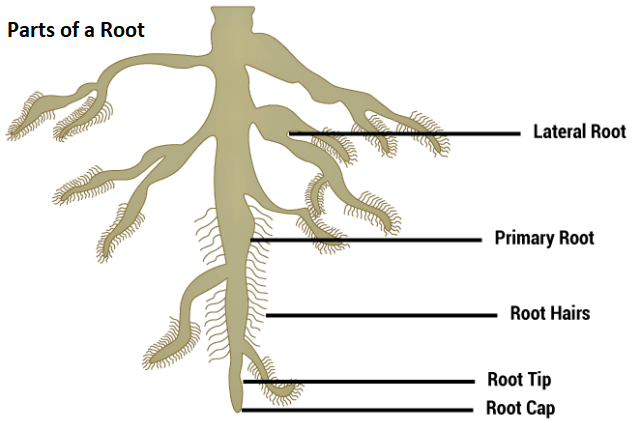
Fig: Root System
Root hairs are the structures which increase the surface area of absorption of water and minerals. They are delicate and very fine, thread-like structures, which arise from the region of maturation of the root. In origin, they are exogenous. They are unicellular structures, which are developed from the epidermis of the root. The major function of root hairs is the increase in the surface area of absorption of minerals and water from the soil.
The root hairs are suitable for absorption of water from the soil because of the following reasons:
1. The root hairs possess a large surface area. An increase in the surface area leads to greater absorption.
2. Each root hair possesses a semi-permeable membrane.
3. Root hair consists of a solution (cell sap) of a higher concentration than the surrounding soil water.
4. Roots possess hair-like projections called root hairs, which protrude from their surface. The root hairs aid the plant absorb more nutrients and water as they enhance the available surface area. Through the root hairs, the roots of many plants possess a mycorrhizal relationship with the fungi for greater absorption.
Note:
Root provides the proper anchorage to the plants. It transports the absorbed water and minerals to the stem via the xylem. It stores reserve food material. It is involved in the synthesis of plant growth regulators. It performs special physiological functions like storage of food, assimilation, sucking food from the host, absorption of atmospheric moisture, gaseous exchange, and climbing.
Complete answer
Fig: Root System
Root hairs are the structures which increase the surface area of absorption of water and minerals. They are delicate and very fine, thread-like structures, which arise from the region of maturation of the root. In origin, they are exogenous. They are unicellular structures, which are developed from the epidermis of the root. The major function of root hairs is the increase in the surface area of absorption of minerals and water from the soil.
The root hairs are suitable for absorption of water from the soil because of the following reasons:
1. The root hairs possess a large surface area. An increase in the surface area leads to greater absorption.
2. Each root hair possesses a semi-permeable membrane.
3. Root hair consists of a solution (cell sap) of a higher concentration than the surrounding soil water.
4. Roots possess hair-like projections called root hairs, which protrude from their surface. The root hairs aid the plant absorb more nutrients and water as they enhance the available surface area. Through the root hairs, the roots of many plants possess a mycorrhizal relationship with the fungi for greater absorption.
Note:
Root provides the proper anchorage to the plants. It transports the absorbed water and minerals to the stem via the xylem. It stores reserve food material. It is involved in the synthesis of plant growth regulators. It performs special physiological functions like storage of food, assimilation, sucking food from the host, absorption of atmospheric moisture, gaseous exchange, and climbing.
Recently Updated Pages
Write structures of the following compounds i 2 Chloro3methylpentane class 11 chemistry CBSE

What is BLO What is the full form of BLO class 8 social science CBSE
Explain the Treaty of Vienna of 1815 class 10 social science CBSE
A Paragraph on Pollution in about 100-150 Words
XIX+XXX A 49 B 51 C 55 D 44 class 5 maths CBSE
If x a + bt + ct2 where x is in meters and t is in class 11 physics CBSE
Trending doubts
One Metric ton is equal to kg A 10000 B 1000 C 100 class 11 physics CBSE
Find the value of the expression given below sin 30circ class 11 maths CBSE
What do you mean by retardation What is its SI uni class 11 physics CBSE
Draw a diagram of nephron and explain its structur class 11 biology CBSE
10 examples of friction in our daily life
Difference between physical and chemical change class 11 chemistry CBSE