




In retroviruses, RNA dependent DNA polymerase synthesizes
A) DNA
B) RNA
C) RNA-DNA
D) None of the above
Answer
 Verified
606.6k+ views
Hint: It is a molecule consisting of two strands and forms a structure known as a double helix. It carries genetic information in all living organisms. Its backbone is made up of deoxyribose sugars and phosphate groups.
Complete step by step answer:
- Reverse transcriptase also termed RNA- dependent DNA polymerase. It is a DNA polymerase enzyme that transcribes single-stranded RNA into DNA.
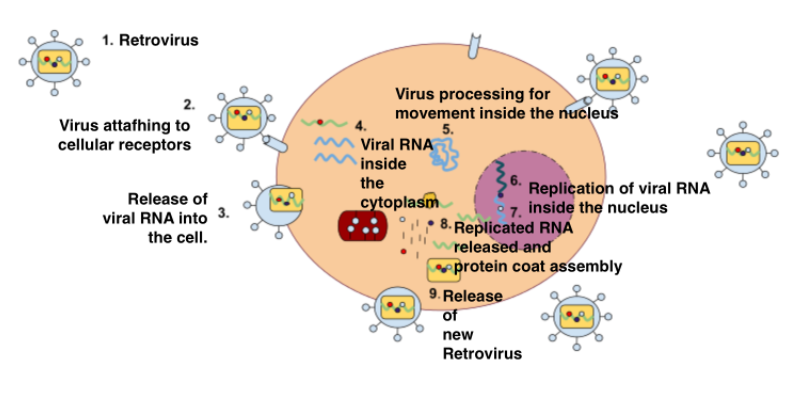
- In the first step RNA has been reverse transcribed by reverse transcriptase enzymes and able to synthesize double- stranded DNA into a single- stranded DNA.
- RNA virus mainly retrovirus uses reverse transcriptase enzyme to reverse transcribe the RNA genome into DNA and then is integrated into the genome of the host cell and there they replicate along with DNA to make new DNA viral strands.
- It is generally produced by HIV and other retroviruses to synthesize complementary DNA from their viral RNA.
Additional information:
- Retrovirus has an RNA genome present in a protein shell and enclosed by a lipid envelope. When retrovirus enters the host cell it takes over the host genome and performs transcription machinery to make new viral DNA. This overall process of the conversion of RNA to viral DNA is catalyzed by reverse transcriptase enzyme.
- RNA dependent DNA polymerase was discovered by Howard Temin and David Baltimore in 1970.
So, the correct answer is, "DNA".
Note:
- A reverse transcriptase enzyme is a powerful tool for molecular biology research.
- It is used to produce cDNA libraries from the mRNA.
- The reverse transcriptase enzyme is comprised of three enzymatic activities -
1) RNA dependent DNA polymerase.
2) RNase H.
3) DNA dependent DNA polymerase.
Complete step by step answer:
- Reverse transcriptase also termed RNA- dependent DNA polymerase. It is a DNA polymerase enzyme that transcribes single-stranded RNA into DNA.
- In the first step RNA has been reverse transcribed by reverse transcriptase enzymes and able to synthesize double- stranded DNA into a single- stranded DNA.
- RNA virus mainly retrovirus uses reverse transcriptase enzyme to reverse transcribe the RNA genome into DNA and then is integrated into the genome of the host cell and there they replicate along with DNA to make new DNA viral strands.
- It is generally produced by HIV and other retroviruses to synthesize complementary DNA from their viral RNA.
Additional information:
- Retrovirus has an RNA genome present in a protein shell and enclosed by a lipid envelope. When retrovirus enters the host cell it takes over the host genome and performs transcription machinery to make new viral DNA. This overall process of the conversion of RNA to viral DNA is catalyzed by reverse transcriptase enzyme.
- RNA dependent DNA polymerase was discovered by Howard Temin and David Baltimore in 1970.
So, the correct answer is, "DNA".
Note:
- A reverse transcriptase enzyme is a powerful tool for molecular biology research.
- It is used to produce cDNA libraries from the mRNA.
- The reverse transcriptase enzyme is comprised of three enzymatic activities -
1) RNA dependent DNA polymerase.
2) RNase H.
3) DNA dependent DNA polymerase.
Recently Updated Pages
Master Class 12 Economics: Engaging Questions & Answers for Success

Master Class 12 English: Engaging Questions & Answers for Success
Master Class 12 Social Science: Engaging Questions & Answers for Success
Master Class 12 Maths: Engaging Questions & Answers for Success
Master Class 12 Physics: Engaging Questions & Answers for Success
Master Class 9 General Knowledge: Engaging Questions & Answers for Success
Trending doubts
Which are the Top 10 Largest Countries of the World?
Draw a labelled sketch of the human eye class 12 physics CBSE
Differentiate between homogeneous and heterogeneous class 12 chemistry CBSE
Sulphuric acid is known as the king of acids State class 12 chemistry CBSE
Why is the cell called the structural and functional class 12 biology CBSE
Draw ray diagrams each showing i myopic eye and ii class 12 physics CBSE