




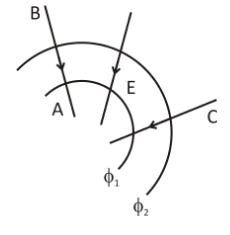
In moving from A to B along an electric field line, the electric field does $6.4 \times {10^{ - 19}}\,J$ of work on an electron. If ${\phi _1}$, ${\phi _2}$ are equipotential surfaces, then the potential difference $\left( {{V_C} - {V_A}} \right)$ is
A. $ - 4V$
B. $4V$
C. Zero
D. $64V$
Answer
 Verified
591.9k+ views
Hint:First let us see what an equipotential surface is: Any surface on which the potential is constant is called an equipotential surface. In other words, the potential distance between any two points on an equipotential surface is zero. Here we have to use the formula for work done in an equipotential surface to get the answer.
Complete step by step solution:
The work done in moving a charge on an equipotential surface between two points is zero. If a point charge is transferred from point ${V_A}$ to ${V_B}$ on an equipotential surface, the work performed in transferring the charge is given by the equipotential surface as:
$W = {q_ \circ }\left( {{V_A} - {V_B}} \right)$
Since, ${V_A} - {V_B}$ is equal to zero, the total work done is $W = 0$.
Given, Work done, $W = 6.4 \times {10^{ - 19}}\,J$
Charge, ${q_ \circ } = 1.6 \times {10^{ - 19}}\,C$
We know that,
$
W = {q_ \circ }\left( {{V_c} - {V_A}} \right) \\
\Rightarrow {V_C} - {V_A} = \dfrac{W}{{{q_ \circ }}} \\
\Rightarrow {V_C} - {V_A} = \dfrac{{6.4 \times {{10}^{ - 19}}}}{{1.6 \times {{10}^{ - 19}}}} \\
\therefore{V_C} - {V_A} = 4V \\
$
Hence, option B is the answer.
Additional information:
-Equipotential surface properties
-The electric field is still perpendicular to the potential surface of the equipment.
-Two potentially identical surfaces will never collide.
-Equipotential surfaces are concentric spherical shells with a point charge.
-Equipotential surfaces are planes normal to the x-axis with a uniform electric field.
-From high potential to low potential, the position of the equipotential surface.
Note:Here we have to remember the formula of work done for equipotential surfaces properly. Also, we should properly put the values of the work done and charge otherwise the answer would be wrong. If the points are all at the same electric potential in an electric field, so they are known as the equipotential points. It is known as an equipotential line if these points are connected by a line or a curve. It is called an equipotential surface if those points lie on a surface. In addition, it is known as an equipotential volume if these points are spread throughout a room or a volume.
Complete step by step solution:
The work done in moving a charge on an equipotential surface between two points is zero. If a point charge is transferred from point ${V_A}$ to ${V_B}$ on an equipotential surface, the work performed in transferring the charge is given by the equipotential surface as:
$W = {q_ \circ }\left( {{V_A} - {V_B}} \right)$
Since, ${V_A} - {V_B}$ is equal to zero, the total work done is $W = 0$.
Given, Work done, $W = 6.4 \times {10^{ - 19}}\,J$
Charge, ${q_ \circ } = 1.6 \times {10^{ - 19}}\,C$
We know that,
$
W = {q_ \circ }\left( {{V_c} - {V_A}} \right) \\
\Rightarrow {V_C} - {V_A} = \dfrac{W}{{{q_ \circ }}} \\
\Rightarrow {V_C} - {V_A} = \dfrac{{6.4 \times {{10}^{ - 19}}}}{{1.6 \times {{10}^{ - 19}}}} \\
\therefore{V_C} - {V_A} = 4V \\
$
Hence, option B is the answer.
Additional information:
-Equipotential surface properties
-The electric field is still perpendicular to the potential surface of the equipment.
-Two potentially identical surfaces will never collide.
-Equipotential surfaces are concentric spherical shells with a point charge.
-Equipotential surfaces are planes normal to the x-axis with a uniform electric field.
-From high potential to low potential, the position of the equipotential surface.
Note:Here we have to remember the formula of work done for equipotential surfaces properly. Also, we should properly put the values of the work done and charge otherwise the answer would be wrong. If the points are all at the same electric potential in an electric field, so they are known as the equipotential points. It is known as an equipotential line if these points are connected by a line or a curve. It is called an equipotential surface if those points lie on a surface. In addition, it is known as an equipotential volume if these points are spread throughout a room or a volume.
Recently Updated Pages
Master Class 12 Business Studies: Engaging Questions & Answers for Success

Master Class 12 Biology: Engaging Questions & Answers for Success
Master Class 12 Chemistry: Engaging Questions & Answers for Success
Class 12 Question and Answer - Your Ultimate Solutions Guide
Master Class 11 Social Science: Engaging Questions & Answers for Success
Master Class 11 English: Engaging Questions & Answers for Success
Trending doubts
Which is more stable and why class 12 chemistry CBSE
Which are the Top 10 Largest Countries of the World?
Draw a labelled sketch of the human eye class 12 physics CBSE
Differentiate between homogeneous and heterogeneous class 12 chemistry CBSE
What are the major means of transport Explain each class 12 social science CBSE
Sulphuric acid is known as the king of acids State class 12 chemistry CBSE