




In man, the bile juice secreted per day is
A. 10-700 ml
B. 100-800 ml
C. 400-1000 ml
D. 1500 ml
E. None of the above
Answer
 Verified
611.4k+ views
Hint: The liver produces bile juice and it is contained in the gallbladder. It helps in the digestion process by breaking down fats into fatty acids. Bile juice contains mostly cholesterol, bile acids, bilirubin, water, body salts, copper, and other metals.
Complete answer:
Options (A), (B), (D), and (E) are incorrect. The average amount of bile juice secreted by an adult human lies in the range of 400-800 ml. This range is not satisfied with any of these options.
Option (C) is correct because it contains a range of 400-1000ml which corresponds to the range of an average amount of bile secreted per day by a man i.e., 400-800 ml.
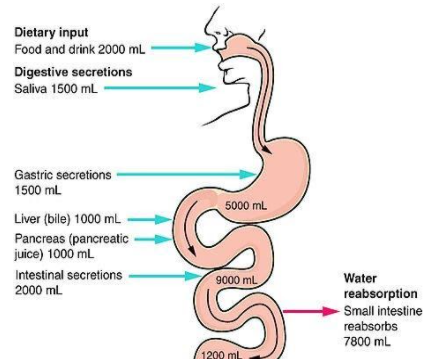
Hence, the correct option is (C).
Additional information
The secretion of bile juice is a two-step process:
> The liver cells or hepatocytes secrete the bile in the canaliculi (bile capillaries or thin tubes), from which it flows into the bile ducts. The bile in the liver contains large quantities of bile acids, cholesterol, and other organic molecules.
> After moving into the bile ducts, the bile gets modified through the addition of water and bicarbonate rich secretions from the ductal epithelial cells.
Bile juice serves many important functions:
> The main function of bile juice involves the emulsification of fatty substances and converts the fats into fatty acids which can be absorbed easily.
> The alkaline nature of bile juice helps in neutralizing any excess stomach acids before it enters the small intestine.
> The salts present in bile juice act as Bacteroides, thus destroying the microbes that may be present in the food.
Note: Bile word came from the Latin word ‘bilis’ which means fluid secreted by the liver. It is a greenish-yellow fluid that helps in the digestion and absorption of fats. In adult humans, the liver produces about 400-800 ml bile per day.
Complete answer:
Options (A), (B), (D), and (E) are incorrect. The average amount of bile juice secreted by an adult human lies in the range of 400-800 ml. This range is not satisfied with any of these options.
Option (C) is correct because it contains a range of 400-1000ml which corresponds to the range of an average amount of bile secreted per day by a man i.e., 400-800 ml.
Hence, the correct option is (C).
Additional information
The secretion of bile juice is a two-step process:
> The liver cells or hepatocytes secrete the bile in the canaliculi (bile capillaries or thin tubes), from which it flows into the bile ducts. The bile in the liver contains large quantities of bile acids, cholesterol, and other organic molecules.
> After moving into the bile ducts, the bile gets modified through the addition of water and bicarbonate rich secretions from the ductal epithelial cells.
Bile juice serves many important functions:
> The main function of bile juice involves the emulsification of fatty substances and converts the fats into fatty acids which can be absorbed easily.
> The alkaline nature of bile juice helps in neutralizing any excess stomach acids before it enters the small intestine.
> The salts present in bile juice act as Bacteroides, thus destroying the microbes that may be present in the food.
Note: Bile word came from the Latin word ‘bilis’ which means fluid secreted by the liver. It is a greenish-yellow fluid that helps in the digestion and absorption of fats. In adult humans, the liver produces about 400-800 ml bile per day.
Recently Updated Pages
Master Class 12 Economics: Engaging Questions & Answers for Success

Master Class 12 English: Engaging Questions & Answers for Success
Master Class 12 Social Science: Engaging Questions & Answers for Success
Master Class 12 Maths: Engaging Questions & Answers for Success
Master Class 12 Physics: Engaging Questions & Answers for Success
Master Class 9 General Knowledge: Engaging Questions & Answers for Success
Trending doubts
Which are the Top 10 Largest Countries of the World?
Draw a labelled sketch of the human eye class 12 physics CBSE
Differentiate between homogeneous and heterogeneous class 12 chemistry CBSE
Sulphuric acid is known as the king of acids State class 12 chemistry CBSE
Why is the cell called the structural and functional class 12 biology CBSE
A dentist uses a small mirror that gives a magnification class 12 physics CBSE