




In LCR circuit at resonance, current in the circuit is $10\sqrt 2 A$. If now the frequency of the source is changed such that current lags by${45^0}$ than the applied voltage in the circuit then, which of the following is correct?
$\left( {\text{A}} \right)$ Frequency must be increased and current after the change is \[{\text{10A}}\].
$\left( {\text{B}} \right)$ Frequency must be decreased and current after the change is \[{\text{10A}}\].
$\left( {\text{C}} \right)$ Frequency must be decreased and current is the same as that of initial value.
$\left( {\text{D}} \right)$ The given information is insufficient to conclude anything.
Answer
 Verified
618.3k+ views
Hint:The resonance phenomenon is exhibited by a circuit only if both \[{\text{L}}\] and \[{\text{C}}\] are present in the circuit. Only then, the voltage across \[{\text{L}}\] and \[{\text{C}}\] cancel each other so that the voltage across \[{\text{R}}\] is equal to the source voltage.
Complete step by step answer:
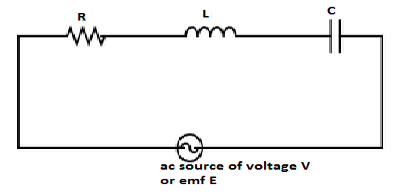
Consider a circuit containing an inductor, capacitor and resistor are connected in series across an alternating source of voltage \[{\text{V}}\] or emf $\varepsilon $ .
Let the source supplies a sinusoidal voltage which is given by,
$V = {V_0}\sin \omega t$
Where, ${V_0}$ is the peak value of voltage $\omega $ is the angular frequency and \[t\] is the time period.
Let \[q\] be the charge on the capacitor and \[i\] be the current in the circuit at any instant of time \[t\] .
Let ${V_R},{V_L},{V_C}$ represent the voltage across the resistor, inductor, and capacitor respectively.
Then, the voltage across the resistor, ${V_R} = {i_0}R$
The voltage across an inductor, ${V_L} = {i_0}{X_L}$
The voltage across a capacitor, ${V_C} = {i_0}{X_C}$
Where, ${i_0}$ is the peak value of current, ${X_C}$ is capacitive reactance, ${X_L}$ is the inductive reactance, and \[{\text{R}}\] is the resistance of the resistor.
It is stated in the questions that are the current lags by${45^0}$ that is,$\phi = {45^0}$
Then, $\cos \phi = \dfrac{R}{Z}$
$\cos {45^0} = \dfrac{R}{Z}$
Here $\cos {45^0} = \dfrac{1}{{\sqrt 2 }}$
So we can write it as,
$\dfrac{1}{{\sqrt 2 }} = \dfrac{R}{Z}$
Taking cross multiplication we get,
$ \Rightarrow Z = \sqrt 2 R$
At resonance condition,${X_L} = {X_C}$
Then impedance $Z = \sqrt {\left( {{R^2} + {{\left( {{X_L} - {X_C}} \right)}^2}} \right)} $ becomes, $Z = R$
There is a maximum value of current is flowing in the circuit ${I_{rms}} = 10\sqrt 2 A$
That is, ${I_{rms}} = \dfrac{{{I_0}}}{{\sqrt 2 }}$
$10\sqrt 2 = \dfrac{{{I_0}}}{{\sqrt 2 }}$
After simplification we get,
${I_0} = 10A$
Now we already have an given that, current lags behind the applied voltage by \[\;45\] degree, then ${X_L} > {X_C}$ for this condition angular frequency $\omega $ must be increases, so that ${X_L}$ will increase and ${X_C}$ will decrease.
Therefore, the frequency must be increased and current after the change is \[{\text{10A}}\].
The correct option is A
Note:
Inductive reactance is the opposition offered by an inductance to the ac through it.
Capacitive reactance is the effective opposition offered by the capacitance to the ac through it.
Impedance of an ace circuit is the effective opposition offered by the circuit to the alternating current through it.
Complete step by step answer:
Consider a circuit containing an inductor, capacitor and resistor are connected in series across an alternating source of voltage \[{\text{V}}\] or emf $\varepsilon $ .
Let the source supplies a sinusoidal voltage which is given by,
$V = {V_0}\sin \omega t$
Where, ${V_0}$ is the peak value of voltage $\omega $ is the angular frequency and \[t\] is the time period.
Let \[q\] be the charge on the capacitor and \[i\] be the current in the circuit at any instant of time \[t\] .
Let ${V_R},{V_L},{V_C}$ represent the voltage across the resistor, inductor, and capacitor respectively.
Then, the voltage across the resistor, ${V_R} = {i_0}R$
The voltage across an inductor, ${V_L} = {i_0}{X_L}$
The voltage across a capacitor, ${V_C} = {i_0}{X_C}$
Where, ${i_0}$ is the peak value of current, ${X_C}$ is capacitive reactance, ${X_L}$ is the inductive reactance, and \[{\text{R}}\] is the resistance of the resistor.
It is stated in the questions that are the current lags by${45^0}$ that is,$\phi = {45^0}$
Then, $\cos \phi = \dfrac{R}{Z}$
$\cos {45^0} = \dfrac{R}{Z}$
Here $\cos {45^0} = \dfrac{1}{{\sqrt 2 }}$
So we can write it as,
$\dfrac{1}{{\sqrt 2 }} = \dfrac{R}{Z}$
Taking cross multiplication we get,
$ \Rightarrow Z = \sqrt 2 R$
At resonance condition,${X_L} = {X_C}$
Then impedance $Z = \sqrt {\left( {{R^2} + {{\left( {{X_L} - {X_C}} \right)}^2}} \right)} $ becomes, $Z = R$
There is a maximum value of current is flowing in the circuit ${I_{rms}} = 10\sqrt 2 A$
That is, ${I_{rms}} = \dfrac{{{I_0}}}{{\sqrt 2 }}$
$10\sqrt 2 = \dfrac{{{I_0}}}{{\sqrt 2 }}$
After simplification we get,
${I_0} = 10A$
Now we already have an given that, current lags behind the applied voltage by \[\;45\] degree, then ${X_L} > {X_C}$ for this condition angular frequency $\omega $ must be increases, so that ${X_L}$ will increase and ${X_C}$ will decrease.
Therefore, the frequency must be increased and current after the change is \[{\text{10A}}\].
The correct option is A
Note:
Inductive reactance is the opposition offered by an inductance to the ac through it.
Capacitive reactance is the effective opposition offered by the capacitance to the ac through it.
Impedance of an ace circuit is the effective opposition offered by the circuit to the alternating current through it.
Recently Updated Pages
Master Class 12 Economics: Engaging Questions & Answers for Success

Master Class 12 English: Engaging Questions & Answers for Success
Master Class 12 Social Science: Engaging Questions & Answers for Success
Master Class 12 Maths: Engaging Questions & Answers for Success
Master Class 12 Physics: Engaging Questions & Answers for Success
Master Class 9 General Knowledge: Engaging Questions & Answers for Success
Trending doubts
Which are the Top 10 Largest Countries of the World?
Draw a labelled sketch of the human eye class 12 physics CBSE
Differentiate between homogeneous and heterogeneous class 12 chemistry CBSE
Why is the cell called the structural and functional class 12 biology CBSE
Draw ray diagrams each showing i myopic eye and ii class 12 physics CBSE
Which is the correct genotypic ratio of mendel dihybrid class 12 biology CBSE