




In karyogram, sex chromosomes should be placed at the end, but the exception is-
A. Drosophila
B. Homo sapiens
C. Pisum
D. Ginkgo
Answer
 Verified
594.9k+ views
Hint: A karyogram is defined as the graphical representation of a karyotype. The chromosome count of an organism, location of centromeres, banding patterns, and paired homologous pairs arranged according to size are represented by a karyotype.
Complete answer: A karyogram is a tool used to represent chromosomes, making it simple to visualize the way chromosomes are arranged in the image. They are organized into homologous pairs, each of which is arranged in order of size, from largest to smallest. Each chromosome is matched with its homologous chromosome, even though it carries different alleles, and is an exact match in size and structure. Such pairs of autosomal chromosomes are numbered according to size. The sex chromosomes, X and Y, are put at the top, even though they are smaller in number. Karyograms aid in the study of chromosomal aberrations, taxonomic relationships, and events in evolution.
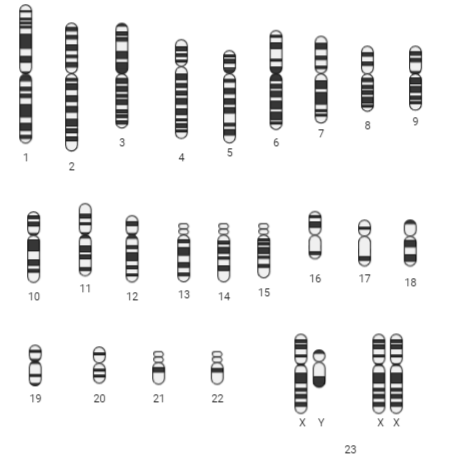
The common fruit fly or vinegar fly is also known as Drosophila. As well as autosomes, Drosophila flies have both X and Y chromosomes. The Y chromosome, unlike humans, does not impart maleness on them, but rather encodes genes required for sperm development. Their sex is determined by the ratio of autosomes and X chromosomes.
Hence, the correct answer is option A, i.e., Drosophila.
Note: Each Drosophila cell, independently of the rest of the organism, determines whether to be male or female, resulting in the occasional occurrence of gynandromorphs, i.e. An organism that incorporates the features of both men and women. Among the first species used for genetic research was Drosophila.
Complete answer: A karyogram is a tool used to represent chromosomes, making it simple to visualize the way chromosomes are arranged in the image. They are organized into homologous pairs, each of which is arranged in order of size, from largest to smallest. Each chromosome is matched with its homologous chromosome, even though it carries different alleles, and is an exact match in size and structure. Such pairs of autosomal chromosomes are numbered according to size. The sex chromosomes, X and Y, are put at the top, even though they are smaller in number. Karyograms aid in the study of chromosomal aberrations, taxonomic relationships, and events in evolution.
The common fruit fly or vinegar fly is also known as Drosophila. As well as autosomes, Drosophila flies have both X and Y chromosomes. The Y chromosome, unlike humans, does not impart maleness on them, but rather encodes genes required for sperm development. Their sex is determined by the ratio of autosomes and X chromosomes.
Hence, the correct answer is option A, i.e., Drosophila.
Note: Each Drosophila cell, independently of the rest of the organism, determines whether to be male or female, resulting in the occasional occurrence of gynandromorphs, i.e. An organism that incorporates the features of both men and women. Among the first species used for genetic research was Drosophila.
Recently Updated Pages
Master Class 11 English: Engaging Questions & Answers for Success

Master Class 11 Maths: Engaging Questions & Answers for Success
Class 11 Question and Answer - Your Ultimate Solutions Guide
Master Class 11 Biology: Engaging Questions & Answers for Success
Master Class 11 Physics: Engaging Questions & Answers for Success
Master Class 11 Accountancy: Engaging Questions & Answers for Success
Trending doubts
Differentiate between an exothermic and an endothermic class 11 chemistry CBSE
One Metric ton is equal to kg A 10000 B 1000 C 100 class 11 physics CBSE
Difference Between Prokaryotic Cells and Eukaryotic Cells
There are 720 permutations of the digits 1 2 3 4 5 class 11 maths CBSE
Draw a diagram of a plant cell and label at least eight class 11 biology CBSE
1 Quintal is equal to a 110 kg b 10 kg c 100kg d 1000 class 11 physics CBSE