




In ${K_2}C{r_2}{O_7}$, every $Cr$ is linked to:
A.Two oxygen atoms
B.Three oxygen atoms
C.Four oxygen atoms
D.Five oxygen atoms
Answer
 Verified
630k+ views
Hint:Potassium dichromate consists of dichromate ion and has a chemical formula $C{r_2}O_7^{2 - }$. To answer this question, you must recall the structure if the dichromate ion. Each chromium has 6 bonds.
Complete answer:
The name dichromate has a prefix di-, suggesting that the ion contains two chromate ions joined together.
The atomic number of chromium is 24 and its electronic configuration can be written as:
$Cr:\left[ {Ar} \right]4{s^1}3{d^5}$
Thus, a chromium atom can form 6 covalent bonds.
There is one chromium atom bonded to four oxygen atoms. Two oxygen atoms are double bonded with the chromium while the other 2 form single bonds. These two oxygen atoms satisfy their valencies with an extra electron denoted by the charge on the ion. The structure of chromate ion can be drawn as
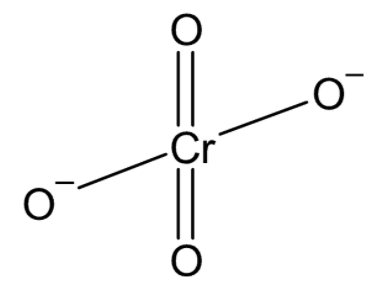
In the dichromate ion, there are two chromium atoms bonded to a total of seven oxygen atoms. One oxygen atom acts as a bridge bonded to each chromium atom. Two oxygen atoms on each chromium atom are double bonded to chromium and one oxygen on each chromium carries a negative charge giving the ion a total charge of $ - 2$. The structure of the dichromate ion can be drawn as:
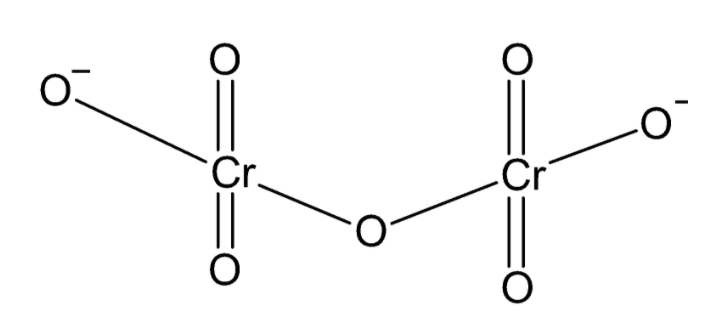
From the structure of the ion, we can conclude that each chromium atom is bonded to four oxygen atoms.
Thus, the correct answer is C.
Note:
We can see that two tetrahedral shaped chromate units share a common oxygen atom forming dichromate ion. So, the number of oxygen atoms bonded to chromium atoms remains the same, i.e., four in both chromate and dichromate ions.
Complete answer:
The name dichromate has a prefix di-, suggesting that the ion contains two chromate ions joined together.
The atomic number of chromium is 24 and its electronic configuration can be written as:
$Cr:\left[ {Ar} \right]4{s^1}3{d^5}$
Thus, a chromium atom can form 6 covalent bonds.
There is one chromium atom bonded to four oxygen atoms. Two oxygen atoms are double bonded with the chromium while the other 2 form single bonds. These two oxygen atoms satisfy their valencies with an extra electron denoted by the charge on the ion. The structure of chromate ion can be drawn as
In the dichromate ion, there are two chromium atoms bonded to a total of seven oxygen atoms. One oxygen atom acts as a bridge bonded to each chromium atom. Two oxygen atoms on each chromium atom are double bonded to chromium and one oxygen on each chromium carries a negative charge giving the ion a total charge of $ - 2$. The structure of the dichromate ion can be drawn as:
From the structure of the ion, we can conclude that each chromium atom is bonded to four oxygen atoms.
Thus, the correct answer is C.
Note:
We can see that two tetrahedral shaped chromate units share a common oxygen atom forming dichromate ion. So, the number of oxygen atoms bonded to chromium atoms remains the same, i.e., four in both chromate and dichromate ions.
Recently Updated Pages
Which of the following graphs shows the variation of class 12 physics CBSE

Draw a labelled diagram of the human male reproductive class 12 biology CBSE
Describe the experiment to compare the emf of two cells class 12 physics CBSE
What is standard hydrogen electrode
What is conventional current and electric current class 12 physics CBSE
2Bromopentane is treated with an alcoholic KOH solution class 12 chemistry CBSE
Trending doubts
Draw a labelled sketch of the human eye class 12 physics CBSE
Which are the Top 10 Largest Countries of the World?
Draw ray diagrams each showing i myopic eye and ii class 12 physics CBSE
Give one example of a reptile that is viviparous class 12 biology CBSE
Which is the correct genotypic ratio of mendel dihybrid class 12 biology CBSE
Give 10 examples of unisexual and bisexual flowers