




In humans, sex is determined by:
I) 22 pairs of chromosomes which are exactly alike in male and female.
II) A pair of sex chromosomes
III) Egg with a single set of chromosomes.
IV) The genetic makeup of a sperm
A) III & IV
B) II, III and IV
C) I, III and IV
D) II & IV
Answer
 Verified
528.6k+ views
Hint: In contrast to the sex chromosomes, an autosome is any of the numbered chromosomes. There are 22 pairs of autosomes and one pair of sex chromosomes in humans (the X and Y). Autosomes are roughly numbered according to their size.
Complete answer:
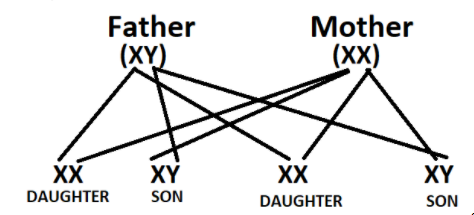
A sex chromosome is a type of chromosome that plays a role in determining a person's gender. The X and Y chromosomes are found in humans and most other mammals. Males have both X and Y chromosomes in their cells, whereas females have two X chromosomes. X chromosomes are found in all egg cells, while X or Y chromosomes are found in sperm cells. This system means that when fertilisation occurs, the male selects the sex of the offspring.
In humans, sex is determined by the pair of sex chromosomes provided by both the mother and father.
The mother has both XX chromosomes, whereas the male has both an X and a Y chromosome. The father gives one of the two gametes, whereas the mother only provides X. When the infant receives XY, the sex is judged to be a boy, and when the child receives XX, the sex is decided to be a girl.
Therefore the correct answer is option ‘A’.
Note: In the ovum, the X chromosome is always present as the 23rd chromosome, although each individual sperm can have either an X or a Y chromosome. One of the X chromosomes is randomly and permanently partially inactive in cells other than egg cells early in female embryonic development. This ensures that each bodily cell in both sexes has exactly one functioning copy of the X chromosome. Repressive heterochromatin, which compacts DNA and blocks the expression of most genes, silences the inactive X-chromosome.
Complete answer:
A sex chromosome is a type of chromosome that plays a role in determining a person's gender. The X and Y chromosomes are found in humans and most other mammals. Males have both X and Y chromosomes in their cells, whereas females have two X chromosomes. X chromosomes are found in all egg cells, while X or Y chromosomes are found in sperm cells. This system means that when fertilisation occurs, the male selects the sex of the offspring.
In humans, sex is determined by the pair of sex chromosomes provided by both the mother and father.
The mother has both XX chromosomes, whereas the male has both an X and a Y chromosome. The father gives one of the two gametes, whereas the mother only provides X. When the infant receives XY, the sex is judged to be a boy, and when the child receives XX, the sex is decided to be a girl.
Therefore the correct answer is option ‘A’.
Note: In the ovum, the X chromosome is always present as the 23rd chromosome, although each individual sperm can have either an X or a Y chromosome. One of the X chromosomes is randomly and permanently partially inactive in cells other than egg cells early in female embryonic development. This ensures that each bodily cell in both sexes has exactly one functioning copy of the X chromosome. Repressive heterochromatin, which compacts DNA and blocks the expression of most genes, silences the inactive X-chromosome.
Recently Updated Pages
Master Class 11 Economics: Engaging Questions & Answers for Success

Master Class 11 English: Engaging Questions & Answers for Success
Master Class 11 Maths: Engaging Questions & Answers for Success
Class 11 Question and Answer - Your Ultimate Solutions Guide
Master Class 11 Social Science: Engaging Questions & Answers for Success
Master Class 11 Business Studies: Engaging Questions & Answers for Success
Trending doubts
Differentiate between an exothermic and an endothermic class 11 chemistry CBSE
One Metric ton is equal to kg A 10000 B 1000 C 100 class 11 physics CBSE
There are 720 permutations of the digits 1 2 3 4 5 class 11 maths CBSE
In what year Guru Nanak Dev ji was born A15 April 1469 class 11 social science CBSE
Difference Between Prokaryotic Cells and Eukaryotic Cells
Draw a diagram of a plant cell and label at least eight class 11 biology CBSE