




In $ {{H}_{2}}O, $ the bond angle $ HOH $ is $ {{104}^{\circ }}28\prime ~ $ but in $ {{H}_{2}}S,~{{H}_{2}}Se~ $ and $ {{H}_{2}}Te~ $ the bond angles are pretty close to $ {{90}^{\circ }}. $ This suggests that:
(A) oxygen uses $ \text{s}{{\text{p}}^{2}} $ hybrid orbitals to bond with the two hydrogen atoms while $ S,Se~ $ and $ Te $ use $ \text{s}{{\text{p}}^{3}} $ hybrid orbitals for bonding with the hydrogen atoms.
(B) oxygen uses $ \text{s}{{\text{p}}^{3}} $ hybrid orbitals to bond with the two hydrogen atoms while $ S,Se~ $ and $ Te $ use almost pure p orbitals
(C) oxygen uses $ \text{s}{{\text{p}}^{3}} $ hybrid orbitals to bond with the two hydrogen atoms while $ S,Se~ $ and $ Te $ utilize d orbitals for bonding with the hydrogen atoms.
(D) All the atoms use pure p orbitals to bond with the hydrogen atoms.
Answer
 Verified
557.1k+ views
Hint :VSEPR (Valence shell electron repulsion theory) explains the minimal variations we can see from the theoretical bond angles in some of the molecules. As the name suggests it involves repulsion between valence shell orbitals.
Complete Step By Step Answer:
The traditional textbook explanation would argue that the orbitals in the water molecule is close to being $ \text{s}{{\text{p}}^{3}} $ hybridized, but due to lone pair - lone pair electron repulsions, the lone pair-lone pair angle opens up slightly in order to reduce these repulsions, thereby forcing the $ H-X-H $ angle to contract slightly. So instead of the $ H-O-H $ angle being the perfect tetrahedral angle $ 109.5{}^\circ $ it is slightly reduced to $ 104.5{}^\circ $ We know and we can see that oxygen has two lone pairs on itself. The water molecule has hybridization that means it is supposed to have bond angles of but there is a special case. In terms of repulsion, lone pair-lone pair repulsion is higher than any other repulsion. So, bond pair-bond pair repulsion and lone pair-bond pair repulsion is lower than lone pair- lone pair repulsion. So, due to lone pair-lone pair repulsion of two lone pairs of the oxygen atom, they both tend to repulse each other and try to stay as far as possible to each other. In that case, the bond angles of $ \text{s}{{\text{p}}^{3}} $ hybridization do not remain same and have less angle due to that because there is an increase in the angle between two lone pairs and hence there is a decrease in $ H-O-H $ angle. So, that is the reason why Water has $ H-O-H $ bond angle of $ 104.5{}^\circ $ and not $ 109.5{}^\circ $ .
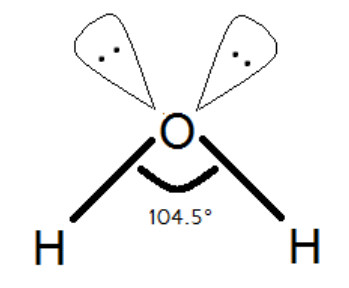
$ \text{s}{{\text{p}}^{3}} $ orbitals have an angle of $ 109{}^\circ 28\prime ~ $ which hints that $ O $ is using this hybridisation to bond whereas the pure p orbitals are at $ 90 $ degrees with each other hinting that $ S,Se~ $ and $ Te $ use almost pure p orbitals. So in water, the orbitals in $ 2\left( O-H \right) $ bonds are roughly $ \text{s}{{\text{p}}^{3}} $ hybridized, but one lone pair resides in a nearly pure $ p-orbital $ and the other lone pair is in roughly $ \text{s}{{\text{p}}^{3}} $ hybridized orbital.
Therefore, correct answer is option B i.e. oxygen uses $ \text{s}{{\text{p}}^{3}} $ hybrid orbitals to bond with the two hydrogen atoms while $ S,Se~ $ and $ Te $ use almost pure p orbitals.
Note :
Remember that oxygen atoms have two lone pairs in the structure of water molecules. Do not forget to consider the lone pair while predicting the shape or bond angles of a molecule.
Complete Step By Step Answer:
The traditional textbook explanation would argue that the orbitals in the water molecule is close to being $ \text{s}{{\text{p}}^{3}} $ hybridized, but due to lone pair - lone pair electron repulsions, the lone pair-lone pair angle opens up slightly in order to reduce these repulsions, thereby forcing the $ H-X-H $ angle to contract slightly. So instead of the $ H-O-H $ angle being the perfect tetrahedral angle $ 109.5{}^\circ $ it is slightly reduced to $ 104.5{}^\circ $ We know and we can see that oxygen has two lone pairs on itself. The water molecule has hybridization that means it is supposed to have bond angles of but there is a special case. In terms of repulsion, lone pair-lone pair repulsion is higher than any other repulsion. So, bond pair-bond pair repulsion and lone pair-bond pair repulsion is lower than lone pair- lone pair repulsion. So, due to lone pair-lone pair repulsion of two lone pairs of the oxygen atom, they both tend to repulse each other and try to stay as far as possible to each other. In that case, the bond angles of $ \text{s}{{\text{p}}^{3}} $ hybridization do not remain same and have less angle due to that because there is an increase in the angle between two lone pairs and hence there is a decrease in $ H-O-H $ angle. So, that is the reason why Water has $ H-O-H $ bond angle of $ 104.5{}^\circ $ and not $ 109.5{}^\circ $ .
$ \text{s}{{\text{p}}^{3}} $ orbitals have an angle of $ 109{}^\circ 28\prime ~ $ which hints that $ O $ is using this hybridisation to bond whereas the pure p orbitals are at $ 90 $ degrees with each other hinting that $ S,Se~ $ and $ Te $ use almost pure p orbitals. So in water, the orbitals in $ 2\left( O-H \right) $ bonds are roughly $ \text{s}{{\text{p}}^{3}} $ hybridized, but one lone pair resides in a nearly pure $ p-orbital $ and the other lone pair is in roughly $ \text{s}{{\text{p}}^{3}} $ hybridized orbital.
Therefore, correct answer is option B i.e. oxygen uses $ \text{s}{{\text{p}}^{3}} $ hybrid orbitals to bond with the two hydrogen atoms while $ S,Se~ $ and $ Te $ use almost pure p orbitals.
Note :
Remember that oxygen atoms have two lone pairs in the structure of water molecules. Do not forget to consider the lone pair while predicting the shape or bond angles of a molecule.
Recently Updated Pages
Three beakers labelled as A B and C each containing 25 mL of water were taken A small amount of NaOH anhydrous CuSO4 and NaCl were added to the beakers A B and C respectively It was observed that there was an increase in the temperature of the solutions contained in beakers A and B whereas in case of beaker C the temperature of the solution falls Which one of the following statements isarecorrect i In beakers A and B exothermic process has occurred ii In beakers A and B endothermic process has occurred iii In beaker C exothermic process has occurred iv In beaker C endothermic process has occurred

Master Class 12 Social Science: Engaging Questions & Answers for Success
Master Class 12 Physics: Engaging Questions & Answers for Success
Master Class 12 Maths: Engaging Questions & Answers for Success
Master Class 12 Economics: Engaging Questions & Answers for Success
Master Class 12 Chemistry: Engaging Questions & Answers for Success
Three beakers labelled as A B and C each containing 25 mL of water were taken A small amount of NaOH anhydrous CuSO4 and NaCl were added to the beakers A B and C respectively It was observed that there was an increase in the temperature of the solutions contained in beakers A and B whereas in case of beaker C the temperature of the solution falls Which one of the following statements isarecorrect i In beakers A and B exothermic process has occurred ii In beakers A and B endothermic process has occurred iii In beaker C exothermic process has occurred iv In beaker C endothermic process has occurred
Master Class 12 Social Science: Engaging Questions & Answers for Success
Master Class 12 Physics: Engaging Questions & Answers for Success
Trending doubts
Which are the Top 10 Largest Countries of the World?
Draw a labelled sketch of the human eye class 12 physics CBSE
Differentiate between homogeneous and heterogeneous class 12 chemistry CBSE
What are the major means of transport Explain each class 12 social science CBSE
Sulphuric acid is known as the king of acids State class 12 chemistry CBSE
Why should a magnesium ribbon be cleaned before burning class 12 chemistry CBSE