




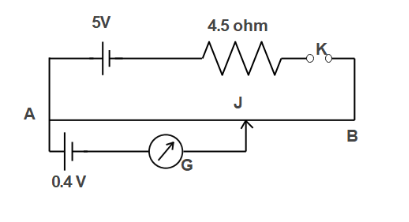
In figure, the potentiometer wire AB has a resistance of $5$ ohm and length $10 m$. The balancing length AJ for the cell of e.m.f. of $0.4 m$ is:
Answer
 Verified
540.9k+ views
Hint: The potentiometer is based on the theory of potential gradient and null deflection. So, to work problems on the potentiometer, we should find a potential gradient and later for a null location. The galvanometer has a null point as the potential difference is equivalent to zero, and there is no current flow.
Complete step-by-step solution:
The potentiometer consists of L, along the resistive wire, and a battery of known EMF V, known as driver cell voltage. Consider a primary circuit arrangement by joining the two ends of L to the battery ends. One end of the primary circuit is joined to the cell whose EMF E is to be estimated, and the other end is joined to galvanometer G. This circuit is supposed to be a secondary circuit.
The practical principle depends on the potential to cross any portion of the wire, which is directly proportional to the wire length with a uniform cross-sectional area, and current movement is constant.
$E=KL$ ……(i)
L: length of potentiometer wire
E: EMF
K: potential gradient
Put $E=iR$ (ohm’s law) …...(ii)
Equate both equations, we get
$K=\dfrac{iR}{L}$ ……(iii)
R is the resistance of length of wire L.
i is the current.
$R =5 ohm$
$i=\dfrac{5}{4.5+5} = 0.526 A$
$L=10 m$
Put all values in (iii), we get
$K=\dfrac{0.526 \times 5}{10} = 0.236 $
Now we have to find the balancing length for $0.4 V$:
$E =KL$
$\implies 0.4 = 0.263 \times L$
$L = \dfrac{0.4}{0.263} = 1.52 m$
The balancing length AJ for the cell of e.m.f. of $0.4 V$ is $1.52 m$.
Note: The potentiometer is a simplistic device used to estimate electrical potentials. One form is a uniform high-resistance wire joined to insulating support. In use, a flexible regulated voltage source E, of higher magnitude than the potential to be estimated, is combined across the wire to transfer a steady current into it.
Complete step-by-step solution:
The potentiometer consists of L, along the resistive wire, and a battery of known EMF V, known as driver cell voltage. Consider a primary circuit arrangement by joining the two ends of L to the battery ends. One end of the primary circuit is joined to the cell whose EMF E is to be estimated, and the other end is joined to galvanometer G. This circuit is supposed to be a secondary circuit.
The practical principle depends on the potential to cross any portion of the wire, which is directly proportional to the wire length with a uniform cross-sectional area, and current movement is constant.
$E=KL$ ……(i)
L: length of potentiometer wire
E: EMF
K: potential gradient
Put $E=iR$ (ohm’s law) …...(ii)
Equate both equations, we get
$K=\dfrac{iR}{L}$ ……(iii)
R is the resistance of length of wire L.
i is the current.
$R =5 ohm$
$i=\dfrac{5}{4.5+5} = 0.526 A$
$L=10 m$
Put all values in (iii), we get
$K=\dfrac{0.526 \times 5}{10} = 0.236 $
Now we have to find the balancing length for $0.4 V$:
$E =KL$
$\implies 0.4 = 0.263 \times L$
$L = \dfrac{0.4}{0.263} = 1.52 m$
The balancing length AJ for the cell of e.m.f. of $0.4 V$ is $1.52 m$.
Note: The potentiometer is a simplistic device used to estimate electrical potentials. One form is a uniform high-resistance wire joined to insulating support. In use, a flexible regulated voltage source E, of higher magnitude than the potential to be estimated, is combined across the wire to transfer a steady current into it.
Recently Updated Pages
Master Class 12 Business Studies: Engaging Questions & Answers for Success

Master Class 12 Biology: Engaging Questions & Answers for Success
Master Class 12 Chemistry: Engaging Questions & Answers for Success
Class 12 Question and Answer - Your Ultimate Solutions Guide
Master Class 11 Social Science: Engaging Questions & Answers for Success
Master Class 11 English: Engaging Questions & Answers for Success
Trending doubts
Which is more stable and why class 12 chemistry CBSE
Which are the Top 10 Largest Countries of the World?
Draw a labelled sketch of the human eye class 12 physics CBSE
Differentiate between homogeneous and heterogeneous class 12 chemistry CBSE
What are the major means of transport Explain each class 12 social science CBSE
Sulphuric acid is known as the king of acids State class 12 chemistry CBSE