



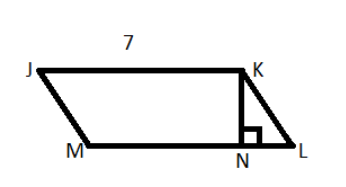
In Figure, the area of parallelogram JKLM is 28 and JK=7. If, KN is perpendicular to ML and if N is the midpoint of ML, calculate the perimeter of JKLM.
A. 24.62
B. 23.25
C. 28
D. 31.596
E. 33.941
Answer
 Verified
649.5k+ views
Hint – In order to solve this problem we need to solve to get the length of all the sides. To do that we need to use the midpoint N, we need to use the area of the triangle to get KN and Pythagoras theorem to find KL. Doing this will solve our problem and will give us the right answer.
Complete step-by-step answer:
On analyzing the diagram and the information we know that,
It is given that the area of the parallelogram is 28 and the length JK=7.
It is also given that KN is perpendicular to ML and N is the mid-point of ML
So we can clearly say that NL=$\dfrac{{{\text{ML}}}}{{\text{2}}}$ and ML =7.
Therefore NL=$\dfrac{7}{2}$=3.5
We know that the area of the parallelogram is the length of base multiplied by height and it is given as 28.
So, we can do 28=7×KN
Therefore we get the value of KN=4.
Now we consider the triangle KNL.
In triangle KNL,
Using Pythagoras theorem we get,
$
{\text{KL = }}\sqrt {{\text{N}}{{\text{L}}^{\text{2}}}{\text{ + K}}{{\text{N}}^{\text{2}}}} \\
{\text{KL = }}\sqrt {{\text{3}}{\text{.}}{{\text{5}}^{\text{2}}}{\text{ + }}{{\text{4}}^{\text{2}}}} \\
{\text{KL = }}\sqrt {{\text{12}}{\text{.25 + 16}}} \\
{\text{KL = }}\sqrt {{\text{28}}{\text{.25}}} \\
{\text{KL = 5}}{\text{.31}} \\
$
Then perimeter of JKLM = 2(JK+KL) = 2(7+5.31)=24.62
Hence, the correct answer is option A.
Note – To get answers to such problems always analyze the diagram properly and use the properties of the diagram if it is symmetric. Here we have used the information of N is the midpoint and it is the point which is on altitude of the parallelogram so we can use the area and solved to get another side and then found another side by using the Pythagoras theorem as the triangle formed is right angled at N. After summing up all the sides we got the value of perimeter.
Complete step-by-step answer:
On analyzing the diagram and the information we know that,
It is given that the area of the parallelogram is 28 and the length JK=7.
It is also given that KN is perpendicular to ML and N is the mid-point of ML
So we can clearly say that NL=$\dfrac{{{\text{ML}}}}{{\text{2}}}$ and ML =7.
Therefore NL=$\dfrac{7}{2}$=3.5
We know that the area of the parallelogram is the length of base multiplied by height and it is given as 28.
So, we can do 28=7×KN
Therefore we get the value of KN=4.
Now we consider the triangle KNL.
In triangle KNL,
Using Pythagoras theorem we get,
$
{\text{KL = }}\sqrt {{\text{N}}{{\text{L}}^{\text{2}}}{\text{ + K}}{{\text{N}}^{\text{2}}}} \\
{\text{KL = }}\sqrt {{\text{3}}{\text{.}}{{\text{5}}^{\text{2}}}{\text{ + }}{{\text{4}}^{\text{2}}}} \\
{\text{KL = }}\sqrt {{\text{12}}{\text{.25 + 16}}} \\
{\text{KL = }}\sqrt {{\text{28}}{\text{.25}}} \\
{\text{KL = 5}}{\text{.31}} \\
$
Then perimeter of JKLM = 2(JK+KL) = 2(7+5.31)=24.62
Hence, the correct answer is option A.
Note – To get answers to such problems always analyze the diagram properly and use the properties of the diagram if it is symmetric. Here we have used the information of N is the midpoint and it is the point which is on altitude of the parallelogram so we can use the area and solved to get another side and then found another side by using the Pythagoras theorem as the triangle formed is right angled at N. After summing up all the sides we got the value of perimeter.

Recently Updated Pages
Basicity of sulphurous acid and sulphuric acid are

Master Class 12 Economics: Engaging Questions & Answers for Success
Master Class 12 Biology: Engaging Questions & Answers for Success
Master Class 11 English: Engaging Questions & Answers for Success
Master Class 11 Physics: Engaging Questions & Answers for Success
Master Class 11 Computer Science: Engaging Questions & Answers for Success
Trending doubts
Difference Between Plant Cell and Animal Cell
Fill the blanks with the suitable prepositions 1 The class 9 english CBSE
What is pollution? How many types of pollution? Define it
What is the full form of pH?
What is the Full Form of ICSE, CBSE and SSC
Name 10 Living and Non living things class 9 biology CBSE