




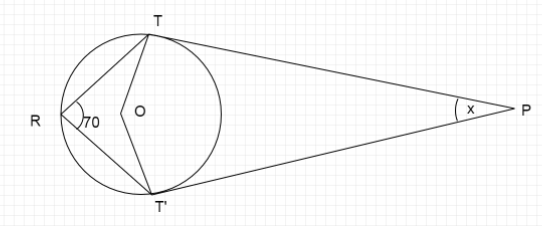
In figure \[PT\]and \[PT'\]are tangents to the circle with center \[O\]. If \[\angle TRT' = {70^ \circ }\]then \[x\]equals
A. \[{30^ \circ }\]
B. \[{35^ \circ }\]
C. \[{40^ \circ }\]
D. \[{50^ \circ }\]
Answer
 Verified
596.1k+ views
Hint:Here we use the property which states that tangents meet the radius of the circle at right angles. We find all the angles of the quadrilateral \[TOT'P\] and then using the property that the sum of all angles of a quadrilateral is \[{360^ \circ }\] we find the value of \[x\].
Also, angle subtended by the same arc at the center of the circle is twice the angle subtended by that arc at any other point on the circumference.
Complete step-by-step answer:
First we calculate the value of \[\angle TOT'\]
Since, \[\angle TRT' = {70^ \circ }\]
Therefore, using the theorem which states that angle subtended by an arc of a circle at its center is twice of the angle it subtends anywhere on the circumference of the circle.
Here the arc which is subtending the angles is arc
The angle subtended by the arc at the circumference is \[TRT'\]and the angle subtended by the arc at the center of the circle is \[\angle TOT'\]
From the theorem, \[\angle TOT' = 2 \times TRT'\]
Substituting the value of \[\angle TRT' = {70^ \circ }\]
\[\angle TOT' = 2 \times {70^ \circ } = {140^ \circ }\]
Now, since we know that tangent at a point meet the radius of circle at a right angle
Therefore, two tangents \[PT,PT'\] make angle \[{90^ \circ }\]at points \[T,T'\].
Therefore, \[\angle OTP = \angle OT'P = {90^ \circ }\]
Now we look at the quadrilateral \[TOT'P\]
Sum of all angles is \[{360^ \circ }\]
\[\angle OTP + \angle TPT' + \angle OT'P + \angle T'OT = {360^ \circ }\]
Now we substitute the values of angles in the equation
\[
{90^ \circ } + x + {90^ \circ } + 140 = {360^ \circ } \\
x + {320^ \circ } = {360^ \circ } \\
\]
Taking the constant terms on one side of the equation
\[x = {360^ \circ } - {320^ \circ } = {40^ \circ }\]
Thus, the value of \[x = {40^ \circ }\]
So, option C is correct.
Note:Alternate method:
Join \[TT'\]which forms a chord for the circle.
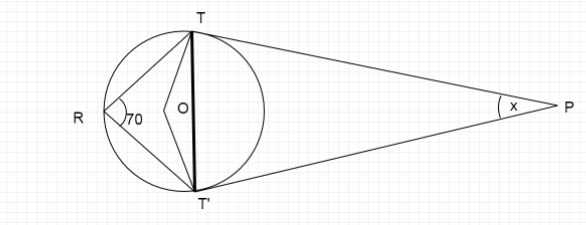
We calculate the value of \[\angle TOT'\]
Since, \[\angle TRT' = {70^ \circ }\]
Therefore, using the theorem which states that angle subtended by an arc of a circle at its center is twice of the angle it subtends anywhere on the circumference of the circle.
Here the arc which is subtending the angles is arc
The angle subtended by the arc at the circumference is \[TRT'\]and the angle subtended by the arc at the center of the circle is \[\angle TOT'\]
From the theorem, \[\angle TOT' = 2 \times TRT'\]
Substituting the value of \[\angle TRT' = {70^ \circ }\]
\[\angle TOT' = 2 \times {70^ \circ } = {140^ \circ }\]
Therefore in \[\vartriangle TOT'\] sum of all angles is \[{180^ \circ }\]
Therefore, \[\angle TOT' + \angle OTT' + \angle OT'T = {180^ \circ }\]
Both sides \[TO,T'O\] of the \[\vartriangle TOT'\] are same because they are equal to radius of the circle.
Therefore, \[\vartriangle TOT'\] is an isosceles triangle.
So, from the property of isosceles triangle having angles opposite to equal sides are equal.
\[\angle OTT' = \angle OT'T\]
So the sum \[\angle TOT' + \angle OTT' + \angle OT'T = {180^ \circ }\] becomes
\[
{140^ \circ } + \angle OTT' + \angle OTT' = {180^ \circ } \\
{140^ \circ } + 2\angle OTT' = {180^ \circ } \\
\]
Take all constants to one side of the equation
\[
2\angle OTT' = {180^ \circ } - {140^ \circ } \\
2\angle OTT' = {40^ \circ } \\
\]
Divide both sides of the equation by \[2\]
\[
\dfrac{{2\angle OTT'}}{2} = \dfrac{{{{40}^ \circ }}}{2} \\
\angle OTT' = {20^ \circ } \\
\]
\[\angle OTT' = \angle OT'T = {20^ \circ }\]
Now, since we know that tangent at a point meet the radius of circle at a right angle
Therefore, two tangents \[PT,PT'\] make angle \[{90^ \circ }\]at points \[T,T'\].
Therefore, \[\angle OTP = \angle OT'P = {90^ \circ }\]
\[
\angle OTP = {90^ \circ } \\
\angle OTT' + \angle T'TP = {90^ \circ } \\
{20^ \circ } + \angle T'TP = {90^ \circ } \\
\angle T'TP = {90^ \circ } - {20^ \circ } = {70^ \circ } \\
\]
Similarly,
\[
\angle OT'P = {90^ \circ } \\
\angle OT'T + \angle TT'P = {90^ \circ } \\
{20^ \circ } + \angle TT'P = {90^ \circ } \\
\angle TT'P = {90^ \circ } - {20^ \circ } = {70^ \circ } \\
\]
Now using the property of sum of all three angles of a triangle is \[{180^ \circ }\]
\[\angle TT'P + \angle T'TP + \angle TPT' = {180^ \circ }\]
Substituting the values of angles
\[
{70^ \circ } + {70^ \circ } + x = {180^ \circ } \\
{140^ \circ } + x = {180^ \circ } \\
\]
Shift all constants to one side of the equation.
\[x = {180^ \circ } - {140^ \circ } = {40^ \circ }\]
So, option C is correct.
Also, angle subtended by the same arc at the center of the circle is twice the angle subtended by that arc at any other point on the circumference.
Complete step-by-step answer:
First we calculate the value of \[\angle TOT'\]
Since, \[\angle TRT' = {70^ \circ }\]
Therefore, using the theorem which states that angle subtended by an arc of a circle at its center is twice of the angle it subtends anywhere on the circumference of the circle.
Here the arc which is subtending the angles is arc
The angle subtended by the arc at the circumference is \[TRT'\]and the angle subtended by the arc at the center of the circle is \[\angle TOT'\]
From the theorem, \[\angle TOT' = 2 \times TRT'\]
Substituting the value of \[\angle TRT' = {70^ \circ }\]
\[\angle TOT' = 2 \times {70^ \circ } = {140^ \circ }\]
Now, since we know that tangent at a point meet the radius of circle at a right angle
Therefore, two tangents \[PT,PT'\] make angle \[{90^ \circ }\]at points \[T,T'\].
Therefore, \[\angle OTP = \angle OT'P = {90^ \circ }\]
Now we look at the quadrilateral \[TOT'P\]
Sum of all angles is \[{360^ \circ }\]
\[\angle OTP + \angle TPT' + \angle OT'P + \angle T'OT = {360^ \circ }\]
Now we substitute the values of angles in the equation
\[
{90^ \circ } + x + {90^ \circ } + 140 = {360^ \circ } \\
x + {320^ \circ } = {360^ \circ } \\
\]
Taking the constant terms on one side of the equation
\[x = {360^ \circ } - {320^ \circ } = {40^ \circ }\]
Thus, the value of \[x = {40^ \circ }\]
So, option C is correct.
Note:Alternate method:
Join \[TT'\]which forms a chord for the circle.
We calculate the value of \[\angle TOT'\]
Since, \[\angle TRT' = {70^ \circ }\]
Therefore, using the theorem which states that angle subtended by an arc of a circle at its center is twice of the angle it subtends anywhere on the circumference of the circle.
Here the arc which is subtending the angles is arc
The angle subtended by the arc at the circumference is \[TRT'\]and the angle subtended by the arc at the center of the circle is \[\angle TOT'\]
From the theorem, \[\angle TOT' = 2 \times TRT'\]
Substituting the value of \[\angle TRT' = {70^ \circ }\]
\[\angle TOT' = 2 \times {70^ \circ } = {140^ \circ }\]
Therefore in \[\vartriangle TOT'\] sum of all angles is \[{180^ \circ }\]
Therefore, \[\angle TOT' + \angle OTT' + \angle OT'T = {180^ \circ }\]
Both sides \[TO,T'O\] of the \[\vartriangle TOT'\] are same because they are equal to radius of the circle.
Therefore, \[\vartriangle TOT'\] is an isosceles triangle.
So, from the property of isosceles triangle having angles opposite to equal sides are equal.
\[\angle OTT' = \angle OT'T\]
So the sum \[\angle TOT' + \angle OTT' + \angle OT'T = {180^ \circ }\] becomes
\[
{140^ \circ } + \angle OTT' + \angle OTT' = {180^ \circ } \\
{140^ \circ } + 2\angle OTT' = {180^ \circ } \\
\]
Take all constants to one side of the equation
\[
2\angle OTT' = {180^ \circ } - {140^ \circ } \\
2\angle OTT' = {40^ \circ } \\
\]
Divide both sides of the equation by \[2\]
\[
\dfrac{{2\angle OTT'}}{2} = \dfrac{{{{40}^ \circ }}}{2} \\
\angle OTT' = {20^ \circ } \\
\]
\[\angle OTT' = \angle OT'T = {20^ \circ }\]
Now, since we know that tangent at a point meet the radius of circle at a right angle
Therefore, two tangents \[PT,PT'\] make angle \[{90^ \circ }\]at points \[T,T'\].
Therefore, \[\angle OTP = \angle OT'P = {90^ \circ }\]
\[
\angle OTP = {90^ \circ } \\
\angle OTT' + \angle T'TP = {90^ \circ } \\
{20^ \circ } + \angle T'TP = {90^ \circ } \\
\angle T'TP = {90^ \circ } - {20^ \circ } = {70^ \circ } \\
\]
Similarly,
\[
\angle OT'P = {90^ \circ } \\
\angle OT'T + \angle TT'P = {90^ \circ } \\
{20^ \circ } + \angle TT'P = {90^ \circ } \\
\angle TT'P = {90^ \circ } - {20^ \circ } = {70^ \circ } \\
\]
Now using the property of sum of all three angles of a triangle is \[{180^ \circ }\]
\[\angle TT'P + \angle T'TP + \angle TPT' = {180^ \circ }\]
Substituting the values of angles
\[
{70^ \circ } + {70^ \circ } + x = {180^ \circ } \\
{140^ \circ } + x = {180^ \circ } \\
\]
Shift all constants to one side of the equation.
\[x = {180^ \circ } - {140^ \circ } = {40^ \circ }\]
So, option C is correct.
Recently Updated Pages
Master Class 12 Economics: Engaging Questions & Answers for Success

Master Class 12 Physics: Engaging Questions & Answers for Success
Master Class 12 English: Engaging Questions & Answers for Success
Master Class 12 Social Science: Engaging Questions & Answers for Success
Master Class 12 Maths: Engaging Questions & Answers for Success
Master Class 12 Business Studies: Engaging Questions & Answers for Success
Trending doubts
Which are the Top 10 Largest Countries of the World?
What are the major means of transport Explain each class 12 social science CBSE
Draw a labelled sketch of the human eye class 12 physics CBSE
Why cannot DNA pass through cell membranes class 12 biology CBSE
Differentiate between insitu conservation and exsitu class 12 biology CBSE
Draw a neat and well labeled diagram of TS of ovary class 12 biology CBSE