



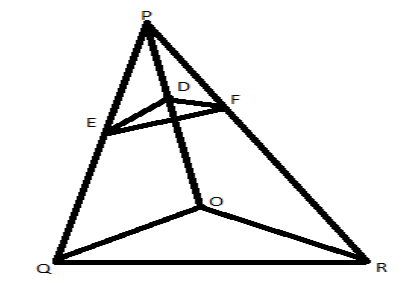
In figure, \[DE\parallel OQ\] and \[DF\parallel OR\]. Show that \[EF\parallel QR\].
Answer
 Verified
615k+ views
Hint: To solve this geometry, use a similar triangle concept. Similar triangles, two figures having the same shape (but not necessarily the same size) are called similar figures.
The first part of the solution is important, for that, we use one of the theorems of a similar triangle that is, if a line is drawn parallel to one side of a triangle to intersect the other two sides in distinct points, the other two sides are divided in the same ratio.
The second part of the solution is done by using “if a line divides any two sides of a triangle in the same ratio, the line is parallel to the third side”.
Complete step-by-step answer:
Given: \[DE\parallel OQ\] and \[DF\parallel OR\]
To show that: \[EF\parallel QR\]
In \[\Delta PQO\],
\[DE\parallel OQ\]
Here, by the theorem, in a \[\Delta PQO\] the line \[DE\]which is parallel to \[OQ\] intersects the other two sides in distinct points, so it divides the other two side in same ratio
The ratio is, \[\dfrac{{PE}}{{EQ}} = \dfrac{{PD}}{{DO}}...\left( 1 \right)\]
Similarly,
In \[\Delta PRO\],
\[DF\parallel OR\]
Here, by the theorem, in a \[\Delta PRO\] the line \[DF\]which is parallel to \[OR\] intersects the other two sides in distinct points, so it divides the other two side in same ratio
The ratio is, \[\dfrac{{PF}}{{FR}} = \dfrac{{PD}}{{DO}}...\left( 2 \right)\]
The ratio of \[(1)\ & (2)\]shows the two \[\Delta PRO\] and \[\Delta PQO\], \[\angle PQO = \angle PRO\] also corresponding sides are same ratio\[\dfrac{{PE}}{{EQ}} = \dfrac{{PD}}{{DO}}\]=\[\dfrac{{PF}}{{FR}} = \dfrac{{PD}}{{DO}}\]
Thus,\[\dfrac{{PE}}{{EQ}} = \dfrac{{PF}}{{FR}}\]
Now, we can say that the triangle is a similar triangle.
To show that the side is parallel, we use the second part of the hint
In a \[\Delta PQR\],
Line \[EF\]divides the \[\Delta PQR\] in the same ratio, therefore
\[EF\parallel QR\]
Hence proved.
Note: The theorem, we state the first part and second part is called basic proportionality theorem.
Two triangles are said to be similar, if their corresponding angles are equal and their corresponding sides are in the same ratio proportion.
The first part of the solution is important, for that, we use one of the theorems of a similar triangle that is, if a line is drawn parallel to one side of a triangle to intersect the other two sides in distinct points, the other two sides are divided in the same ratio.
The second part of the solution is done by using “if a line divides any two sides of a triangle in the same ratio, the line is parallel to the third side”.
Complete step-by-step answer:
Given: \[DE\parallel OQ\] and \[DF\parallel OR\]
To show that: \[EF\parallel QR\]
In \[\Delta PQO\],
\[DE\parallel OQ\]
Here, by the theorem, in a \[\Delta PQO\] the line \[DE\]which is parallel to \[OQ\] intersects the other two sides in distinct points, so it divides the other two side in same ratio
The ratio is, \[\dfrac{{PE}}{{EQ}} = \dfrac{{PD}}{{DO}}...\left( 1 \right)\]
Similarly,
In \[\Delta PRO\],
\[DF\parallel OR\]
Here, by the theorem, in a \[\Delta PRO\] the line \[DF\]which is parallel to \[OR\] intersects the other two sides in distinct points, so it divides the other two side in same ratio
The ratio is, \[\dfrac{{PF}}{{FR}} = \dfrac{{PD}}{{DO}}...\left( 2 \right)\]
The ratio of \[(1)\ & (2)\]shows the two \[\Delta PRO\] and \[\Delta PQO\], \[\angle PQO = \angle PRO\] also corresponding sides are same ratio\[\dfrac{{PE}}{{EQ}} = \dfrac{{PD}}{{DO}}\]=\[\dfrac{{PF}}{{FR}} = \dfrac{{PD}}{{DO}}\]
Thus,\[\dfrac{{PE}}{{EQ}} = \dfrac{{PF}}{{FR}}\]
Now, we can say that the triangle is a similar triangle.
To show that the side is parallel, we use the second part of the hint
In a \[\Delta PQR\],
Line \[EF\]divides the \[\Delta PQR\] in the same ratio, therefore
\[EF\parallel QR\]
Hence proved.
Note: The theorem, we state the first part and second part is called basic proportionality theorem.
Two triangles are said to be similar, if their corresponding angles are equal and their corresponding sides are in the same ratio proportion.

Recently Updated Pages
Master Class 12 Business Studies: Engaging Questions & Answers for Success

Master Class 12 Biology: Engaging Questions & Answers for Success
Master Class 12 Chemistry: Engaging Questions & Answers for Success
Class 12 Question and Answer - Your Ultimate Solutions Guide
Master Class 11 Social Science: Engaging Questions & Answers for Success
Master Class 11 English: Engaging Questions & Answers for Success
Trending doubts
Find the sum of series 1 + 2 + 3 + 4 + 5 + + 100 class 9 maths CBSE
On an outline map of India show its neighbouring c class 9 social science CBSE
Write an Article on Save Earth Save Life
On an outline map of India mark the Karakoram range class 9 social science CBSE
If HCF of 210 and 55 is expressed in the form of 210 class 9 maths CBSE
What is the difference between Atleast and Atmost in class 9 maths CBSE