




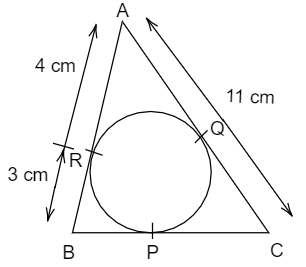
In figure $\Delta ABC$ is circumscribing a circle. Find the length of $BC$
A. $8\,cm$
B. $10\,cm$
C. $12\,cm$
D. $14\,cm$
Answer
 Verified
533.7k+ views
Hint: Here we have been given a circle and a triangle is circumscribing it we have to find the length of the unknown side. Firstly we will use the concept of tangents drawn from the same point are equal. Then using this we will try to get the length of the two parts of the unknown side. Finally we will add the two parts and get our desired answer.
Complete step-by-step solution:
From the figure given we get the following information:
$AR=4\,cm$…..$\left( 1 \right)$
$BR=3\,cm$…..$\left( 2 \right)$
$AC=11\,cm$…..$\left( 3 \right)$
And $P,Q,R$ are three points where the triangle meets the circle.
Now as we can see that $AR$ and $AQ$ are tangent from the same point $A$ to the circle so by the concept of tangent from the same points are equal we get,
$AR=AQ$
From equation (1) we get,
$\therefore AQ=4\,cm$…..$\left( 4 \right)$
Now as we can see that,
$AQ+CQ=AC$
Substitute the value from equation (3), (4) above we get,
$4\,cm+CQ=11\,cm$
$\Rightarrow CQ=11\,cm-4\,cm$
So we get,
$CQ=7\,cm$…..$\left( 5 \right)$
Next from the figure we can see that the two tangent $CQ,CP$ are from the same point on the circle so by using tangent from same point are equal concept we get,
$CQ=CP$
From equation (5) we get,
$CP=7\,cm$…..$\left( 6 \right)$
Again by the same concept
$BR=BP$
Using equation (2) we get,
$BP=3\,cm$…..$\left( 7 \right)$
Finally as we can see that,
$BC=CP+BP$
On substituting the values from equation (6) and (7) above we get,
$BC=7\,cm+3\,cm$
$\Rightarrow BC=10\,cm$
Hence the correct option is (B).
Note: Tangent to a circle is any straight line that touches the circle at only one point. This point is also known as the point of tangency and this tangent on the circle is always perpendicular to the radius. One of the most important properties of a tangent is that the length of any tangent from an external point to a circle is always equal.
Complete step-by-step solution:
From the figure given we get the following information:
$AR=4\,cm$…..$\left( 1 \right)$
$BR=3\,cm$…..$\left( 2 \right)$
$AC=11\,cm$…..$\left( 3 \right)$
And $P,Q,R$ are three points where the triangle meets the circle.
Now as we can see that $AR$ and $AQ$ are tangent from the same point $A$ to the circle so by the concept of tangent from the same points are equal we get,
$AR=AQ$
From equation (1) we get,
$\therefore AQ=4\,cm$…..$\left( 4 \right)$
Now as we can see that,
$AQ+CQ=AC$
Substitute the value from equation (3), (4) above we get,
$4\,cm+CQ=11\,cm$
$\Rightarrow CQ=11\,cm-4\,cm$
So we get,
$CQ=7\,cm$…..$\left( 5 \right)$
Next from the figure we can see that the two tangent $CQ,CP$ are from the same point on the circle so by using tangent from same point are equal concept we get,
$CQ=CP$
From equation (5) we get,
$CP=7\,cm$…..$\left( 6 \right)$
Again by the same concept
$BR=BP$
Using equation (2) we get,
$BP=3\,cm$…..$\left( 7 \right)$
Finally as we can see that,
$BC=CP+BP$
On substituting the values from equation (6) and (7) above we get,
$BC=7\,cm+3\,cm$
$\Rightarrow BC=10\,cm$
Hence the correct option is (B).
Note: Tangent to a circle is any straight line that touches the circle at only one point. This point is also known as the point of tangency and this tangent on the circle is always perpendicular to the radius. One of the most important properties of a tangent is that the length of any tangent from an external point to a circle is always equal.
Recently Updated Pages
Master Class 12 Economics: Engaging Questions & Answers for Success

Master Class 12 English: Engaging Questions & Answers for Success
Master Class 12 Social Science: Engaging Questions & Answers for Success
Master Class 12 Maths: Engaging Questions & Answers for Success
Master Class 12 Physics: Engaging Questions & Answers for Success
Master Class 9 General Knowledge: Engaging Questions & Answers for Success
Trending doubts
Find the sum of series 1 + 2 + 3 + 4 + 5 + + 100 class 9 maths CBSE
Difference Between Plant Cell and Animal Cell
Fill the blanks with the suitable prepositions 1 The class 9 english CBSE
What is pollution? How many types of pollution? Define it
Name 10 Living and Non living things class 9 biology CBSE
What is the full form of pH?