




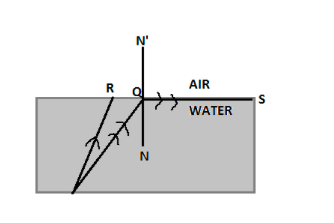
In fig. PQ and PR are the two light rays emerging from an object P. The ray PQ is refracted as QS. The ray PR suffers partial reflection and refraction on the water-air interface. This is because:
A) The angle of incidence is more than the critical angle.
B) The angle of incidence is equal to the critical angle.
C) The angle of incidence is less than the critical angle.
D) The angle of incidence is ${90^\circ}$
Answer
 Verified
618.6k+ views
Hint: Whenever change in the medium there change in velocity of light takes place. This is because the refractive index of the medium in which it travels from denser to rarer refracted ray bends away from the normal and vice versa.
Complete step by step answer:
A ray PQ coming from object p is refracted along QS as shown in the figure. And it grazes the air- water interface because; incident angle is equal to critical angle.
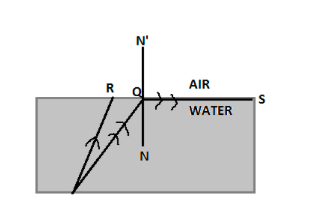
Now one more ray coming from P that is PR whose angle of incidence is less than the critical angle. Thus we can say, PR ray has an angle of incidence less than critical angle, hence it will undergo refraction (with the refracted ray bending away from the normal) and partial reflection at the air and water interface.
When light travels from an optically denser medium to a rarer medium, at the interface, under certain conditions, light is totally reflected back into the denser medium. This phenomenon is called total internal reflection. For a pair of given media, the angle of incident in the denser medium for which the angle of refraction in the rarer medium becomes ${90^0}$ is called critical angle (C).
Additional information:
A ) The phenomenon of bending of a ray of light when it travels from one medium to another of different optical density is known as refraction of light.
B )The phenomenon in which light travelling in one medium, incident on the surface of another returns to the first medium is called reflection of light.
C) The refractive index of a medium is a measure of the velocity of light in the medium. The greater the refractive index of a medium the smaller is the velocity of light in that medium and vice versa. A medium that has a higher refractive index is called an optically denser medium and the one that has a smaller refractive index is said to be an optically rarer medium.
Note:
There is relation between a critical angle and the refractive index ${n_{21}} = \dfrac{1}{{\sin C}}$
Conditions for total internal reflection are
- Critical angle must be lesser than the angle of incidence.
- A ray of light must travel from denser medium to rarer medium.
Complete step by step answer:
A ray PQ coming from object p is refracted along QS as shown in the figure. And it grazes the air- water interface because; incident angle is equal to critical angle.
Now one more ray coming from P that is PR whose angle of incidence is less than the critical angle. Thus we can say, PR ray has an angle of incidence less than critical angle, hence it will undergo refraction (with the refracted ray bending away from the normal) and partial reflection at the air and water interface.
When light travels from an optically denser medium to a rarer medium, at the interface, under certain conditions, light is totally reflected back into the denser medium. This phenomenon is called total internal reflection. For a pair of given media, the angle of incident in the denser medium for which the angle of refraction in the rarer medium becomes ${90^0}$ is called critical angle (C).
Additional information:
A ) The phenomenon of bending of a ray of light when it travels from one medium to another of different optical density is known as refraction of light.
B )The phenomenon in which light travelling in one medium, incident on the surface of another returns to the first medium is called reflection of light.
C) The refractive index of a medium is a measure of the velocity of light in the medium. The greater the refractive index of a medium the smaller is the velocity of light in that medium and vice versa. A medium that has a higher refractive index is called an optically denser medium and the one that has a smaller refractive index is said to be an optically rarer medium.
Note:
There is relation between a critical angle and the refractive index ${n_{21}} = \dfrac{1}{{\sin C}}$
Conditions for total internal reflection are
- Critical angle must be lesser than the angle of incidence.
- A ray of light must travel from denser medium to rarer medium.
Recently Updated Pages
Master Class 12 Economics: Engaging Questions & Answers for Success

Master Class 12 English: Engaging Questions & Answers for Success
Master Class 12 Social Science: Engaging Questions & Answers for Success
Master Class 12 Maths: Engaging Questions & Answers for Success
Master Class 12 Physics: Engaging Questions & Answers for Success
Master Class 9 General Knowledge: Engaging Questions & Answers for Success
Trending doubts
Which are the Top 10 Largest Countries of the World?
Draw a labelled sketch of the human eye class 12 physics CBSE
Differentiate between homogeneous and heterogeneous class 12 chemistry CBSE
Sulphuric acid is known as the king of acids State class 12 chemistry CBSE
Why is the cell called the structural and functional class 12 biology CBSE
Draw ray diagrams each showing i myopic eye and ii class 12 physics CBSE