




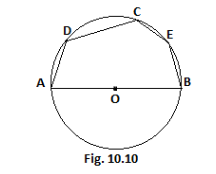
In fig. $10.10$ if \[AOB\] is a diameter and $\angle ADC = {120^0}$, then $\angle CAB = {30^0}$.
State true or false.
Answer
 Verified
597.6k+ views
Hint: In the given question, we have to check whether $\angle CAB$ is equal to ${30^0}$ or not. To solve this question, we have to use some Geometric theorems, regarding cyclic quadrilateral, Angle of circle, chord of circles and tangents of circle. Since $\angle ADC$ is given, first join $A,C$ and $B,C$. Find out the value of $\angle CBA$ as $ADCB$ is a cyclic quadrilateral. Afterwards find out the $\angle CAD$ as $\angle ACB$ is angle on semicircle.
Complete step-by-step answer:
According to the hint,
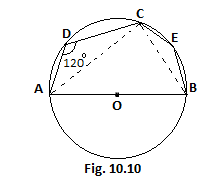
Join $A,C$ and $B,C$.
In cyclic quadrilateral, $ADCB$-
We know, opposite angles of cyclic quadrilateral are supplementary.
$\therefore \angle ADC + \angle CBA = {180^0}$
&$\angle ADC = {120^0}$(given in question)
$\therefore \angle CBA = {180^0} - \angle ADC = {180^0} - {120^0}$
$\therefore $$\angle CBA = {60^0}$
In $\Delta ACB$-
$AOB$is a diameter.
$\therefore $$\angle ACB$is angle on semicircle & we know, angle one semicircle is right angle.
$\therefore \angle ACB = {90^0}$
Now, we get, $\angle ABC = {60^0}$
We know that the sum of all angles of a triangle is $180^\circ $.
$\therefore $In $\Delta AOB$-
${
\therefore \angle ABC + \angle ACB + \angle CAB = {180^0} \\
\Rightarrow {60^0} + {90^0} + \angle CAB = {180^0} \\
\Rightarrow \angle CAB = {180^0} - {150^0} \\
\therefore \angle CAB = {30^0} \\
} $[ Putting the values of known angles]
Hence, the given statement is true, $\angle CAB = {30^0}$.
Note: The terms used in the solution are important. Cyclic quadrilateral is the quadrilateral formed when all four vertices lie on circumference. We have learnt in ‘Angle of circle’ topic, that ‘Angles on the Centre are always double the angles on the circumference’, ‘Angles on the same segment are equal’, ‘Angles on semicircle are always ${90^0}$etc. The reason behind saying this is that, the asked question can also be solved using said theorems but the way using cyclic quadrilateral (as done) is much better and easy way to solve it.
Complete step-by-step answer:
According to the hint,
Join $A,C$ and $B,C$.
In cyclic quadrilateral, $ADCB$-
We know, opposite angles of cyclic quadrilateral are supplementary.
$\therefore \angle ADC + \angle CBA = {180^0}$
&$\angle ADC = {120^0}$(given in question)
$\therefore \angle CBA = {180^0} - \angle ADC = {180^0} - {120^0}$
$\therefore $$\angle CBA = {60^0}$
In $\Delta ACB$-
$AOB$is a diameter.
$\therefore $$\angle ACB$is angle on semicircle & we know, angle one semicircle is right angle.
$\therefore \angle ACB = {90^0}$
Now, we get, $\angle ABC = {60^0}$
We know that the sum of all angles of a triangle is $180^\circ $.
$\therefore $In $\Delta AOB$-
${
\therefore \angle ABC + \angle ACB + \angle CAB = {180^0} \\
\Rightarrow {60^0} + {90^0} + \angle CAB = {180^0} \\
\Rightarrow \angle CAB = {180^0} - {150^0} \\
\therefore \angle CAB = {30^0} \\
} $[ Putting the values of known angles]
Hence, the given statement is true, $\angle CAB = {30^0}$.
Note: The terms used in the solution are important. Cyclic quadrilateral is the quadrilateral formed when all four vertices lie on circumference. We have learnt in ‘Angle of circle’ topic, that ‘Angles on the Centre are always double the angles on the circumference’, ‘Angles on the same segment are equal’, ‘Angles on semicircle are always ${90^0}$etc. The reason behind saying this is that, the asked question can also be solved using said theorems but the way using cyclic quadrilateral (as done) is much better and easy way to solve it.
Recently Updated Pages
Basicity of sulphurous acid and sulphuric acid are

Master Class 11 Business Studies: Engaging Questions & Answers for Success
Master Class 11 Computer Science: Engaging Questions & Answers for Success
Master Class 11 Economics: Engaging Questions & Answers for Success
Master Class 12 English: Engaging Questions & Answers for Success
Master Class 12 Social Science: Engaging Questions & Answers for Success
Trending doubts
Fill the blanks with the suitable prepositions 1 The class 9 english CBSE
Difference Between Plant Cell and Animal Cell
What is the color of ferrous sulphate crystals? How does this color change after heating? Name the products formed on strongly heating ferrous sulphate crystals. What type of chemical reaction occurs in this type of change.
Find the mode and median of the data 13 16 12 14 1-class-9-maths-CBSE
What is pollution? How many types of pollution? Define it
Explain the importance of pH in everyday life class 9 chemistry CBSE
Fill the blanks with the suitable prepositions 1 The class 9 english CBSE
Difference Between Plant Cell and Animal Cell
What is the color of ferrous sulphate crystals? How does this color change after heating? Name the products formed on strongly heating ferrous sulphate crystals. What type of chemical reaction occurs in this type of change.