




In convey on a long straight level road, \[50\] identical cars are at rest in a queue at equal separation \[10m\] from each other as shown
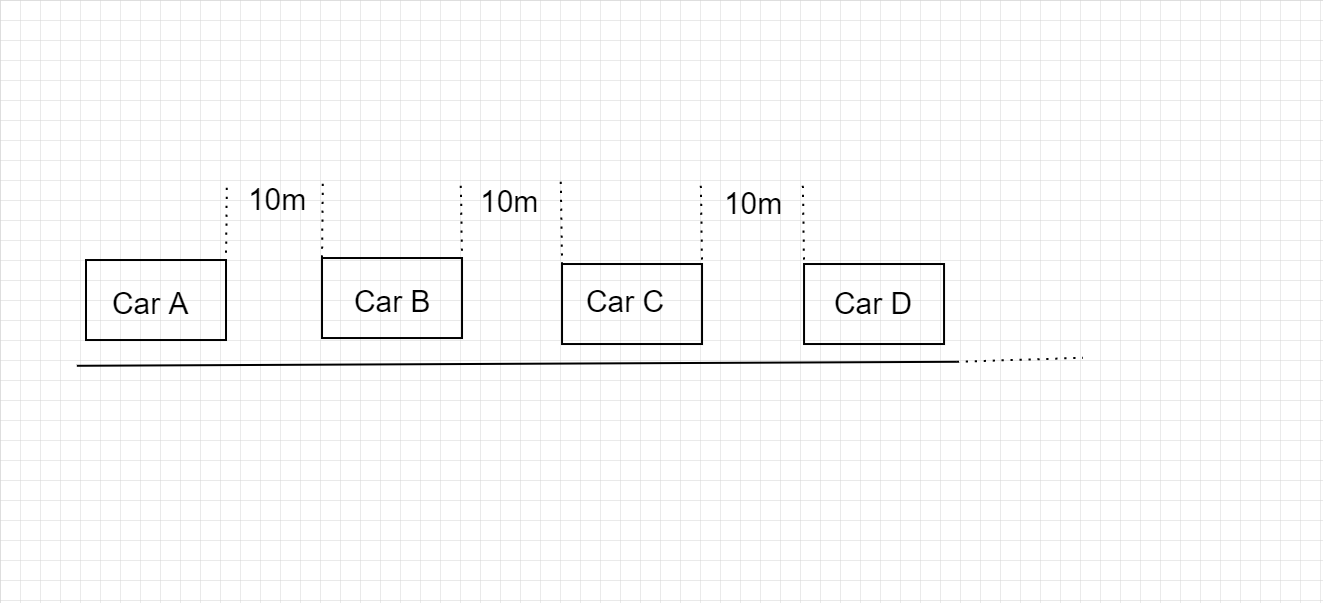
Engine of a car provides a constant acceleration \[2\dfrac{m}{{{s}^{2}}}\] and brakes can provide a maximum deceleration\[4\dfrac{m}{{{s}^{2}}}\]. When an order is given to start the convey, the first car starts immediately and each subsequent car starts when its distance from a car that is immediately ahead becomes\[35m\]. Maximum speed limit on this road is\[72\dfrac{km}{h}\]. When an order is given to stop the convoy, the driver of the first car applies brakes immediately and driver of each subsequent car applies brakes with a certain time delay after noticing the brake light of the front car turned red.
During the time when motion is building up in the convoy, some of the cars are moving and the others are at rest. What is the average rate of change in length of the segment consisting of stationary cars?
Answer
 Verified
526.8k+ views
Hint:First defined average velocity formula. Taking the given value and putting the second equation of motion will give the time interval for one car multiple with total car moving. Further distance covered by one car is multiplied by the total car in-between distance. After, the formula for finding the average rate of change in length of the segment.
Complete step-by-step solution:
Uniform motion:
An object can be termed as uniform motion if it covers equal distance in equal time intervals, however small these time intervals may be in the same fixed direction.
Average velocity:
For an object moving with not consistent velocity, average velocity is defined as the ratio of its total displacement to the total time interval in which that displacement occurs.
If \[{{s}_{1}}\] and \[{{s}_{2}}\] are the positions for an object at times \[{{t}_{1}}\] and\[{{t}_{2}}\], then the average velocity from time \[{{t}_{2}}\] and \[{{t}_{1}}\] is given by
\[{{v}_{av}}=\dfrac{{{s}_{2}}-{{s}_{1}}}{{{t}_{2}}-{{t}_{1}}}\]
At the start of convey one
Acceleration is given \[2\dfrac{m}{{{s}^{2}}}\]
The following car starts moving after the preceding car reaches a distance of \[35m\].
Time is taken to reach\[35m\], t have to be found
Equation of motion for the uniformly accelerated motion:
\[s=ut+\dfrac{1}{2}a{{t}^{2}}\]
Time is taken to reach\[35m\], t have to be found
\[35=\left( 0 \right)t+\dfrac{1}{2}\times 2{{t}^{2}}\]
\[{{t}^{2}}=35\]
\[t\simeq 6\sec \]
Each car start moving after \[6\] seconds
Initially, the length of the segments having stationary cars can be calculated by the space given between cars that will be \[49\]spaces and the distance between them is\[10m\].
Total \[50\] cars then, \[49\]spaces between them:
\[49\times 10=490\]
Thus, the distance becomes\[490m\].
After \[6\sec \]one car starts moving, which means the length of the segment between stationary cars decreases by \[10m\] after each\[6\sec \].
As there are \[50\] cars and the \[{{49}^{th}}\]car starts moving the distance between the stationary cars becomes\[0\].
It takes about \[49\times 6\]seconds for this
The Formula for Average acceleration:
\[{{v}_{av}}=\dfrac{{{s}_{2}}-{{s}_{1}}}{{{t}_{2}}-{{t}_{1}}}\]
\[=\dfrac{\Delta s}{\Delta t}\]
Where\[\Delta s\] is the distance and \[\Delta t\] is the average time
\[=\dfrac{490}{49\times 6}\]
\[=\dfrac{10}{6}\]
\[\simeq 2\dfrac{m}{s}\]
As the distance is decreasing with the car moving to the preceding car position, the Average rate of change of length of the segment will be decreasing too.
Thus, the final result is decreasing at\[2\dfrac{m}{s}\]
Note:The average velocity is always less than or equal to the average speed of an object. This can be seen by realizing that while distance is always strictly increasing, displacement can increase or decrease in magnitude as well as change direction. The average speed is a scalar quantity and not a vector quantity.
Complete step-by-step solution:
Uniform motion:
An object can be termed as uniform motion if it covers equal distance in equal time intervals, however small these time intervals may be in the same fixed direction.
Average velocity:
For an object moving with not consistent velocity, average velocity is defined as the ratio of its total displacement to the total time interval in which that displacement occurs.
If \[{{s}_{1}}\] and \[{{s}_{2}}\] are the positions for an object at times \[{{t}_{1}}\] and\[{{t}_{2}}\], then the average velocity from time \[{{t}_{2}}\] and \[{{t}_{1}}\] is given by
\[{{v}_{av}}=\dfrac{{{s}_{2}}-{{s}_{1}}}{{{t}_{2}}-{{t}_{1}}}\]
At the start of convey one
Acceleration is given \[2\dfrac{m}{{{s}^{2}}}\]
The following car starts moving after the preceding car reaches a distance of \[35m\].
Time is taken to reach\[35m\], t have to be found
Equation of motion for the uniformly accelerated motion:
\[s=ut+\dfrac{1}{2}a{{t}^{2}}\]
Time is taken to reach\[35m\], t have to be found
\[35=\left( 0 \right)t+\dfrac{1}{2}\times 2{{t}^{2}}\]
\[{{t}^{2}}=35\]
\[t\simeq 6\sec \]
Each car start moving after \[6\] seconds
Initially, the length of the segments having stationary cars can be calculated by the space given between cars that will be \[49\]spaces and the distance between them is\[10m\].
Total \[50\] cars then, \[49\]spaces between them:
\[49\times 10=490\]
Thus, the distance becomes\[490m\].
After \[6\sec \]one car starts moving, which means the length of the segment between stationary cars decreases by \[10m\] after each\[6\sec \].
As there are \[50\] cars and the \[{{49}^{th}}\]car starts moving the distance between the stationary cars becomes\[0\].
It takes about \[49\times 6\]seconds for this
The Formula for Average acceleration:
\[{{v}_{av}}=\dfrac{{{s}_{2}}-{{s}_{1}}}{{{t}_{2}}-{{t}_{1}}}\]
\[=\dfrac{\Delta s}{\Delta t}\]
Where\[\Delta s\] is the distance and \[\Delta t\] is the average time
\[=\dfrac{490}{49\times 6}\]
\[=\dfrac{10}{6}\]
\[\simeq 2\dfrac{m}{s}\]
As the distance is decreasing with the car moving to the preceding car position, the Average rate of change of length of the segment will be decreasing too.
Thus, the final result is decreasing at\[2\dfrac{m}{s}\]
Note:The average velocity is always less than or equal to the average speed of an object. This can be seen by realizing that while distance is always strictly increasing, displacement can increase or decrease in magnitude as well as change direction. The average speed is a scalar quantity and not a vector quantity.
Recently Updated Pages
Three beakers labelled as A B and C each containing 25 mL of water were taken A small amount of NaOH anhydrous CuSO4 and NaCl were added to the beakers A B and C respectively It was observed that there was an increase in the temperature of the solutions contained in beakers A and B whereas in case of beaker C the temperature of the solution falls Which one of the following statements isarecorrect i In beakers A and B exothermic process has occurred ii In beakers A and B endothermic process has occurred iii In beaker C exothermic process has occurred iv In beaker C endothermic process has occurred

Master Class 11 Social Science: Engaging Questions & Answers for Success
Master Class 11 Physics: Engaging Questions & Answers for Success
Master Class 11 Maths: Engaging Questions & Answers for Success
Master Class 11 Economics: Engaging Questions & Answers for Success
Master Class 11 Computer Science: Engaging Questions & Answers for Success
Three beakers labelled as A B and C each containing 25 mL of water were taken A small amount of NaOH anhydrous CuSO4 and NaCl were added to the beakers A B and C respectively It was observed that there was an increase in the temperature of the solutions contained in beakers A and B whereas in case of beaker C the temperature of the solution falls Which one of the following statements isarecorrect i In beakers A and B exothermic process has occurred ii In beakers A and B endothermic process has occurred iii In beaker C exothermic process has occurred iv In beaker C endothermic process has occurred
Master Class 11 Social Science: Engaging Questions & Answers for Success
Master Class 11 Physics: Engaging Questions & Answers for Success
Trending doubts
One Metric ton is equal to kg A 10000 B 1000 C 100 class 11 physics CBSE
There are 720 permutations of the digits 1 2 3 4 5 class 11 maths CBSE
State and prove Bernoullis theorem class 11 physics CBSE
Draw a diagram of a plant cell and label at least eight class 11 biology CBSE
Difference Between Prokaryotic Cells and Eukaryotic Cells
1 Quintal is equal to a 110 kg b 10 kg c 100kg d 1000 class 11 physics CBSE