




In applying the superposition theorem
A. The sources are considered one at a time with all others replaced by their internal impedance
B. All sources are considered independently
C. The sources are considered one at a time with all others replaced by their internal resistance
D. None of the above
Answer
 Verified
584.1k+ views
Hint: Superposition theorem is used in simplifying the analysis of complicated linear circuits having two or more than two potential sources. It can be applied to both A.C. and D.C. circuits.
Complete answer:
According to the superposition theorem, in a linear network, the current flowing in any element at a time is an algebraic sum of currents that would flow in that element by each potential source, while all other sources being replaced at the time being replaced by their internal impedances.
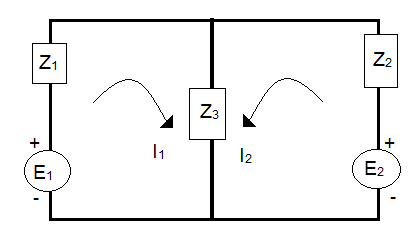
To see what it means, consider the following circuit consisting of impedances $Z_1$, $Z_2$ and $Z_3$; and voltage sources $E_1$ and $E_2$:
Now, we replace source $E_2$ first so that currents $I'_1$ and $I'_2$ flow through the two loops respectively then we will get the following circuit:
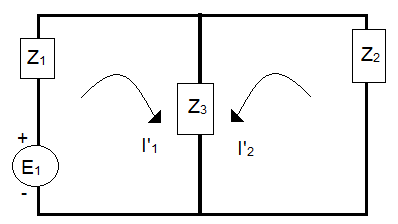
Here we have just connected a wire in place of the voltage source as the internal impedance of the source is negligible.
We can do the same thing by removing $E_1$ and going through the same analysis. The currents we get in that case would be $I''_1$ and $I''_2$.
The superposition theorem says that we must obtain the sum of the currents when the two sources are considered separately, to be equal to the current when the two sources are connected. So,
$I_1 = I'_1 + I''_1$ and $I_2 = I'_2 + I''_2$
are the currents flowing in the two elements when the two voltage sources are connected.
So, the correct answer is “Option A”.
Note:
We have marked here (in the diagrams) the currents flowing in the two adjacent loops. In complicated networks we usually consider loops instead of other elements as we can apply Kirchoff's laws for analysis easily.
Complete answer:
According to the superposition theorem, in a linear network, the current flowing in any element at a time is an algebraic sum of currents that would flow in that element by each potential source, while all other sources being replaced at the time being replaced by their internal impedances.
To see what it means, consider the following circuit consisting of impedances $Z_1$, $Z_2$ and $Z_3$; and voltage sources $E_1$ and $E_2$:
Now, we replace source $E_2$ first so that currents $I'_1$ and $I'_2$ flow through the two loops respectively then we will get the following circuit:
Here we have just connected a wire in place of the voltage source as the internal impedance of the source is negligible.
We can do the same thing by removing $E_1$ and going through the same analysis. The currents we get in that case would be $I''_1$ and $I''_2$.
The superposition theorem says that we must obtain the sum of the currents when the two sources are considered separately, to be equal to the current when the two sources are connected. So,
$I_1 = I'_1 + I''_1$ and $I_2 = I'_2 + I''_2$
are the currents flowing in the two elements when the two voltage sources are connected.
So, the correct answer is “Option A”.
Note:
We have marked here (in the diagrams) the currents flowing in the two adjacent loops. In complicated networks we usually consider loops instead of other elements as we can apply Kirchoff's laws for analysis easily.
Recently Updated Pages
Master Class 12 Economics: Engaging Questions & Answers for Success

Master Class 12 Physics: Engaging Questions & Answers for Success
Master Class 12 English: Engaging Questions & Answers for Success
Master Class 12 Social Science: Engaging Questions & Answers for Success
Master Class 12 Maths: Engaging Questions & Answers for Success
Master Class 12 Business Studies: Engaging Questions & Answers for Success
Trending doubts
Which are the Top 10 Largest Countries of the World?
What are the major means of transport Explain each class 12 social science CBSE
Draw a labelled sketch of the human eye class 12 physics CBSE
Why cannot DNA pass through cell membranes class 12 biology CBSE
Differentiate between insitu conservation and exsitu class 12 biology CBSE
Draw a neat and well labeled diagram of TS of ovary class 12 biology CBSE