




In any $\Delta ABC$ , prove that
${{\left( a-b \right)}^{2}}{{\cos }^{2}}\dfrac{C}{2}+{{\left( a+b\right)}^{2}}{{\sin}^{2}} \dfrac{C}{2} = {{c}^{2}}$
Answer
 Verified
614.4k+ views
Hint: Try to simplify the left-hand side of the equation given in the question by the application of the sine rule of a triangle followed by the use of the formula of sin2A and the formula of (sinX-sinY).
Complete step-by-step answer:
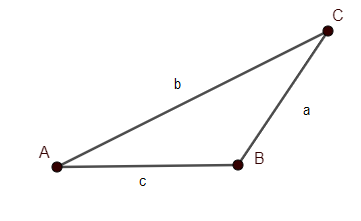
Before starting with the solution, let us draw a diagram for better visualisation.
Now starting with the left-hand side of the equation that is given in the question.
We know, according to the sine rule of the triangle: $\dfrac{a}{\sin A}=\dfrac{b}{\sin B}=\dfrac{c}{\sin C}=k$ and in other terms, it can be written as:
$\begin{align}
& a=k\sin A \\
& b=k\sin B \\
& c=k\sin C \\
\end{align}$
So, applying this to our expression, we get
${{\left( a-b \right)}^{2}}{{\cos }^{2}}\dfrac{C}{2}+{{\left( a+b \right)}^{2}}{{\sin }^{2}}\dfrac{C}{2}$
$={{\left( k\operatorname{sinA}-k\sin B \right)}^{2}}{{\cos }^{2}}\dfrac{C}{2}+{{\left( k\sin A+k\sin B \right)}^{2}}{{\sin }^{2}}\dfrac{C}{2}$
Now we will take ${{k}^{2}}$ common from each term. On doing so, we get
$={{k}^{2}}{{\left( \operatorname{sinA}-\sin B \right)}^{2}}{{\cos }^{2}}\dfrac{C}{2}+{{k}^{2}}{{\left( \sin A+\sin B \right)}^{2}}{{\sin }^{2}}\dfrac{C}{2}$
According to the formula: $2\sin \left( \dfrac{X-Y}{2} \right)\cos \left( \dfrac{X+Y}{2} \right)=\sin \left( X \right)-sin\left( Y \right)$ , we get
$=4{{k}^{2}}si{{n}^{2}}\left( \dfrac{A-B}{2} \right)co{{s}^{2}}\left( \dfrac{A+B}{2} \right){{\cos }^{2}}\dfrac{C}{2}+{{k}^{2}}{{\left( \sin A+\sin B \right)}^{2}}{{\sin }^{2}}\dfrac{C}{2}$
Now according to the formula: $2\sin \left( \dfrac{X+Y}{2} \right)\cos \left( \dfrac{X-Y}{2} \right)=\sin \left( X \right)+sin\left( Y \right)$ , we get
$=4{{k}^{2}}si{{n}^{2}}\left( \dfrac{A-B}{2} \right)co{{s}^{2}}\left( \dfrac{A+B}{2} \right){{\cos }^{2}}\dfrac{C}{2}+4{{k}^{2}}{{\cos }^{2}}\left( \dfrac{A-B}{2} \right)si{{n}^{2}}\left( \dfrac{A+B}{2} \right){{\sin }^{2}}\dfrac{C}{2}$
Now as ABC is a triangle, we can say:
$\angle A+\angle B+\angle C=180{}^\circ $
$\Rightarrow \angle A+\angle B=180{}^\circ -\angle C$
So, substituting the value of A+B in our expression. On doing so, we get
$=4{{k}^{2}}si{{n}^{2}}\left( \dfrac{A-B}{2} \right)co{{s}^{2}}\left( 90{}^\circ -\dfrac{C}{2} \right){{\cos }^{2}}\dfrac{C}{2}+4{{k}^{2}}{{\cos }^{2}}\left( \dfrac{A-B}{2} \right)si{{n}^{2}}\left( 90{}^\circ -\dfrac{C}{2} \right){{\sin }^{2}}\dfrac{C}{2}$
We know $\sin \left( 90{}^\circ -X \right)=\cos X$ and $\cos \left( 90{}^\circ -X \right)=\sin X$ . Using this in our expression, we get
$=4{{k}^{2}}si{{n}^{2}}\left( \dfrac{A-B}{2} \right)si{{n}^{2}}\dfrac{C}{2}{{\cos }^{2}}\dfrac{C}{2}+4{{k}^{2}}{{\cos }^{2}}\left( \dfrac{A-B}{2} \right)co{{s}^{2}}\dfrac{C}{2}{{\sin }^{2}}\dfrac{C}{2}$
Now, when we use the formula $\sin 2X=2\operatorname{sinX}\operatorname{cosX}$ , we get
$={{k}^{2}}si{{n}^{2}}\left( \dfrac{A-B}{2} \right)si{{n}^{2}}C+{{k}^{2}}{{\cos }^{2}}\left( \dfrac{A-B}{2} \right){{\sin }^{2}}C$
Now using the sine rule we can say that $k\sin C=c$ .
$={{c}^{2}}si{{n}^{2}}\left( \dfrac{A-B}{2} \right)+{{c}^{2}}{{\cos }^{2}}\left( \dfrac{A-B}{2} \right)$
Now we know ${{\sin }^{2}}X+{{\cos }^{2}}X=1$ . So, our expression becomes:
$={{c}^{2}}\left( si{{n}^{2}}\left( \dfrac{A-B}{2} \right)+{{\cos }^{2}}\left( \dfrac{A-B}{2} \right) \right)$
$={{c}^{2}}$
The left-hand side of the equation given in the question is equal to the right-hand side of the equation. Hence, we can say that we have proved the equation given in the question.
Note: Be careful about the calculation and the signs while opening the brackets. Also, you need to learn the sine rule and the cosine rule as they are used very often. The k in the sine rule is twice the radius of the circumcircle of the triangle, i.e., sine rule can also be written as $\dfrac{a}{\sin A}=\dfrac{b}{\sin B}=\dfrac{c}{\sin C}=k=2R=\dfrac{abc}{2\Delta }$ , where $\Delta $ represents the area of the triangle.
Complete step-by-step answer:
Before starting with the solution, let us draw a diagram for better visualisation.
Now starting with the left-hand side of the equation that is given in the question.
We know, according to the sine rule of the triangle: $\dfrac{a}{\sin A}=\dfrac{b}{\sin B}=\dfrac{c}{\sin C}=k$ and in other terms, it can be written as:
$\begin{align}
& a=k\sin A \\
& b=k\sin B \\
& c=k\sin C \\
\end{align}$
So, applying this to our expression, we get
${{\left( a-b \right)}^{2}}{{\cos }^{2}}\dfrac{C}{2}+{{\left( a+b \right)}^{2}}{{\sin }^{2}}\dfrac{C}{2}$
$={{\left( k\operatorname{sinA}-k\sin B \right)}^{2}}{{\cos }^{2}}\dfrac{C}{2}+{{\left( k\sin A+k\sin B \right)}^{2}}{{\sin }^{2}}\dfrac{C}{2}$
Now we will take ${{k}^{2}}$ common from each term. On doing so, we get
$={{k}^{2}}{{\left( \operatorname{sinA}-\sin B \right)}^{2}}{{\cos }^{2}}\dfrac{C}{2}+{{k}^{2}}{{\left( \sin A+\sin B \right)}^{2}}{{\sin }^{2}}\dfrac{C}{2}$
According to the formula: $2\sin \left( \dfrac{X-Y}{2} \right)\cos \left( \dfrac{X+Y}{2} \right)=\sin \left( X \right)-sin\left( Y \right)$ , we get
$=4{{k}^{2}}si{{n}^{2}}\left( \dfrac{A-B}{2} \right)co{{s}^{2}}\left( \dfrac{A+B}{2} \right){{\cos }^{2}}\dfrac{C}{2}+{{k}^{2}}{{\left( \sin A+\sin B \right)}^{2}}{{\sin }^{2}}\dfrac{C}{2}$
Now according to the formula: $2\sin \left( \dfrac{X+Y}{2} \right)\cos \left( \dfrac{X-Y}{2} \right)=\sin \left( X \right)+sin\left( Y \right)$ , we get
$=4{{k}^{2}}si{{n}^{2}}\left( \dfrac{A-B}{2} \right)co{{s}^{2}}\left( \dfrac{A+B}{2} \right){{\cos }^{2}}\dfrac{C}{2}+4{{k}^{2}}{{\cos }^{2}}\left( \dfrac{A-B}{2} \right)si{{n}^{2}}\left( \dfrac{A+B}{2} \right){{\sin }^{2}}\dfrac{C}{2}$
Now as ABC is a triangle, we can say:
$\angle A+\angle B+\angle C=180{}^\circ $
$\Rightarrow \angle A+\angle B=180{}^\circ -\angle C$
So, substituting the value of A+B in our expression. On doing so, we get
$=4{{k}^{2}}si{{n}^{2}}\left( \dfrac{A-B}{2} \right)co{{s}^{2}}\left( 90{}^\circ -\dfrac{C}{2} \right){{\cos }^{2}}\dfrac{C}{2}+4{{k}^{2}}{{\cos }^{2}}\left( \dfrac{A-B}{2} \right)si{{n}^{2}}\left( 90{}^\circ -\dfrac{C}{2} \right){{\sin }^{2}}\dfrac{C}{2}$
We know $\sin \left( 90{}^\circ -X \right)=\cos X$ and $\cos \left( 90{}^\circ -X \right)=\sin X$ . Using this in our expression, we get
$=4{{k}^{2}}si{{n}^{2}}\left( \dfrac{A-B}{2} \right)si{{n}^{2}}\dfrac{C}{2}{{\cos }^{2}}\dfrac{C}{2}+4{{k}^{2}}{{\cos }^{2}}\left( \dfrac{A-B}{2} \right)co{{s}^{2}}\dfrac{C}{2}{{\sin }^{2}}\dfrac{C}{2}$
Now, when we use the formula $\sin 2X=2\operatorname{sinX}\operatorname{cosX}$ , we get
$={{k}^{2}}si{{n}^{2}}\left( \dfrac{A-B}{2} \right)si{{n}^{2}}C+{{k}^{2}}{{\cos }^{2}}\left( \dfrac{A-B}{2} \right){{\sin }^{2}}C$
Now using the sine rule we can say that $k\sin C=c$ .
$={{c}^{2}}si{{n}^{2}}\left( \dfrac{A-B}{2} \right)+{{c}^{2}}{{\cos }^{2}}\left( \dfrac{A-B}{2} \right)$
Now we know ${{\sin }^{2}}X+{{\cos }^{2}}X=1$ . So, our expression becomes:
$={{c}^{2}}\left( si{{n}^{2}}\left( \dfrac{A-B}{2} \right)+{{\cos }^{2}}\left( \dfrac{A-B}{2} \right) \right)$
$={{c}^{2}}$
The left-hand side of the equation given in the question is equal to the right-hand side of the equation. Hence, we can say that we have proved the equation given in the question.
Note: Be careful about the calculation and the signs while opening the brackets. Also, you need to learn the sine rule and the cosine rule as they are used very often. The k in the sine rule is twice the radius of the circumcircle of the triangle, i.e., sine rule can also be written as $\dfrac{a}{\sin A}=\dfrac{b}{\sin B}=\dfrac{c}{\sin C}=k=2R=\dfrac{abc}{2\Delta }$ , where $\Delta $ represents the area of the triangle.
Recently Updated Pages
Master Class 12 Economics: Engaging Questions & Answers for Success

Master Class 12 Physics: Engaging Questions & Answers for Success
Master Class 12 English: Engaging Questions & Answers for Success
Master Class 12 Social Science: Engaging Questions & Answers for Success
Master Class 12 Maths: Engaging Questions & Answers for Success
Master Class 12 Business Studies: Engaging Questions & Answers for Success
Trending doubts
Why cannot DNA pass through cell membranes class 12 biology CBSE
Draw a neat and well labeled diagram of TS of ovary class 12 biology CBSE
In a human foetus the limbs and digits develop after class 12 biology CBSE
AABbCc genotype forms how many types of gametes a 4 class 12 biology CBSE
Differentiate between homogeneous and heterogeneous class 12 chemistry CBSE
The correct structure of ethylenediaminetetraacetic class 12 chemistry CBSE