




In any $\Delta ABC$ , prove that
$\dfrac{b-c}{b+c}=\dfrac{\tan \left( \dfrac{B-C}{2} \right)}{\tan \left( \dfrac{B+C}{2} \right)}$
Answer
 Verified
624.9k+ views
Hint: Try to simplify the left-hand side of the equation given in the question by the application of the sine rule of a triangle followed by the use of the formula of (sinA+sinB) and the formula of (sinA-sinB).
Complete step-by-step answer:
Before starting with the solution, let us draw a diagram for better visualisation.
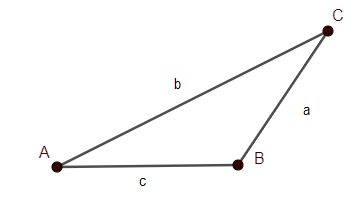
Now starting with the left-hand side of the equation that is given in the question.
We know, according to the sine rule of the triangle: $\dfrac{a}{\sin A}=\dfrac{b}{\sin B}=\dfrac{c}{\sin C}=k$ and in other terms, it can be written as:
$\begin{align}
& a=k\sin A \\
& b=k\sin B \\
& c=k\sin C \\
\end{align}$
So, applying this to our expression, we get
$\dfrac{b-c}{b+c}$
$=\dfrac{k\sin B-k\sin C}{k\sin B+k\sin C}$
Now we will take $k$ common from all the terms. On doing so, we get
$\dfrac{\left( \sin B-\sin C \right)}{\left( \sin B+\sin C \right)}$
Now we know that $\operatorname{sinB}-\operatorname{sinC}=2\cos \left( \dfrac{C+B}{2} \right)\sin \left( \dfrac{B-C}{2} \right)$ . On using this in our expression, we get
$\dfrac{2\cos \left( \dfrac{C+B}{2} \right)\sin \left( \dfrac{B-C}{2} \right)}{\left( \sin B+\sin C \right)}$
We also know that $\operatorname{sinB}+\operatorname{sinC}=2\sin \left( \dfrac{C+B}{2} \right)\cos \left( \dfrac{B-C}{2} \right)$ . On using this in our expression, we get
$\dfrac{\cos \left( \dfrac{C+B}{2} \right)\sin \left( \dfrac{B-C}{2} \right)}{\sin \left( \dfrac{C+B}{2} \right)\cos \left( \dfrac{B-C}{2} \right)}$
Now to reach the answer, let’s arrange the above expression according to our need.
$\dfrac{\cos \left( \dfrac{C+B}{2} \right)}{\sin \left( \dfrac{C+B}{2} \right)}\times \dfrac{sin\left( \dfrac{B-C}{2} \right)}{\cos \left( \dfrac{B-C}{2} \right)}$
$=\dfrac{\cos \left( \dfrac{C+B}{2} \right)}{\sin \left( \dfrac{C+B}{2} \right)}\times \dfrac{1}{\dfrac{\cos \left( \dfrac{B-C}{2} \right)}{\sin \left( \dfrac{B-C}{2} \right)}}$
Now we know that $\dfrac{\sin X}{\cos X}=\tan X$ . So, we can write our expression as
$tan\left( \dfrac{C+B}{2} \right)\times \dfrac{1}{\tan \left( \dfrac{B-C}{2} \right)}$
$=\dfrac{\tan \left( \dfrac{B+C}{2} \right)}{\tan \left( \dfrac{B-C}{2} \right)}$
The left-hand side of the equation given in the question is equal to the right-hand side of the equation. Hence, we can say that we have proved the equation given in the question.
Note: Be careful about the calculation and the signs while opening the brackets. Also, you need to learn the sine rule and the cosine rule as they are used very often. The k in the sine rule is twice the radius of the circumcircle of the triangle, i.e., sine rule can also be written as $\dfrac{a}{\sin A}=\dfrac{b}{\sin B}=\dfrac{c}{\sin C}=k=2R=\dfrac{abc}{2\Delta }$ , where $\Delta $ represents the area of the triangle. Alternately, you can solve the above question using Napier’s analogy, according to which $\tan \dfrac{B-C}{2}$ is equal to $\dfrac{b-c}{b+c}\cot \dfrac{A}{2}$.
Complete step-by-step answer:
Before starting with the solution, let us draw a diagram for better visualisation.
Now starting with the left-hand side of the equation that is given in the question.
We know, according to the sine rule of the triangle: $\dfrac{a}{\sin A}=\dfrac{b}{\sin B}=\dfrac{c}{\sin C}=k$ and in other terms, it can be written as:
$\begin{align}
& a=k\sin A \\
& b=k\sin B \\
& c=k\sin C \\
\end{align}$
So, applying this to our expression, we get
$\dfrac{b-c}{b+c}$
$=\dfrac{k\sin B-k\sin C}{k\sin B+k\sin C}$
Now we will take $k$ common from all the terms. On doing so, we get
$\dfrac{\left( \sin B-\sin C \right)}{\left( \sin B+\sin C \right)}$
Now we know that $\operatorname{sinB}-\operatorname{sinC}=2\cos \left( \dfrac{C+B}{2} \right)\sin \left( \dfrac{B-C}{2} \right)$ . On using this in our expression, we get
$\dfrac{2\cos \left( \dfrac{C+B}{2} \right)\sin \left( \dfrac{B-C}{2} \right)}{\left( \sin B+\sin C \right)}$
We also know that $\operatorname{sinB}+\operatorname{sinC}=2\sin \left( \dfrac{C+B}{2} \right)\cos \left( \dfrac{B-C}{2} \right)$ . On using this in our expression, we get
$\dfrac{\cos \left( \dfrac{C+B}{2} \right)\sin \left( \dfrac{B-C}{2} \right)}{\sin \left( \dfrac{C+B}{2} \right)\cos \left( \dfrac{B-C}{2} \right)}$
Now to reach the answer, let’s arrange the above expression according to our need.
$\dfrac{\cos \left( \dfrac{C+B}{2} \right)}{\sin \left( \dfrac{C+B}{2} \right)}\times \dfrac{sin\left( \dfrac{B-C}{2} \right)}{\cos \left( \dfrac{B-C}{2} \right)}$
$=\dfrac{\cos \left( \dfrac{C+B}{2} \right)}{\sin \left( \dfrac{C+B}{2} \right)}\times \dfrac{1}{\dfrac{\cos \left( \dfrac{B-C}{2} \right)}{\sin \left( \dfrac{B-C}{2} \right)}}$
Now we know that $\dfrac{\sin X}{\cos X}=\tan X$ . So, we can write our expression as
$tan\left( \dfrac{C+B}{2} \right)\times \dfrac{1}{\tan \left( \dfrac{B-C}{2} \right)}$
$=\dfrac{\tan \left( \dfrac{B+C}{2} \right)}{\tan \left( \dfrac{B-C}{2} \right)}$
The left-hand side of the equation given in the question is equal to the right-hand side of the equation. Hence, we can say that we have proved the equation given in the question.
Note: Be careful about the calculation and the signs while opening the brackets. Also, you need to learn the sine rule and the cosine rule as they are used very often. The k in the sine rule is twice the radius of the circumcircle of the triangle, i.e., sine rule can also be written as $\dfrac{a}{\sin A}=\dfrac{b}{\sin B}=\dfrac{c}{\sin C}=k=2R=\dfrac{abc}{2\Delta }$ , where $\Delta $ represents the area of the triangle. Alternately, you can solve the above question using Napier’s analogy, according to which $\tan \dfrac{B-C}{2}$ is equal to $\dfrac{b-c}{b+c}\cot \dfrac{A}{2}$.
Recently Updated Pages
Basicity of sulphurous acid and sulphuric acid are

Master Class 12 English: Engaging Questions & Answers for Success
Master Class 12 Social Science: Engaging Questions & Answers for Success
Master Class 12 Maths: Engaging Questions & Answers for Success
Master Class 12 Economics: Engaging Questions & Answers for Success
Master Class 12 Physics: Engaging Questions & Answers for Success
Trending doubts
Which are the Top 10 Largest Countries of the World?
Draw a labelled sketch of the human eye class 12 physics CBSE
Which country did Danny Casey play for class 12 english CBSE
Give 10 examples of unisexual and bisexual flowers
Coming together federation is practiced in A India class 12 social science CBSE
Write the formula to find the shortest distance between class 12 maths CBSE