




In Antirrhinum (dog flower), the phenotypic ratio in ${{F}_{2}}$ generation for the inheritance of flower colour would be
(a) 3:1
(b) 1:2:1
(c) 1:1
(d) 2:1
Answer
 Verified
615.3k+ views
Hint: The ratio occurs in incomplete dominance where no factor of a gene is dominant causes a blend of dominant and recessive traits. The result of phenotype in ${{F}_{2}}$ is due to neither of the alleles being fully dominant over the recessive allele.
Complete answer:
The Antirrhinum shows incomplete dominance where the dominant allele form of a gene does not completely mask the effects of recessive alleles. Thus the flower of Antirrhinum blending of both alleles. It is also called semi dominance or partial dominance.
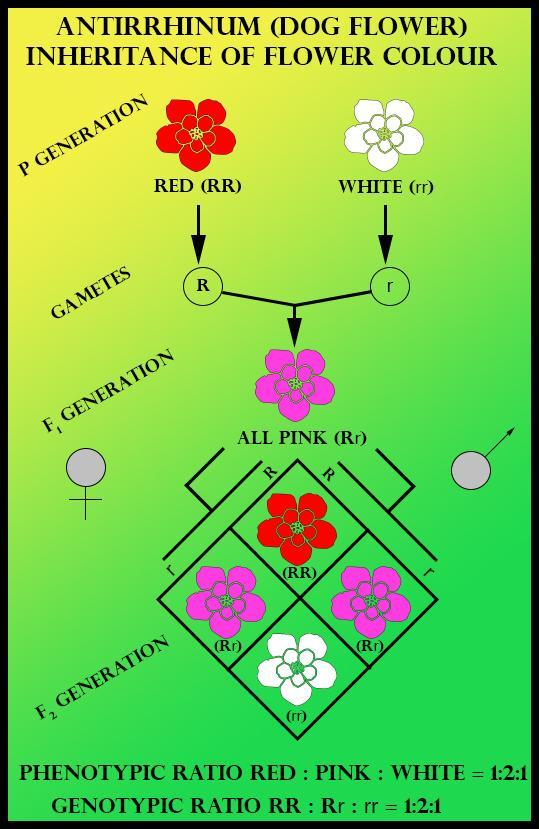
- The monohybrid cross between red and white dog flower where the allele that produces the red colour (R) is not completely expressed over the allele that produces the white flower causes offspring are all pink.
- When the red flower of genotype RR is crossed with white flower rr produces all pink colours offspring of genotype Rr in ${{F}_{1}}$ generation.
- The first filial generation consisting of all pink phenotypes is allowed to cross, where the resulting plants are second filial ${{F}_{2}}$ consist of three phenotypes.
One red cloud flower
Two pink colour flower
One white colour flower.
So, the correct answer is, ‘1:2:1.’
Note:
- When the ${{F}_{1}}$ generation is allowed to cross- pollinate with true- breeding red colours flower plants than the resulting ${{F}_{2}}$ generation plants consists of half red and half pink coloured phenotype flower.
- When the ${{F}_{1}}$ generation is allowed to cross- pollinate with true- breeding white colour flower plants than the resulting ${{F}_{2}}$ generation plants consist of half red and half pink coloured phenotype flower.
Complete answer:
The Antirrhinum shows incomplete dominance where the dominant allele form of a gene does not completely mask the effects of recessive alleles. Thus the flower of Antirrhinum blending of both alleles. It is also called semi dominance or partial dominance.
- The monohybrid cross between red and white dog flower where the allele that produces the red colour (R) is not completely expressed over the allele that produces the white flower causes offspring are all pink.
- When the red flower of genotype RR is crossed with white flower rr produces all pink colours offspring of genotype Rr in ${{F}_{1}}$ generation.
- The first filial generation consisting of all pink phenotypes is allowed to cross, where the resulting plants are second filial ${{F}_{2}}$ consist of three phenotypes.
One red cloud flower
Two pink colour flower
One white colour flower.
So, the correct answer is, ‘1:2:1.’
Note:
- When the ${{F}_{1}}$ generation is allowed to cross- pollinate with true- breeding red colours flower plants than the resulting ${{F}_{2}}$ generation plants consists of half red and half pink coloured phenotype flower.
- When the ${{F}_{1}}$ generation is allowed to cross- pollinate with true- breeding white colour flower plants than the resulting ${{F}_{2}}$ generation plants consist of half red and half pink coloured phenotype flower.
Recently Updated Pages
Master Class 12 Business Studies: Engaging Questions & Answers for Success

Master Class 12 Biology: Engaging Questions & Answers for Success
Master Class 12 Chemistry: Engaging Questions & Answers for Success
Class 12 Question and Answer - Your Ultimate Solutions Guide
Master Class 11 Social Science: Engaging Questions & Answers for Success
Master Class 11 English: Engaging Questions & Answers for Success
Trending doubts
Which is more stable and why class 12 chemistry CBSE
Which are the Top 10 Largest Countries of the World?
Draw a labelled sketch of the human eye class 12 physics CBSE
Differentiate between homogeneous and heterogeneous class 12 chemistry CBSE
What are the major means of transport Explain each class 12 social science CBSE
Sulphuric acid is known as the king of acids State class 12 chemistry CBSE