




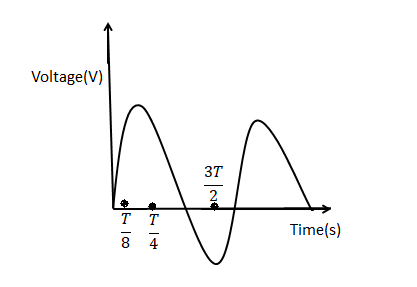
In an RL Series circuit, sinusoidal voltage \[v = {v_0}\;sin\;\omega t\] is applied. it is given that \[\dfrac{T}{2}\], \[R = 11\;\Omega \], \[{V_{rms}} = 220{\text{ V}}\], \[\dfrac{\omega }{{2\pi }}\; = 50{\text{ Hz}}\] and \[\pi = \dfrac{{22}}{7}\]. Obtain the phase difference between the current and voltage and find the amplitude of current in the steady state. Plot the variation of current for one cycle on the given graph.
Answer
 Verified
626.1k+ views
Hint:A $LR$ Circuit consists of an inductor of inductance $L$ connected in series with a resistor of resistance $R$. First find the inductive reactance then find the maximum current flowing in the circuit. In the above waveform, time period is given as $2\pi $.Then from data obtained we can plot the variation of current for one cycle on the given graph.
Formula used:
\[{X_L} = \omega L\]
${I_{rms}} = \dfrac{{{V_{rms}}}}{{\sqrt {{R^2} + {X^2}} }}$
${I_{\max }} = {I_{rms}} \times \sqrt 2 $
Where ${X_L}$ is the inductive reactance, $R$ is the resistance, ${I_{\max }}$ is the maximum current,${I_{rms}}$ is the root mean square current.
Complete step by step answer:
$LR$ circuit consists of a resistor of resistance $R$ connected in series with an inductor $L$ .${V_R}$ is equal to $IR$ due to the voltage drop across the resistor. Hence it will have the same exponential shape and growth as the current. Just like $RC$ and $LCR$ circuit, RL circuit will also consume energy.
The current and voltage are in the same phase and the phase angle difference between current and voltage is zero, in case of resistors. The current and the voltage are not in phase. The current lags voltage by ${90^ \circ }$. As seen before the phase angle between voltage and current is zero in case of pure resistance circuit and phase angle${90^ \circ }$ in case of pure inductive circuit. But when we combine both resistance and inductor, $LR$ circuit phase angle is between ${0^ \circ }$to${90^ \circ }$.
\[{X_L} = \omega L\]$ = 2\pi \times 50 \times 35 \times {10^{ - 3}} = 11\Omega $
$\left( {1mH = 1 \times {{10}^{ - 3}}H} \right)$
${I_{rms}} = \dfrac{{{V_{rms}}}}{{\sqrt {{R^2} + {X^2}} }}$
${I_{rms}} = \dfrac{{220}}{{\sqrt {\left( {{{11}^2} + {{11}^2}} \right)} }} = $${I_{rms}} = \dfrac{{220}}{{\sqrt {\left( {{{11}^2} + {{11}^2}} \right)} }} = \dfrac{{20}}{{\sqrt 2 }}A$
Then the maximum current is given by
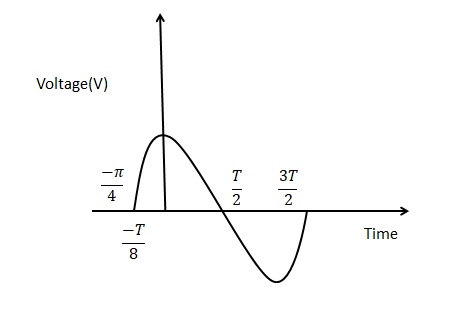
${I_{\max }} = {I_{rms}} \times \sqrt 2 = \dfrac{{20}}{{\sqrt 2 }} \times \sqrt 2 = 20A$
$\tan \phi = \dfrac{{{X_L}}}{R} = \dfrac{1}{1} = 1$
Therefore, the value of $\phi $ is $\dfrac{\pi }{4}$
Then the sinusoidal current equation is given by
$I = {I_{\max }}\sin \left( {\omega t + \phi } \right) = 20\sin \left( {\omega t + \dfrac{\pi }{4}} \right)$
Note:A $LR$ Circuit consists of an inductor of inductance $L$ connected in series with a resistor of resistance $R$. The impedance of $LR$ circuit opposes the flow of alternating current. The flow of alternating current opposed by the impedance of $LR$ circuit. $LR$ circuit phase angle is between ${0^ \circ }$ to ${90^ \circ }$. Just like $RC$ and $LCR$ circuit, $LR$ circuit will also consume energy.
Formula used:
\[{X_L} = \omega L\]
${I_{rms}} = \dfrac{{{V_{rms}}}}{{\sqrt {{R^2} + {X^2}} }}$
${I_{\max }} = {I_{rms}} \times \sqrt 2 $
Where ${X_L}$ is the inductive reactance, $R$ is the resistance, ${I_{\max }}$ is the maximum current,${I_{rms}}$ is the root mean square current.
Complete step by step answer:
$LR$ circuit consists of a resistor of resistance $R$ connected in series with an inductor $L$ .${V_R}$ is equal to $IR$ due to the voltage drop across the resistor. Hence it will have the same exponential shape and growth as the current. Just like $RC$ and $LCR$ circuit, RL circuit will also consume energy.
The current and voltage are in the same phase and the phase angle difference between current and voltage is zero, in case of resistors. The current and the voltage are not in phase. The current lags voltage by ${90^ \circ }$. As seen before the phase angle between voltage and current is zero in case of pure resistance circuit and phase angle${90^ \circ }$ in case of pure inductive circuit. But when we combine both resistance and inductor, $LR$ circuit phase angle is between ${0^ \circ }$to${90^ \circ }$.
\[{X_L} = \omega L\]$ = 2\pi \times 50 \times 35 \times {10^{ - 3}} = 11\Omega $
$\left( {1mH = 1 \times {{10}^{ - 3}}H} \right)$
${I_{rms}} = \dfrac{{{V_{rms}}}}{{\sqrt {{R^2} + {X^2}} }}$
${I_{rms}} = \dfrac{{220}}{{\sqrt {\left( {{{11}^2} + {{11}^2}} \right)} }} = $${I_{rms}} = \dfrac{{220}}{{\sqrt {\left( {{{11}^2} + {{11}^2}} \right)} }} = \dfrac{{20}}{{\sqrt 2 }}A$
Then the maximum current is given by
${I_{\max }} = {I_{rms}} \times \sqrt 2 = \dfrac{{20}}{{\sqrt 2 }} \times \sqrt 2 = 20A$
$\tan \phi = \dfrac{{{X_L}}}{R} = \dfrac{1}{1} = 1$
Therefore, the value of $\phi $ is $\dfrac{\pi }{4}$
Then the sinusoidal current equation is given by
$I = {I_{\max }}\sin \left( {\omega t + \phi } \right) = 20\sin \left( {\omega t + \dfrac{\pi }{4}} \right)$
Note:A $LR$ Circuit consists of an inductor of inductance $L$ connected in series with a resistor of resistance $R$. The impedance of $LR$ circuit opposes the flow of alternating current. The flow of alternating current opposed by the impedance of $LR$ circuit. $LR$ circuit phase angle is between ${0^ \circ }$ to ${90^ \circ }$. Just like $RC$ and $LCR$ circuit, $LR$ circuit will also consume energy.
Recently Updated Pages
Basicity of sulphurous acid and sulphuric acid are

Master Class 12 Economics: Engaging Questions & Answers for Success
Master Class 12 Biology: Engaging Questions & Answers for Success
Master Class 11 English: Engaging Questions & Answers for Success
Master Class 11 Physics: Engaging Questions & Answers for Success
Master Class 11 Computer Science: Engaging Questions & Answers for Success
Trending doubts
Draw a labelled sketch of the human eye class 12 physics CBSE
The chemical formula of tear gas is A CO Cl 2 B C 10 class 12 chemistry CBSE
Draw ray diagrams each showing i myopic eye and ii class 12 physics CBSE
Which are the Top 10 Largest Countries of the World?
Differentiate between homogeneous and heterogeneous class 12 chemistry CBSE
Which is the correct genotypic ratio of mendel dihybrid class 12 biology CBSE