




In an LCR circuit the potential difference between the terminals of the inductance is \[60V\], between the terminals of the capacitor is \[30V\] and that between the terminals of resistance is \[40V\]. The supply voltage will be:
A) $25V$
B) $50V$
C) $100V$
D) $200V$
Answer
 Verified
646.5k+ views
Hint:Inductance opposes the change in the current and serves to delay the decrease or increase of current in the circuit. This causes the circuit current to lag behind the applied voltage in an inductive circuit. Capacitance opposes the change in voltage and serves to delay the increase or decrease of voltage across the capacitor. This causes the voltage to lag behind the current in a capacitive circuit.
Complete step by step answer:
Consider a circuit containing an inductor, capacitor and resistor connected in series across an alternating source of voltage $V$ or emf $\varepsilon $ .
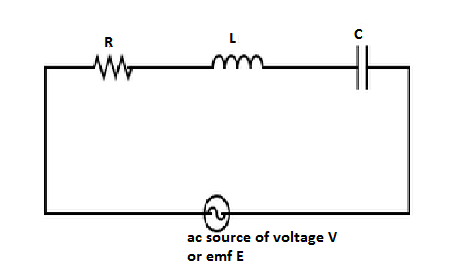
Let the source supplies a sinusoidal voltage which is given by,
$V = {V_0}\sin \omega t$
Where, ${V_0}$ is the peak value of voltage $\omega $ is the angular frequency and $t$ is the time period.
Let q be the charge on the capacitor and $I$ be the current in the circuit at any instant of time $t$.
Let ${V_R},{V_L},{V_C}$ represent the voltage across the resistor, inductor and capacitor respectively.
Then, voltage across resistor, ${V_R} = {i_0}R$
Voltage across inductor, ${V_L} = {i_0}{X_L}$
Voltage across capacitor, ${V_C} = {i_0}{X_C}$
Where, ${i_0}$ is the peak value of current, ${X_C}$ is capacitive reactance, ${X_L}$ is the inductive reactance and $R$ is the resistance of the resistor.
Then net voltage or emf is given by,$V$ or$\varepsilon = \sqrt {\left( {{V_R}^2 + {{\left( {{V_L} - {V_C}} \right)}^2}} \right)} $ …………….(1)
Given, potential difference across inductor,${V_L} = 60V$
Potential difference across capacitor,${V_C} = 30V$
Potential difference across resistor,${V_R} = 40V$
Now substitute these values in equation (1), we get
$\varepsilon = \sqrt {\left( {{{40}^2} + {{\left( {60 - 30} \right)}^2}} \right)} $
$ \rightarrow \varepsilon = \sqrt {\left( {1600 + 900} \right)} = 50V$
$\therefore $ The supply voltage will be 50V
Thus, the correct option is (B).
Additional information:
The main difference between a direct current and an alternating current is;
A direct current always flows in one direction in the circuit. However, an alternating current flows periodically in an alternate direction in the circuit.
A direct current has a constant value whereas the value of alternating current varies from instant to instant.
Note:Opposition offered by an inductor for the flow of ac is called ‘inductive reactance’.
An alternating voltage is one whose magnitude changes with time and direction changes periodically.
Frequency of direct current is zero. That is direct current is independent of frequency.
Complete step by step answer:
Consider a circuit containing an inductor, capacitor and resistor connected in series across an alternating source of voltage $V$ or emf $\varepsilon $ .
Let the source supplies a sinusoidal voltage which is given by,
$V = {V_0}\sin \omega t$
Where, ${V_0}$ is the peak value of voltage $\omega $ is the angular frequency and $t$ is the time period.
Let q be the charge on the capacitor and $I$ be the current in the circuit at any instant of time $t$.
Let ${V_R},{V_L},{V_C}$ represent the voltage across the resistor, inductor and capacitor respectively.
Then, voltage across resistor, ${V_R} = {i_0}R$
Voltage across inductor, ${V_L} = {i_0}{X_L}$
Voltage across capacitor, ${V_C} = {i_0}{X_C}$
Where, ${i_0}$ is the peak value of current, ${X_C}$ is capacitive reactance, ${X_L}$ is the inductive reactance and $R$ is the resistance of the resistor.
Then net voltage or emf is given by,$V$ or$\varepsilon = \sqrt {\left( {{V_R}^2 + {{\left( {{V_L} - {V_C}} \right)}^2}} \right)} $ …………….(1)
Given, potential difference across inductor,${V_L} = 60V$
Potential difference across capacitor,${V_C} = 30V$
Potential difference across resistor,${V_R} = 40V$
Now substitute these values in equation (1), we get
$\varepsilon = \sqrt {\left( {{{40}^2} + {{\left( {60 - 30} \right)}^2}} \right)} $
$ \rightarrow \varepsilon = \sqrt {\left( {1600 + 900} \right)} = 50V$
$\therefore $ The supply voltage will be 50V
Thus, the correct option is (B).
Additional information:
The main difference between a direct current and an alternating current is;
A direct current always flows in one direction in the circuit. However, an alternating current flows periodically in an alternate direction in the circuit.
A direct current has a constant value whereas the value of alternating current varies from instant to instant.
Note:Opposition offered by an inductor for the flow of ac is called ‘inductive reactance’.
An alternating voltage is one whose magnitude changes with time and direction changes periodically.
Frequency of direct current is zero. That is direct current is independent of frequency.
Recently Updated Pages
Explain the structure of megasporangium class 12 biology CBSE

Why is chloroform kept in dark coloured bottles class 12 chemistry CBSE
Derive the balancing condition of a Wheatstone bri class 12 physics CBSE
Draw VI characteristics of a pn junction diode Explain class 12 physics CBSE
Is it possible to carry pride in ones language too class 12 english CBSE
In a population at Hardy Weinberg equilibrium the allele class 12 biology CBSE
Trending doubts
Draw a labelled sketch of the human eye class 12 physics CBSE
Which are the Top 10 Largest Countries of the World?
Draw ray diagrams each showing i myopic eye and ii class 12 physics CBSE
Which is the correct genotypic ratio of mendel dihybrid class 12 biology CBSE
Differentiate between homogeneous and heterogeneous class 12 chemistry CBSE
Which animal never drinks water in its entire life class 12 biology CBSE