




In an LC circuit the capacitor has maximum charge ${q_0}$. The value of the ${\left( {\dfrac{{di}}{{dt}}} \right)_{\max }}$ is:
A. $\dfrac{{{q_0}}}{{LC}}$
B. $\dfrac{{{q_0}}}{{\sqrt {LC} }}$
C. $\dfrac{{{q_0}}}{{LC}} - 1$
D. $\dfrac{{{q_0}}}{{LC}} + 1$
Answer
 Verified
618.9k+ views
Hint: to solve the above question we should know the equation for the charge. The general equation for the charge is \[q = {q_0}\cos \omega t\], where ${q_0}$ is the maximum charge that will flow through the circuit and $\omega $ is frequency and $t$ is the time.
Complete answer:
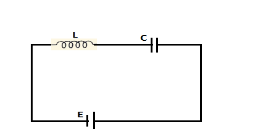
Here in the question a LC circuit is given. LC circuit is an electrical circuit consisting of an inductor, represented by the letter L, and a capacitor, represented by the letter C, connected together.
so, we will prepare a typical LC circuit as shown below,
Firstly, we will write the equation of the charge as follows,
\[q = {q_0}\cos \omega t\]
The differentiation of the charge will give us the current,
So current, $i = \dfrac{{dq}}{{dt}} = \dfrac{d}{{dt}}\left( {{q_0}\cos \omega t} \right)$
$ \Rightarrow i = {q_0}\dfrac{d}{{dt}}\left( {\cos \omega t} \right)$
$ \Rightarrow i = {q_0}\sin \omega t \times \omega $
$ \Rightarrow i = {q_0}\omega \sin \omega t$------equation (1)
Since we have got the equation for the current, so now we can calculate the $\left( {\dfrac{{di}}{{dt}}} \right)$ by differentiating the above equation as follows,
$\left( {\dfrac{{di}}{{dt}}} \right) = \dfrac{d}{{dt}}\left( {{q_0}\omega \sin \omega t} \right)$
$ \Rightarrow \left( {\dfrac{{di}}{{dt}}} \right) = {q_0}\omega \dfrac{d}{{dt}}\left( {\sin \omega t} \right)$
$ \Rightarrow \left( {\dfrac{{di}}{{dt}}} \right) = {q_0}\omega \cos \omega t \times \omega $
$ \Rightarrow \left( {\dfrac{{di}}{{dt}}} \right) = {q_0}{\omega ^2}\cos \omega t$
Now for this value to be maximum we should take the maximum value of the $\cos \omega t$.
So, the maximum value of the $\cos \omega t$ is 1. So, putting this value in the above equation we get the maximum value of the $\left( {\dfrac{{di}}{{dt}}} \right)$,
So, ${\left( {\dfrac{{di}}{{dt}}} \right)_{\max }} = {q_0}{\omega ^2} \times 1$
$ \Rightarrow {\left( {\dfrac{{di}}{{dt}}} \right)_{\max }} = {q_0}{\omega ^2}$------equation (2)
Now we also know that the value of the $\omega $is $\dfrac{1}{{\sqrt {LC} }}$, i.e. $\omega = \dfrac{1}{{\sqrt {LC} }}$.
So, putting this value of the $\omega $in the equation (2), we get
$ \Rightarrow {\left( {\dfrac{{di}}{{dt}}} \right)_{\max }} = {q_0}{\left( {\dfrac{1}{{\sqrt {LC} }}} \right)^2}$
$ \Rightarrow {\left( {\dfrac{{di}}{{dt}}} \right)_{\max }} = \dfrac{{{q_0}}}{{LC}}$
Hence, the value of the ${\left( {\dfrac{{di}}{{dt}}} \right)_{\max }}$ is $\dfrac{{{q_0}}}{{LC}}$.
So, the correct answer is “Option A”.
Note:
The LC circuit can be used as an electrical resonator and an analogue of a tuning fork and also used for storing the energy oscillating at the circuit’s resonant frequency. This is the reason the LC circuit is sometimes called a resonant circuit, tank circuit, or tuned circuit. A LC circuit is assuming to be loss free and assumes that there is no loss of the energy due to the resistance. But in practical it is not possible that the resistance is zero. The LC circuit is usually oscillating with the minimal damping, so the resistance is made as low as possible.
Complete answer:
Here in the question a LC circuit is given. LC circuit is an electrical circuit consisting of an inductor, represented by the letter L, and a capacitor, represented by the letter C, connected together.
so, we will prepare a typical LC circuit as shown below,
Firstly, we will write the equation of the charge as follows,
\[q = {q_0}\cos \omega t\]
The differentiation of the charge will give us the current,
So current, $i = \dfrac{{dq}}{{dt}} = \dfrac{d}{{dt}}\left( {{q_0}\cos \omega t} \right)$
$ \Rightarrow i = {q_0}\dfrac{d}{{dt}}\left( {\cos \omega t} \right)$
$ \Rightarrow i = {q_0}\sin \omega t \times \omega $
$ \Rightarrow i = {q_0}\omega \sin \omega t$------equation (1)
Since we have got the equation for the current, so now we can calculate the $\left( {\dfrac{{di}}{{dt}}} \right)$ by differentiating the above equation as follows,
$\left( {\dfrac{{di}}{{dt}}} \right) = \dfrac{d}{{dt}}\left( {{q_0}\omega \sin \omega t} \right)$
$ \Rightarrow \left( {\dfrac{{di}}{{dt}}} \right) = {q_0}\omega \dfrac{d}{{dt}}\left( {\sin \omega t} \right)$
$ \Rightarrow \left( {\dfrac{{di}}{{dt}}} \right) = {q_0}\omega \cos \omega t \times \omega $
$ \Rightarrow \left( {\dfrac{{di}}{{dt}}} \right) = {q_0}{\omega ^2}\cos \omega t$
Now for this value to be maximum we should take the maximum value of the $\cos \omega t$.
So, the maximum value of the $\cos \omega t$ is 1. So, putting this value in the above equation we get the maximum value of the $\left( {\dfrac{{di}}{{dt}}} \right)$,
So, ${\left( {\dfrac{{di}}{{dt}}} \right)_{\max }} = {q_0}{\omega ^2} \times 1$
$ \Rightarrow {\left( {\dfrac{{di}}{{dt}}} \right)_{\max }} = {q_0}{\omega ^2}$------equation (2)
Now we also know that the value of the $\omega $is $\dfrac{1}{{\sqrt {LC} }}$, i.e. $\omega = \dfrac{1}{{\sqrt {LC} }}$.
So, putting this value of the $\omega $in the equation (2), we get
$ \Rightarrow {\left( {\dfrac{{di}}{{dt}}} \right)_{\max }} = {q_0}{\left( {\dfrac{1}{{\sqrt {LC} }}} \right)^2}$
$ \Rightarrow {\left( {\dfrac{{di}}{{dt}}} \right)_{\max }} = \dfrac{{{q_0}}}{{LC}}$
Hence, the value of the ${\left( {\dfrac{{di}}{{dt}}} \right)_{\max }}$ is $\dfrac{{{q_0}}}{{LC}}$.
So, the correct answer is “Option A”.
Note:
The LC circuit can be used as an electrical resonator and an analogue of a tuning fork and also used for storing the energy oscillating at the circuit’s resonant frequency. This is the reason the LC circuit is sometimes called a resonant circuit, tank circuit, or tuned circuit. A LC circuit is assuming to be loss free and assumes that there is no loss of the energy due to the resistance. But in practical it is not possible that the resistance is zero. The LC circuit is usually oscillating with the minimal damping, so the resistance is made as low as possible.
Recently Updated Pages
Master Class 12 Economics: Engaging Questions & Answers for Success

Master Class 12 English: Engaging Questions & Answers for Success
Master Class 12 Social Science: Engaging Questions & Answers for Success
Master Class 12 Maths: Engaging Questions & Answers for Success
Master Class 12 Physics: Engaging Questions & Answers for Success
Master Class 9 General Knowledge: Engaging Questions & Answers for Success
Trending doubts
Which are the Top 10 Largest Countries of the World?
Draw a labelled sketch of the human eye class 12 physics CBSE
Differentiate between homogeneous and heterogeneous class 12 chemistry CBSE
Sulphuric acid is known as the king of acids State class 12 chemistry CBSE
Why is the cell called the structural and functional class 12 biology CBSE
Draw ray diagrams each showing i myopic eye and ii class 12 physics CBSE