




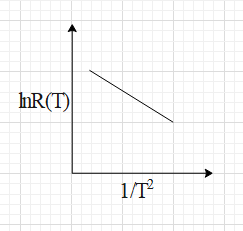
In an experiment, the resistance of a material is plotted as a function of temperature (in some range). As shown in the figure, it is a straight line. One may conclude that:
A. $R(T)=\dfrac{{{T}_{0}}}{{{T}^{2}}}$
B. $R(T)={{\operatorname{R}}_{0}}{{e}^{\dfrac{-{{T}^{2}}}{T_{0}^{2}}}}$
C. $R(T)={{\operatorname{R}}_{0}}{{e}^{\dfrac{-T_{0}^{2}}{{{T}^{2}}}}}$
D. $R(T)={{\operatorname{R}}_{0}}{{e}^{\dfrac{{{T}^{2}}}{T_{0}^{2}}}}$
Answer
 Verified
586.2k+ views
Hint: Let us define some values of the temperature and resistance to help us in our calculations. Also we can see some extra terms or variables used in the options. check for which one we get a negative slope and positive constant.
Complete step by step answer:
In the given graph we can see that the x-axis represents a function of temperature T , i.e. $\dfrac{1}{{{T}^{2}}}$ and the y-axis represents a function of resistance R, i.e. $\ln R$.
The given graph represents a straight line and we know that the equation of a straight line can be written in the form $y=mx+c$ …... (i).
In this case, $y=\ln R$ and $x=\dfrac{1}{T_{0}^{2}}$.
m is the slope of the line and c is the y intercept.
Let x coordinate $\dfrac{1}{{{T}^{2}}}=0$, the y coordinate be $\ln {{R}_{0}}$. This means that the y intercept of the line is $c=\ln {{R}_{0}}$.
Let y coordinate $\ln R=0$, the x coordinate be $\dfrac{1}{T_{0}^{2}}$. This means that the x intercept of the line is $x=\dfrac{1}{T_{0}^{2}}$.
This can be depicted in the graph shown below.
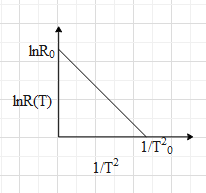
From the figure we get that slope $m=\dfrac{\ln {{R}_{0}}-0}{0-\dfrac{1}{T_{0}^{2}}}=-T_{0}^{2}\ln {{R}_{0}}$.
Substitute the values of x, y, m and c in equation (i).
$\Rightarrow \ln R=\left( -T_{0}^{2}\ln {{R}_{0}} \right)\dfrac{1}{{{T}^{2}}}+\ln {{R}_{0}}$
$\Rightarrow \ln R=\ln {{R}_{0}}\left( 1-\dfrac{T_{0}^{2}}{{{T}^{2}}} \right)$
$\Rightarrow {{e}^{\ln R}}={{e}^{\ln {{R}_{0}}\left( 1-\dfrac{T_{0}^{2}}{{{T}^{2}}} \right)}}$
$\Rightarrow R={{e}^{\ln {{R}_{0}}}}.{{e}^{\left( 1-\dfrac{T_{0}^{2}}{{{T}^{2}}} \right)}}$
$\Rightarrow R={{R}_{0}}{{e}^{\left( 1-\dfrac{T_{0}^{2}}{{{T}^{2}}} \right)}}$
$\Rightarrow R=({{R}_{0}}e){{e}^{\left( \dfrac{-T_{0}^{2}}{{{T}^{2}}} \right)}}$
So, the correct answer is “Option C”.
Note:
Note that the constant that we defined and the constants used in the options are not the same. Therefore, it is not necessary that the equation in the solution and the option must be the same.
We can also check the correct option by the log to the base e on both sides of each and write in the form of the equation of a straight line. Then check for which one we get a negative slope and positive constant.
Complete step by step answer:
In the given graph we can see that the x-axis represents a function of temperature T , i.e. $\dfrac{1}{{{T}^{2}}}$ and the y-axis represents a function of resistance R, i.e. $\ln R$.
The given graph represents a straight line and we know that the equation of a straight line can be written in the form $y=mx+c$ …... (i).
In this case, $y=\ln R$ and $x=\dfrac{1}{T_{0}^{2}}$.
m is the slope of the line and c is the y intercept.
Let x coordinate $\dfrac{1}{{{T}^{2}}}=0$, the y coordinate be $\ln {{R}_{0}}$. This means that the y intercept of the line is $c=\ln {{R}_{0}}$.
Let y coordinate $\ln R=0$, the x coordinate be $\dfrac{1}{T_{0}^{2}}$. This means that the x intercept of the line is $x=\dfrac{1}{T_{0}^{2}}$.
This can be depicted in the graph shown below.
From the figure we get that slope $m=\dfrac{\ln {{R}_{0}}-0}{0-\dfrac{1}{T_{0}^{2}}}=-T_{0}^{2}\ln {{R}_{0}}$.
Substitute the values of x, y, m and c in equation (i).
$\Rightarrow \ln R=\left( -T_{0}^{2}\ln {{R}_{0}} \right)\dfrac{1}{{{T}^{2}}}+\ln {{R}_{0}}$
$\Rightarrow \ln R=\ln {{R}_{0}}\left( 1-\dfrac{T_{0}^{2}}{{{T}^{2}}} \right)$
$\Rightarrow {{e}^{\ln R}}={{e}^{\ln {{R}_{0}}\left( 1-\dfrac{T_{0}^{2}}{{{T}^{2}}} \right)}}$
$\Rightarrow R={{e}^{\ln {{R}_{0}}}}.{{e}^{\left( 1-\dfrac{T_{0}^{2}}{{{T}^{2}}} \right)}}$
$\Rightarrow R={{R}_{0}}{{e}^{\left( 1-\dfrac{T_{0}^{2}}{{{T}^{2}}} \right)}}$
$\Rightarrow R=({{R}_{0}}e){{e}^{\left( \dfrac{-T_{0}^{2}}{{{T}^{2}}} \right)}}$
So, the correct answer is “Option C”.
Note:
Note that the constant that we defined and the constants used in the options are not the same. Therefore, it is not necessary that the equation in the solution and the option must be the same.
We can also check the correct option by the log to the base e on both sides of each and write in the form of the equation of a straight line. Then check for which one we get a negative slope and positive constant.
Recently Updated Pages
Master Class 12 Social Science: Engaging Questions & Answers for Success

Master Class 12 Physics: Engaging Questions & Answers for Success
Master Class 12 Maths: Engaging Questions & Answers for Success
Master Class 12 Economics: Engaging Questions & Answers for Success
Master Class 12 Chemistry: Engaging Questions & Answers for Success
Master Class 12 Business Studies: Engaging Questions & Answers for Success
Trending doubts
Which are the Top 10 Largest Countries of the World?
Draw a labelled sketch of the human eye class 12 physics CBSE
Explain the structure of megasporangium class 12 biology CBSE
What are the major means of transport Explain each class 12 social science CBSE
How many chromosomes are found in human ovum a 46 b class 12 biology CBSE
The diagram of the section of a maize grain is given class 12 biology CBSE