




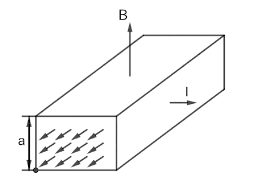
In an electromagnetic pump designed for transferring molten metals a pipe section with metal is located in a uniform magnetic field of induction $ B $ (figure shown above). A current $ I $ is made to flow across this pipe section in the direction perpendicular both to the vector $ \vec{B} $ and to the axis of the pipe. The gauge pressure produced by the pump is $ B=0.10T $ , $ I=100A $ , and $ a=2.0cm $ is $ \dfrac{1}{x}kPa $ . Find $ x $ .
Answer
 Verified
533.4k+ views
Hint :For the pressure produced by the pump, we can calculate the area from the given dimensions and the force acts on the molten metal because it passes through a uniform magnetic field.
Complete Step By Step Answer:
Let us note down the given data;
Magnitude of the magnetic field $ B=0.10T $
Current flowing through the cross section $ I=100A $
Height of the section $ a=2.0cm $
Length of the block perpendicular to the direction of magnetic field and parallel to the direction of current $ l=? $
Gauge pressure produced by pump $ P=\dfrac{1}{x}kPa $
For an object placed in a uniform magnetic field with its axis making an angle with the magnetic field, if a current is applied across the object in any direction, a force acts on the object which can be expressed as,
$ \vec{F}=I(\vec{l}\times \vec{B}) $
Here, for the given case, we are concerned with the magnitude of the force only, and the length of the object perpendicular to magnetic field, which is given by,
$ F=IlB $
For the particular case, this force acting per unit area of the cross section is responsible for the gauge pressure.
The area of the cross section is given as,
$ A=la $
Now, the gauge pressure is equal to the force acting per unit area, which is mathematically shown as,
$ P=\dfrac{F}{A} $
Substituting the derived equations,
$ \therefore P=\dfrac{IlB}{la} $
Canceling the common factor,
$ \therefore P=\dfrac{IB}{a} $
Substituting the given values,
$ \therefore P=\dfrac{100A\times 0.10T}{2.0cm} $
Converting the values to SI unit,
$ \therefore P=\dfrac{100A\times 0.10T}{2.0\times {{10}^{-2}}m} $
Without considering the units,
$ \therefore P=\dfrac{100\times 0.10}{2.0\times {{10}^{-2}}} $
Writing all the powers together,
$ \therefore P=\dfrac{1}{2}\times {{10}^{2}}\times {{10}^{-1}}\times {{10}^{2}} $
$ \therefore P=\dfrac{1}{2}\times {{10}^{3}}Pa $
We know that, $ 1kPa=1000Pa $
$ \therefore P=\dfrac{1}{2}kPa $
Comparing this value with the given value, we get
$ x=2 $.
Note :
Here, the force acts on the object due to its orientation. If the object was arranged in such a way, that the length through which the current passes is parallel to the magnetic field, then no force acts on the object.
Complete Step By Step Answer:
Let us note down the given data;
Magnitude of the magnetic field $ B=0.10T $
Current flowing through the cross section $ I=100A $
Height of the section $ a=2.0cm $
Length of the block perpendicular to the direction of magnetic field and parallel to the direction of current $ l=? $
Gauge pressure produced by pump $ P=\dfrac{1}{x}kPa $
For an object placed in a uniform magnetic field with its axis making an angle with the magnetic field, if a current is applied across the object in any direction, a force acts on the object which can be expressed as,
$ \vec{F}=I(\vec{l}\times \vec{B}) $
Here, for the given case, we are concerned with the magnitude of the force only, and the length of the object perpendicular to magnetic field, which is given by,
$ F=IlB $
For the particular case, this force acting per unit area of the cross section is responsible for the gauge pressure.
The area of the cross section is given as,
$ A=la $
Now, the gauge pressure is equal to the force acting per unit area, which is mathematically shown as,
$ P=\dfrac{F}{A} $
Substituting the derived equations,
$ \therefore P=\dfrac{IlB}{la} $
Canceling the common factor,
$ \therefore P=\dfrac{IB}{a} $
Substituting the given values,
$ \therefore P=\dfrac{100A\times 0.10T}{2.0cm} $
Converting the values to SI unit,
$ \therefore P=\dfrac{100A\times 0.10T}{2.0\times {{10}^{-2}}m} $
Without considering the units,
$ \therefore P=\dfrac{100\times 0.10}{2.0\times {{10}^{-2}}} $
Writing all the powers together,
$ \therefore P=\dfrac{1}{2}\times {{10}^{2}}\times {{10}^{-1}}\times {{10}^{2}} $
$ \therefore P=\dfrac{1}{2}\times {{10}^{3}}Pa $
We know that, $ 1kPa=1000Pa $
$ \therefore P=\dfrac{1}{2}kPa $
Comparing this value with the given value, we get
$ x=2 $.
Note :
Here, the force acts on the object due to its orientation. If the object was arranged in such a way, that the length through which the current passes is parallel to the magnetic field, then no force acts on the object.
Recently Updated Pages
Master Class 12 Economics: Engaging Questions & Answers for Success

Master Class 12 Physics: Engaging Questions & Answers for Success
Master Class 12 English: Engaging Questions & Answers for Success
Master Class 12 Social Science: Engaging Questions & Answers for Success
Master Class 12 Maths: Engaging Questions & Answers for Success
Master Class 12 Business Studies: Engaging Questions & Answers for Success
Trending doubts
Which are the Top 10 Largest Countries of the World?
What are the major means of transport Explain each class 12 social science CBSE
Draw a labelled sketch of the human eye class 12 physics CBSE
Why cannot DNA pass through cell membranes class 12 biology CBSE
Differentiate between insitu conservation and exsitu class 12 biology CBSE
Draw a neat and well labeled diagram of TS of ovary class 12 biology CBSE