




In a Young’s double slit experiment, the slits are placed 0.320 mm apart. Light of wavelength $\lambda = 500nm$ is incident on the slits. The total number of bright fringes that are observed in the angular range $ - {30^ \circ } \leqslant \theta \leqslant {30^ \circ }$ is:
A. 320
B. 641
C. 321
D. 640
Answer
 Verified
638.4k+ views
Hint – In the Young’s double slit experiment, the path difference is given by the formula, $d\sin \theta = n\lambda $ , where d is the distance between the slits, n is the number of maxima and theta is the angle.
Formula used - $d\sin \theta = n\lambda $
Complete step-by-step answer:
We have been given that in Young’s double slit experiment, the slits are placed 0.320 mm apart.
Also, the wavelength of light is 500 nm, and angular range is $ - {30^ \circ } \leqslant \theta \leqslant {30^ \circ }$
So, we know that the path difference is given by the formula-
$d\sin \theta = n\lambda $
So, according to question, $d = 0.320mm,\sin \theta = \sin {30^ \circ },\lambda = 500nm$
Putting these values, we can find the value of n, which is the number of maxima.
\[
d\sin \theta = n\lambda \\
\Rightarrow n = \dfrac{{d\sin \theta }}{\lambda } \\
\Rightarrow n = \dfrac{{0.32 \times {{10}^{ - 3}}\sin {{30}^ \circ }}}{{500 \times {{10}^{ - 9}}}} = \dfrac{{0.32 \times {{10}^{ - 3}} \times \dfrac{1}{2}}}{{500 \times {{10}^{ - 9}}}} = \dfrac{{0.32 \times {{10}^6}}}{{500 \times 2}} = 320 \\
\]
Now this value of n represents the no. of maxima which are for angle 30 degrees and formed above.
So, the same number of maxima will form below also and one fringe will form in the centre.
Refer the figure below for better understanding-
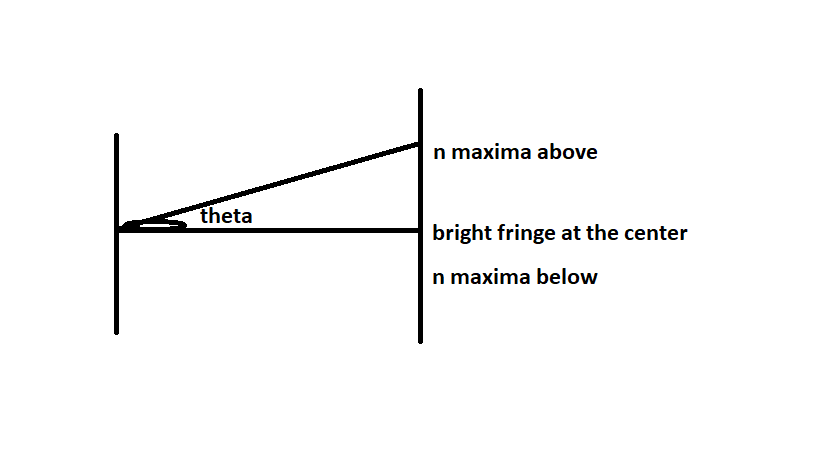
So, total number of maxima $ = n + 1 + n = 320 + 1 + 320 = 641$
Hence, the correct option is B.
Note – Whenever such types of questions appear, then always write the things given in the question and then as mentioned in the solution, use the formula for path difference to find the value of maxima. Also, draw a figure to understand in a better way. So, the total number of maxima is the number of maxima above + number of maxima at the centre + number of maxima below.
Formula used - $d\sin \theta = n\lambda $
Complete step-by-step answer:
We have been given that in Young’s double slit experiment, the slits are placed 0.320 mm apart.
Also, the wavelength of light is 500 nm, and angular range is $ - {30^ \circ } \leqslant \theta \leqslant {30^ \circ }$
So, we know that the path difference is given by the formula-
$d\sin \theta = n\lambda $
So, according to question, $d = 0.320mm,\sin \theta = \sin {30^ \circ },\lambda = 500nm$
Putting these values, we can find the value of n, which is the number of maxima.
\[
d\sin \theta = n\lambda \\
\Rightarrow n = \dfrac{{d\sin \theta }}{\lambda } \\
\Rightarrow n = \dfrac{{0.32 \times {{10}^{ - 3}}\sin {{30}^ \circ }}}{{500 \times {{10}^{ - 9}}}} = \dfrac{{0.32 \times {{10}^{ - 3}} \times \dfrac{1}{2}}}{{500 \times {{10}^{ - 9}}}} = \dfrac{{0.32 \times {{10}^6}}}{{500 \times 2}} = 320 \\
\]
Now this value of n represents the no. of maxima which are for angle 30 degrees and formed above.
So, the same number of maxima will form below also and one fringe will form in the centre.
Refer the figure below for better understanding-
So, total number of maxima $ = n + 1 + n = 320 + 1 + 320 = 641$
Hence, the correct option is B.
Note – Whenever such types of questions appear, then always write the things given in the question and then as mentioned in the solution, use the formula for path difference to find the value of maxima. Also, draw a figure to understand in a better way. So, the total number of maxima is the number of maxima above + number of maxima at the centre + number of maxima below.
Recently Updated Pages
Master Class 12 Economics: Engaging Questions & Answers for Success

Master Class 12 English: Engaging Questions & Answers for Success
Master Class 12 Social Science: Engaging Questions & Answers for Success
Master Class 12 Maths: Engaging Questions & Answers for Success
Master Class 12 Physics: Engaging Questions & Answers for Success
Master Class 12 Business Studies: Engaging Questions & Answers for Success
Trending doubts
Which are the Top 10 Largest Countries of the World?
Draw a labelled sketch of the human eye class 12 physics CBSE
Differentiate between homogeneous and heterogeneous class 12 chemistry CBSE
Why is the cell called the structural and functional class 12 biology CBSE
Draw ray diagrams each showing i myopic eye and ii class 12 physics CBSE
Which is the correct genotypic ratio of mendel dihybrid class 12 biology CBSE