




In a three-dimensional co-ordinate system (XYZ), a concave mirror of radius of curvature 40cm it is placed at x=80cm. An object placed at origin in is given a velocity $\mathop {{v_0}}\limits^ \to (9\mathop i\limits^ \wedge + 6\mathop j\limits^ \wedge + 3\mathop k\limits^ \wedge )\,cm/s$. Find out the magnitude of velocity of its image.
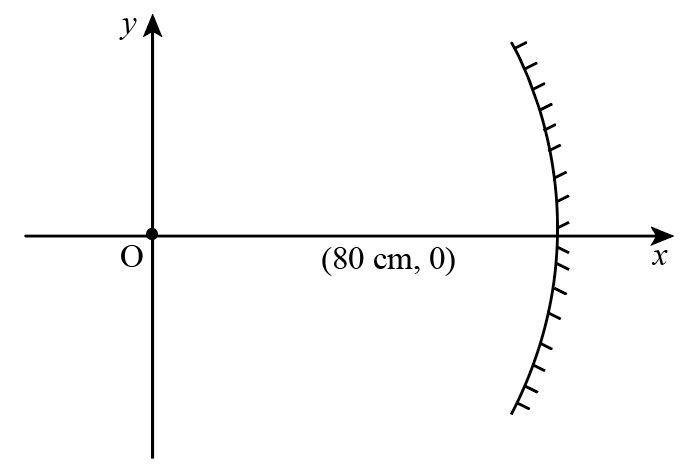
Answer
 Verified
576k+ views
Hint: This question is from the topic of ray optics. In this question we have to find the velocity of the image of a moving object for this we will have to use calculus operations in the relation between the object distance and the image distance. The object and the image distance relation which we have to use is the mirror formula.
Complete step by step answer:
The Mirror formula which we have to use to calculate the relation between the object distance and the image distance is given as follows
$\dfrac{1}{u} + \dfrac{1}{v} = \dfrac{1}{f}$, where u is the object distance, v is the image distance and f is the focal length of the mirror. Also, all the values of u, v and f are to be put with proper sign convention.
We are not given the focal length but we have been given the radius of curvature of the mirror. We will use this to find the focal length of the mirror. The relation between the focal length and the radius of curvature is:
$f = \dfrac{R}{2}$
Putting the value of Radius of curvature above in place of R, we get:
$\begin{array}{l}
f = \dfrac{R}{2}\\
\Rightarrow f = \dfrac{{40}}{2}\\
\Rightarrow f = 20cm\\
{\rm{with sign convention, }}f = - 20cm
\end{array}$
Now we have the value of the focal length of the mirror.
The object distance, $u = - 80cm$
Now we have the focal length and also the object distance. Now we have all the things which we need to calculate the velocity of the image.
For this we will differentiate the mirror formula with respect to time t, because when displacement is differentiated with time it gives the value of velocity.
Differentiating,
$\begin{array}{l}
\dfrac{d}{{dt}}\left( {\dfrac{1}{u}} \right) + \dfrac{d}{{dt}}\left( {\dfrac{1}{v}} \right) = \dfrac{d}{{dt}}\left( {\dfrac{1}{f}} \right)\\
\Rightarrow - \dfrac{1}{{{u^2}}}\dfrac{{du}}{{dt}} - \dfrac{1}{{{v^2}}}\dfrac{{dv}}{{dt}} = 0\\
\Rightarrow - \dfrac{1}{{{u^2}}}\dfrac{{du}}{{dt}} = \dfrac{1}{{{v^2}}}\dfrac{{dv}}{{dt}}\\
\Rightarrow \dfrac{{dv}}{{dt}} = - \dfrac{{{v^2}}}{{{u^2}}}\dfrac{{du}}{{dt}}\\
\Rightarrow \dfrac{{dv}}{{dt}} = - {\left( {\dfrac{v}{u}} \right)^2}\dfrac{{du}}{{dt}}
\end{array}$
In the above relation, $\dfrac{{du}}{{dt}}$ is velocity of the object which is given in the question, u and v are object distance and image distance respectively, and $\dfrac{{dv}}{{dt}}$ is the velocity of the image.
Now in the above derived relation, there is v, the image distance, and we do not have that value. Hence, we will try to make it in the form of u and f, because we have those values. For this we will use the mirror formula.
$\begin{array}{l}
\dfrac{1}{u} + \dfrac{1}{v} = \dfrac{1}{f}\\
{\rm{multiplying both sides with u}}\\
\Rightarrow \dfrac{u}{u} + \dfrac{u}{v} = \dfrac{u}{f}\\
\Rightarrow 1 + \dfrac{u}{v} = \dfrac{u}{f}\\
\Rightarrow \dfrac{u}{v} = \dfrac{u}{f} - 1\\
\Rightarrow \dfrac{u}{v} = \dfrac{{u - f}}{f}\\
\Rightarrow \dfrac{v}{u} = \dfrac{f}{{u - f}}
\end{array}$
Hence, we will put this value of $\dfrac{v}{u}$ and all the given values in the formula we derived.
\[\begin{array}{l}
\dfrac{{dv}}{{dt}} = - {\left( {\dfrac{v}{u}} \right)^2}\dfrac{{du}}{{dt}}\\
\Rightarrow \dfrac{{dv}}{{dt}} = - {\left( {\dfrac{f}{{u - f}}} \right)^2}\dfrac{{du}}{{dt}}\\
\Rightarrow \dfrac{{dv}}{{dt}} = - {\left( {\dfrac{{ - 20}}{{ - 80 - \left( { - 20} \right)}}} \right)^2}\left( {9\mathop i\limits^ \wedge + 6\mathop j\limits^ \wedge + 3\mathop k\limits^ \wedge } \right)\\
\Rightarrow \dfrac{{dv}}{{dt}} = - {\left( {\dfrac{{ - 20}}{{ - 60}}} \right)^2}\left( {9\mathop i\limits^ \wedge + 6\mathop j\limits^ \wedge + 3\mathop k\limits^ \wedge } \right)\\
\Rightarrow \dfrac{{dv}}{{dt}} = - {\left( {\dfrac{1}{3}} \right)^2}\left( {9\mathop i\limits^ \wedge + 6\mathop j\limits^ \wedge + 3\mathop k\limits^ \wedge } \right)\\
\Rightarrow \dfrac{{dv}}{{dt}} = - \dfrac{1}{9}\left( {9\mathop i\limits^ \wedge + 6\mathop j\limits^ \wedge + 3\mathop k\limits^ \wedge } \right)\\
\Rightarrow \dfrac{{dv}}{{dt}} = - \dfrac{1}{3}\left( {3\mathop i\limits^ \wedge + 2\mathop j\limits^ \wedge + \mathop k\limits^ \wedge } \right)cm/s
\end{array}\]
Hence, we have found the speed of the image in vector form, if we calculate its magnitude, it will be:
$\begin{array}{l}
\left| {\dfrac{{dv}}{{dt}}} \right| = \sqrt {{{\left( {\dfrac{3}{3}} \right)}^2} + {{\left( {\dfrac{2}{3}} \right)}^2} + {{\left( {\dfrac{1}{3}} \right)}^2}} \\
\Rightarrow \left| {\dfrac{{dv}}{{dt}}} \right| = \sqrt {\dfrac{9}{9} + \dfrac{4}{9} + \dfrac{1}{9}} \\
\Rightarrow \left| {\dfrac{{dv}}{{dt}}} \right| = \dfrac{1}{3}\sqrt {14} \\
\Rightarrow \left| {\dfrac{{dv}}{{dt}}} \right| = \dfrac{{\sqrt {14} }}{3}\,cm/s
\end{array}$
Hence, we have finally calculated the velocity of the image in vector form and also its magnitude.
So, the correct answer is “Option B”.
Note:
Above question was based on calculus operations on the Standard mirror formula. This kind of questions are considered to be relatively difficult. We had to differentiate the mirror formula to get the relation between velocities of the image and the object. Also, the velocity of the object is given in vector form, so students must find the magnitude of the velocity of the image as it is mentioned in the question as the required answer.
Complete step by step answer:
The Mirror formula which we have to use to calculate the relation between the object distance and the image distance is given as follows
$\dfrac{1}{u} + \dfrac{1}{v} = \dfrac{1}{f}$, where u is the object distance, v is the image distance and f is the focal length of the mirror. Also, all the values of u, v and f are to be put with proper sign convention.
We are not given the focal length but we have been given the radius of curvature of the mirror. We will use this to find the focal length of the mirror. The relation between the focal length and the radius of curvature is:
$f = \dfrac{R}{2}$
Putting the value of Radius of curvature above in place of R, we get:
$\begin{array}{l}
f = \dfrac{R}{2}\\
\Rightarrow f = \dfrac{{40}}{2}\\
\Rightarrow f = 20cm\\
{\rm{with sign convention, }}f = - 20cm
\end{array}$
Now we have the value of the focal length of the mirror.
The object distance, $u = - 80cm$
Now we have the focal length and also the object distance. Now we have all the things which we need to calculate the velocity of the image.
For this we will differentiate the mirror formula with respect to time t, because when displacement is differentiated with time it gives the value of velocity.
Differentiating,
$\begin{array}{l}
\dfrac{d}{{dt}}\left( {\dfrac{1}{u}} \right) + \dfrac{d}{{dt}}\left( {\dfrac{1}{v}} \right) = \dfrac{d}{{dt}}\left( {\dfrac{1}{f}} \right)\\
\Rightarrow - \dfrac{1}{{{u^2}}}\dfrac{{du}}{{dt}} - \dfrac{1}{{{v^2}}}\dfrac{{dv}}{{dt}} = 0\\
\Rightarrow - \dfrac{1}{{{u^2}}}\dfrac{{du}}{{dt}} = \dfrac{1}{{{v^2}}}\dfrac{{dv}}{{dt}}\\
\Rightarrow \dfrac{{dv}}{{dt}} = - \dfrac{{{v^2}}}{{{u^2}}}\dfrac{{du}}{{dt}}\\
\Rightarrow \dfrac{{dv}}{{dt}} = - {\left( {\dfrac{v}{u}} \right)^2}\dfrac{{du}}{{dt}}
\end{array}$
In the above relation, $\dfrac{{du}}{{dt}}$ is velocity of the object which is given in the question, u and v are object distance and image distance respectively, and $\dfrac{{dv}}{{dt}}$ is the velocity of the image.
Now in the above derived relation, there is v, the image distance, and we do not have that value. Hence, we will try to make it in the form of u and f, because we have those values. For this we will use the mirror formula.
$\begin{array}{l}
\dfrac{1}{u} + \dfrac{1}{v} = \dfrac{1}{f}\\
{\rm{multiplying both sides with u}}\\
\Rightarrow \dfrac{u}{u} + \dfrac{u}{v} = \dfrac{u}{f}\\
\Rightarrow 1 + \dfrac{u}{v} = \dfrac{u}{f}\\
\Rightarrow \dfrac{u}{v} = \dfrac{u}{f} - 1\\
\Rightarrow \dfrac{u}{v} = \dfrac{{u - f}}{f}\\
\Rightarrow \dfrac{v}{u} = \dfrac{f}{{u - f}}
\end{array}$
Hence, we will put this value of $\dfrac{v}{u}$ and all the given values in the formula we derived.
\[\begin{array}{l}
\dfrac{{dv}}{{dt}} = - {\left( {\dfrac{v}{u}} \right)^2}\dfrac{{du}}{{dt}}\\
\Rightarrow \dfrac{{dv}}{{dt}} = - {\left( {\dfrac{f}{{u - f}}} \right)^2}\dfrac{{du}}{{dt}}\\
\Rightarrow \dfrac{{dv}}{{dt}} = - {\left( {\dfrac{{ - 20}}{{ - 80 - \left( { - 20} \right)}}} \right)^2}\left( {9\mathop i\limits^ \wedge + 6\mathop j\limits^ \wedge + 3\mathop k\limits^ \wedge } \right)\\
\Rightarrow \dfrac{{dv}}{{dt}} = - {\left( {\dfrac{{ - 20}}{{ - 60}}} \right)^2}\left( {9\mathop i\limits^ \wedge + 6\mathop j\limits^ \wedge + 3\mathop k\limits^ \wedge } \right)\\
\Rightarrow \dfrac{{dv}}{{dt}} = - {\left( {\dfrac{1}{3}} \right)^2}\left( {9\mathop i\limits^ \wedge + 6\mathop j\limits^ \wedge + 3\mathop k\limits^ \wedge } \right)\\
\Rightarrow \dfrac{{dv}}{{dt}} = - \dfrac{1}{9}\left( {9\mathop i\limits^ \wedge + 6\mathop j\limits^ \wedge + 3\mathop k\limits^ \wedge } \right)\\
\Rightarrow \dfrac{{dv}}{{dt}} = - \dfrac{1}{3}\left( {3\mathop i\limits^ \wedge + 2\mathop j\limits^ \wedge + \mathop k\limits^ \wedge } \right)cm/s
\end{array}\]
Hence, we have found the speed of the image in vector form, if we calculate its magnitude, it will be:
$\begin{array}{l}
\left| {\dfrac{{dv}}{{dt}}} \right| = \sqrt {{{\left( {\dfrac{3}{3}} \right)}^2} + {{\left( {\dfrac{2}{3}} \right)}^2} + {{\left( {\dfrac{1}{3}} \right)}^2}} \\
\Rightarrow \left| {\dfrac{{dv}}{{dt}}} \right| = \sqrt {\dfrac{9}{9} + \dfrac{4}{9} + \dfrac{1}{9}} \\
\Rightarrow \left| {\dfrac{{dv}}{{dt}}} \right| = \dfrac{1}{3}\sqrt {14} \\
\Rightarrow \left| {\dfrac{{dv}}{{dt}}} \right| = \dfrac{{\sqrt {14} }}{3}\,cm/s
\end{array}$
Hence, we have finally calculated the velocity of the image in vector form and also its magnitude.
So, the correct answer is “Option B”.
Note:
Above question was based on calculus operations on the Standard mirror formula. This kind of questions are considered to be relatively difficult. We had to differentiate the mirror formula to get the relation between velocities of the image and the object. Also, the velocity of the object is given in vector form, so students must find the magnitude of the velocity of the image as it is mentioned in the question as the required answer.
Recently Updated Pages
Master Class 12 Economics: Engaging Questions & Answers for Success

Master Class 12 Physics: Engaging Questions & Answers for Success
Master Class 12 English: Engaging Questions & Answers for Success
Master Class 12 Social Science: Engaging Questions & Answers for Success
Master Class 12 Maths: Engaging Questions & Answers for Success
Master Class 12 Business Studies: Engaging Questions & Answers for Success
Trending doubts
Which are the Top 10 Largest Countries of the World?
What are the major means of transport Explain each class 12 social science CBSE
Draw a labelled sketch of the human eye class 12 physics CBSE
Why cannot DNA pass through cell membranes class 12 biology CBSE
Differentiate between insitu conservation and exsitu class 12 biology CBSE
Draw a neat and well labeled diagram of TS of ovary class 12 biology CBSE