




In a thin spherical fish bowl of radius $10cm$ filled with water of refractive index $\dfrac{4}{3}$ there is a small fish at a distance of $4cm$ from the center $C$ as shown in figure. Where will the image of the fish appears, if seen from E
A. $5.2cm$
B. $7.2cm$
C. $4.2cm$
D. $3.2cm$
Answer
 Verified
633.6k+ views
Hint: here, we will consider the spherical fish bowl as a spherical surface in which the object is taken as fish. Here, there will be two mediums, one from which the image will be seen and the other in which the image will be made. Here, we will use the refraction formula of the spherical surface to calculate the distance of the image.
Formula used:
The formula of refraction of spherical surface is given by
$\dfrac{{{n_2}}}{v} - \dfrac{{{n_1}}}{u} = \dfrac{{{n_2} - {n_1}}}{R}$
Here, ${n_2}$ is the refractive index of the second medium, ${n_1}$ is the refractive index of the first medium, $v$ is the distance of the image from the mirror, $u$ is the distance of the object from the mirror and $R$ is the radius of the surface.
Complete step by step answer:
Consider a spherical fish bowl of radius $10cm$ filled with water as shown below
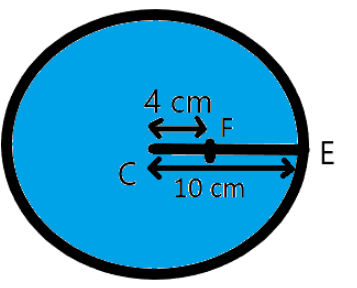
Here, $C$ is the center of the spherical bowl, $F$ is the position of fish which is $4cm$ away from the center and $E$ is the point from which we will see the image of the fish.
Here, the refractive index of water is $\dfrac{4}{3}$ . also let refractive index of air is $1$ .
Here, the distance of the fish from the center is, $ = 4cm$
Therefore, the distance of the fish from the surface, $u = 6cm$
Also, the radius of the bowl is, $R = 10cm$
Now, using the refraction formula at spherical surface which is given below
$\dfrac{{{n_2}}}{v} - \dfrac{{{n_1}}}{u} = \dfrac{{{n_2} - {n_1}}}{R}$
Here, ${n_2}$ is the refractive index of the air and ${n_1}$ is the refractive index of the water.
Putting the values in the above equation, we get
$\dfrac{1}{v} - \dfrac{{\dfrac{4}{3}}}{{ - 6}} = \dfrac{{1 - \dfrac{4}{3}}}{{ - 10}}$
$ \Rightarrow \,\dfrac{1}{v} + \dfrac{4}{{18}} = \dfrac{{\dfrac{{ - 1}}{3}}}{{10}}$
$ \Rightarrow \,\dfrac{1}{v} = \dfrac{1}{{30}} - \dfrac{4}{{18}}$
$ \Rightarrow \,\dfrac{1}{v} = \dfrac{{3 - 20}}{{90}}$
$ \Rightarrow \,\dfrac{1}{v} = \dfrac{{ - 17}}{{90}}$
$ \Rightarrow \,v = \dfrac{{ - 90}}{{17}} = - 5.2$
Taking magnitude, we get
$\therefore v = 5.2cm$
Therefore, the image will be at a distance of $5.2cm$ from the point $E$ .
Hence, option A is the correct option.
Note:Here we have taken two surfaces, because the image will be formed in the water and it will be seen in the air. Also, we have taken the distance of image and the radius as negative, because we have taken these values in the negative X-direction (if we take the point $E$ as origin). Also, we got the answer in the negative, which means that we will get an image somewhere in the negative X-direction.
Formula used:
The formula of refraction of spherical surface is given by
$\dfrac{{{n_2}}}{v} - \dfrac{{{n_1}}}{u} = \dfrac{{{n_2} - {n_1}}}{R}$
Here, ${n_2}$ is the refractive index of the second medium, ${n_1}$ is the refractive index of the first medium, $v$ is the distance of the image from the mirror, $u$ is the distance of the object from the mirror and $R$ is the radius of the surface.
Complete step by step answer:
Consider a spherical fish bowl of radius $10cm$ filled with water as shown below
Here, $C$ is the center of the spherical bowl, $F$ is the position of fish which is $4cm$ away from the center and $E$ is the point from which we will see the image of the fish.
Here, the refractive index of water is $\dfrac{4}{3}$ . also let refractive index of air is $1$ .
Here, the distance of the fish from the center is, $ = 4cm$
Therefore, the distance of the fish from the surface, $u = 6cm$
Also, the radius of the bowl is, $R = 10cm$
Now, using the refraction formula at spherical surface which is given below
$\dfrac{{{n_2}}}{v} - \dfrac{{{n_1}}}{u} = \dfrac{{{n_2} - {n_1}}}{R}$
Here, ${n_2}$ is the refractive index of the air and ${n_1}$ is the refractive index of the water.
Putting the values in the above equation, we get
$\dfrac{1}{v} - \dfrac{{\dfrac{4}{3}}}{{ - 6}} = \dfrac{{1 - \dfrac{4}{3}}}{{ - 10}}$
$ \Rightarrow \,\dfrac{1}{v} + \dfrac{4}{{18}} = \dfrac{{\dfrac{{ - 1}}{3}}}{{10}}$
$ \Rightarrow \,\dfrac{1}{v} = \dfrac{1}{{30}} - \dfrac{4}{{18}}$
$ \Rightarrow \,\dfrac{1}{v} = \dfrac{{3 - 20}}{{90}}$
$ \Rightarrow \,\dfrac{1}{v} = \dfrac{{ - 17}}{{90}}$
$ \Rightarrow \,v = \dfrac{{ - 90}}{{17}} = - 5.2$
Taking magnitude, we get
$\therefore v = 5.2cm$
Therefore, the image will be at a distance of $5.2cm$ from the point $E$ .
Hence, option A is the correct option.
Note:Here we have taken two surfaces, because the image will be formed in the water and it will be seen in the air. Also, we have taken the distance of image and the radius as negative, because we have taken these values in the negative X-direction (if we take the point $E$ as origin). Also, we got the answer in the negative, which means that we will get an image somewhere in the negative X-direction.
Recently Updated Pages
Which of the following graphs shows the variation of class 12 physics CBSE

Draw a labelled diagram of the human male reproductive class 12 biology CBSE
Describe the experiment to compare the emf of two cells class 12 physics CBSE
What is standard hydrogen electrode
What is conventional current and electric current class 12 physics CBSE
2Bromopentane is treated with an alcoholic KOH solution class 12 chemistry CBSE
Trending doubts
Draw a labelled sketch of the human eye class 12 physics CBSE
Which are the Top 10 Largest Countries of the World?
Differentiate between homogeneous and heterogeneous class 12 chemistry CBSE
Draw ray diagrams each showing i myopic eye and ii class 12 physics CBSE
Which is the correct genotypic ratio of mendel dihybrid class 12 biology CBSE
What is the Full Form of PVC, PET, HDPE, LDPE, PP and PS ?