




In a single slit diffraction pattern, the distance between the first maximum on the left and the first maximum on the right is \[\;5mm\]. The screen on which the diffraction pattern is displaced is at a distance of \[\;80cm\]from the slit. The wavelength is $6000angstrom$. The slit width is mm is about
A) \[0.576\]
B) \[0.348\]
C) \[0.192\]
D) \[0.096\]
Answer
 Verified
613.5k+ views
Hint: Diffraction: It is the phenomenon of bending of light around the corners of small obstacles or apertures and the consequent spreading into the regions of geometrical shadows.
Formula used:
${\text{d = }}\dfrac{{{\text{m}}\lambda {\text{D}}}}{{\text{y}}}$, here, d=slit width, $\lambda = $wavelength of the light wave, $D$=distance of the screen from the slit, y=distance between the first maxima from the center, $m$= order of the fringes.
Complete step-by-step solution:
Given details: The order of the fringes, $m = 1$,
Distance between the first maximum (or minimum) and central fringe is, \[y = \dfrac{5}{2} = 2.5cm\],
Distance between the screen and the slit, \[D = 80cm = 800mm,\]
Wavelength if the light wave,$\lambda = 6000angstorm$
Single slit diffraction pattern:
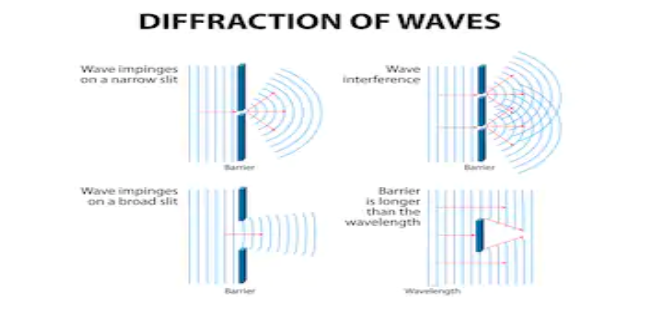
Single slit diffraction can be performed through a single slit whose width is on the order of the wavelength of light, then the light wave is diffracted on the edge of the aperture forming a single slit diffraction pattern on the screen that is placed at a certain distance from the apparatus. Therefore, we can find the value of slit width using the above formula,
${\text{d = }}\dfrac{{{\text{m}}\lambda {\text{D}}}}{{\text{y}}}$,
Substitution of the values in the given equations give,
$ \Rightarrow {\text{d = }}\dfrac{{(1)(800)(6000)}}{{2.5}}$
Simplifying the given equations we get,
$ \Rightarrow (1.92{\text{x1}}{{\text{0}}^5}){10^{ - 7}}$
=$\therefore 0.192mm$
Hence, The correct option is (C).
Note: There are two types of a single slit diffraction pattern,
Fresnel’s diffraction pattern: In this diffraction pattern, the screen and the slit are placed close to the aperture or the obstacles and the light after diffraction appears converging towards the screen.
Fraunhofer’s diffraction pattern: In this diffraction pattern, the source and the screen are placed at a large distance from the aperture or the obstacles.
Formula used:
${\text{d = }}\dfrac{{{\text{m}}\lambda {\text{D}}}}{{\text{y}}}$, here, d=slit width, $\lambda = $wavelength of the light wave, $D$=distance of the screen from the slit, y=distance between the first maxima from the center, $m$= order of the fringes.
Complete step-by-step solution:
Given details: The order of the fringes, $m = 1$,
Distance between the first maximum (or minimum) and central fringe is, \[y = \dfrac{5}{2} = 2.5cm\],
Distance between the screen and the slit, \[D = 80cm = 800mm,\]
Wavelength if the light wave,$\lambda = 6000angstorm$
Single slit diffraction pattern:
Single slit diffraction can be performed through a single slit whose width is on the order of the wavelength of light, then the light wave is diffracted on the edge of the aperture forming a single slit diffraction pattern on the screen that is placed at a certain distance from the apparatus. Therefore, we can find the value of slit width using the above formula,
${\text{d = }}\dfrac{{{\text{m}}\lambda {\text{D}}}}{{\text{y}}}$,
Substitution of the values in the given equations give,
$ \Rightarrow {\text{d = }}\dfrac{{(1)(800)(6000)}}{{2.5}}$
Simplifying the given equations we get,
$ \Rightarrow (1.92{\text{x1}}{{\text{0}}^5}){10^{ - 7}}$
=$\therefore 0.192mm$
Hence, The correct option is (C).
Note: There are two types of a single slit diffraction pattern,
Fresnel’s diffraction pattern: In this diffraction pattern, the screen and the slit are placed close to the aperture or the obstacles and the light after diffraction appears converging towards the screen.
Fraunhofer’s diffraction pattern: In this diffraction pattern, the source and the screen are placed at a large distance from the aperture or the obstacles.
Recently Updated Pages
Master Class 12 Business Studies: Engaging Questions & Answers for Success

Master Class 12 Biology: Engaging Questions & Answers for Success
Master Class 12 Chemistry: Engaging Questions & Answers for Success
Class 12 Question and Answer - Your Ultimate Solutions Guide
Master Class 11 Social Science: Engaging Questions & Answers for Success
Master Class 11 English: Engaging Questions & Answers for Success
Trending doubts
Which are the Top 10 Largest Countries of the World?
Draw a labelled sketch of the human eye class 12 physics CBSE
Differentiate between homogeneous and heterogeneous class 12 chemistry CBSE
Sulphuric acid is known as the king of acids State class 12 chemistry CBSE
Why is the cell called the structural and functional class 12 biology CBSE
Which is the correct genotypic ratio of mendel dihybrid class 12 biology CBSE