




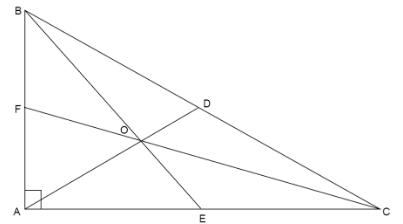
In a right angled \[\vartriangle BAC\],\[\angle BAC = {90^ \circ }\]. Segment AD, BE and CF are the medians. Prove that \[2(A{D^2} + B{E^2} + C{F^2}) = 3B{C^2}\]
Answer
 Verified
612k+ views
Hint: Here we use the property that the median is the midpoint of the line on which it lies. The line joining midpoints of two sides of a triangle is parallel to the third side of the triangle and equal to half the length of the third side. Use the Pythagoras theorem to write the side of a triangle as the sum of squares of the other two sides. Substitute the value in LHS and solve.
* Median is a line that joins a vertex and midpoint of the opposite side.
* Pythagoras theorem states that in a right angled triangle, the sum of square of base and square of height is equal to square of the hypotenuse.
If we have a right angled triangle, \[\vartriangle ABC\] with right angle, \[\angle B = {90^ \circ }\]
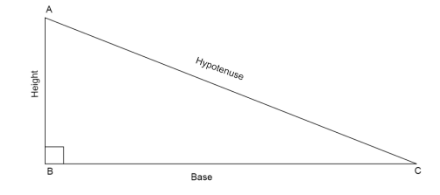
Then using the Pythagoras theorem we can write that \[A{C^2} = A{B^2} + B{C^2}\]
Complete step-by-step answer:
We are given a right angled triangle BAC having \[\angle BAC = {90^ \circ }\]
Use Pythagoras theorem on right angled triangle BAC
\[ \Rightarrow B{C^2} = A{B^2} + A{C^2}\] … (1)
Now we are given segments AD, BE and CF are the medians. From the definition of median we know that the medians bisect the side on which they fall.
When BE is median
\[ \Rightarrow AE = EC = \dfrac{1}{2}AC\]
When AD is median
\[ \Rightarrow BD = DC = \dfrac{1}{2}BC\]
When CF is median
\[ \Rightarrow AF = FB = \dfrac{1}{2}AB\] … (2)
Also, Triangle BAE is a right angled triangle with \[\angle BAE = {90^ \circ }\]
Use Pythagoras theorem to write
\[B{E^2} = A{B^2} + A{E^2}\] … (3)
Also, Triangle CAF is a right angled triangle with \[\angle CAF = {90^ \circ }\]
Use Pythagoras theorem to write
\[C{F^2} = A{F^2} + A{C^2}\] … (4)
Now we know that the points F and D are mid-points of the sides AB and BC respectively. Then we can say the line joining two mid-points is parallel to the third side of the triangle and has length equal to half of the third side of the triangle.
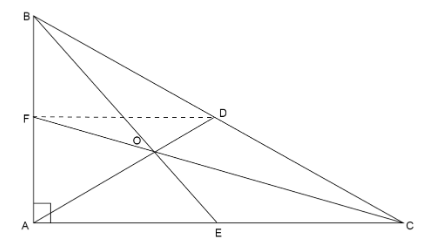
We have \[FD\parallel AC\] and \[FD = \dfrac{1}{2}AC\].
Since AC and FD are parallel, then FD is also perpendicular to AB.
In right triangle AFD, \[\angle AFD = {90^ \circ }\]
Use Pythagoras theorem to write
\[A{D^2} = A{F^2} + F{D^2}\] … (5)
Now we solve the LHS of the equation given in the question.
LHS \[ = 2(A{D^2} + B{E^2} + C{F^2})\]
Substitute the values from equation (3), (4) and (5) in LHS of the equation
\[ \Rightarrow 2(A{D^2} + B{E^2} + C{F^2}) = 2\left[ {(A{F^2} + F{D^2}) + (A{B^2} + A{E^2}) + (A{F^2} + A{C^2})} \right]\]
Open the brackets
\[ \Rightarrow 2(A{D^2} + B{E^2} + C{F^2}) = 2\left[ {A{F^2} + F{D^2} + A{B^2} + A{E^2} + A{F^2} + A{C^2}} \right]\]
Substitute the value of \[A{B^2} + A{C^2} = B{C^2}\]from equation (1)
\[ \Rightarrow 2(A{D^2} + B{E^2} + C{F^2}) = 2\left[ {B{C^2} + A{F^2} + F{D^2} + A{E^2} + A{F^2}} \right]\]
Now substitute the value of \[AE = \dfrac{1}{2}AC\],\[AF = \dfrac{1}{2}AB\]from equation (2) and \[FD = \dfrac{1}{2}AC\]
\[ \Rightarrow 2(A{D^2} + B{E^2} + C{F^2}) = 2\left[ {B{C^2} + {{\left( {\dfrac{{AB}}{2}} \right)}^2} + {{\left( {\dfrac{{AC}}{2}} \right)}^2} + {{\left( {\dfrac{{AC}}{2}} \right)}^2} + {{\left( {\dfrac{{AB}}{2}} \right)}^2}} \right]\]
Square the values in the bracket
\[ \Rightarrow 2(A{D^2} + B{E^2} + C{F^2}) = 2\left[ {B{C^2} + \dfrac{{A{B^2}}}{4} + \dfrac{{A{C^2}}}{4} + \dfrac{{A{C^2}}}{4} + \dfrac{{A{B^2}}}{4}} \right]\]
Add the same terms
\[ \Rightarrow 2(A{D^2} + B{E^2} + C{F^2}) = 2\left[ {B{C^2} + \dfrac{{2A{B^2}}}{4} + \dfrac{{2A{C^2}}}{4}} \right]\]
Cancel factors from numerator and denominator
\[ \Rightarrow 2(A{D^2} + B{E^2} + C{F^2}) = 2\left[ {B{C^2} + \dfrac{{A{B^2}}}{2} + \dfrac{{A{C^2}}}{2}} \right]\]
Take half common from the fractions
\[ \Rightarrow 2(A{D^2} + B{E^2} + C{F^2}) = 2\left[ {B{C^2} + \dfrac{1}{2}(A{B^2} + A{C^2})} \right]\]
Substitute the value of \[A{B^2} + A{C^2} = B{C^2}\]from equation (1)
\[ \Rightarrow 2(A{D^2} + B{E^2} + C{F^2}) = 2\left[ {B{C^2} + \dfrac{1}{2}B{C^2}} \right]\]
Take LCM of terms in the bracket
\[ \Rightarrow 2(A{D^2} + B{E^2} + C{F^2}) = 2\left[ {\dfrac{{2B{C^2} + B{C^2}}}{2}} \right]\]
\[ \Rightarrow 2(A{D^2} + B{E^2} + C{F^2}) = 2\left[ {\dfrac{{3B{C^2}}}{2}} \right]\]
Cancel the same terms from numerator and denominator.
\[ \Rightarrow 2(A{D^2} + B{E^2} + C{F^2}) = 3B{C^2}\]
We have LHS equal to RHS of the equation
Hence proved
Note: Students might make the mistake of assuming that all medians make the right angle when they meet the opposite side of the vertex. Keep in mind all the medians make the right angle only if the triangle is an equilateral triangle. Here we take only the given angle as the right angle and the parallel line constructed makes a right angle.
* Median is a line that joins a vertex and midpoint of the opposite side.
* Pythagoras theorem states that in a right angled triangle, the sum of square of base and square of height is equal to square of the hypotenuse.
If we have a right angled triangle, \[\vartriangle ABC\] with right angle, \[\angle B = {90^ \circ }\]
Then using the Pythagoras theorem we can write that \[A{C^2} = A{B^2} + B{C^2}\]
Complete step-by-step answer:
We are given a right angled triangle BAC having \[\angle BAC = {90^ \circ }\]
Use Pythagoras theorem on right angled triangle BAC
\[ \Rightarrow B{C^2} = A{B^2} + A{C^2}\] … (1)
Now we are given segments AD, BE and CF are the medians. From the definition of median we know that the medians bisect the side on which they fall.
When BE is median
\[ \Rightarrow AE = EC = \dfrac{1}{2}AC\]
When AD is median
\[ \Rightarrow BD = DC = \dfrac{1}{2}BC\]
When CF is median
\[ \Rightarrow AF = FB = \dfrac{1}{2}AB\] … (2)
Also, Triangle BAE is a right angled triangle with \[\angle BAE = {90^ \circ }\]
Use Pythagoras theorem to write
\[B{E^2} = A{B^2} + A{E^2}\] … (3)
Also, Triangle CAF is a right angled triangle with \[\angle CAF = {90^ \circ }\]
Use Pythagoras theorem to write
\[C{F^2} = A{F^2} + A{C^2}\] … (4)
Now we know that the points F and D are mid-points of the sides AB and BC respectively. Then we can say the line joining two mid-points is parallel to the third side of the triangle and has length equal to half of the third side of the triangle.
We have \[FD\parallel AC\] and \[FD = \dfrac{1}{2}AC\].
Since AC and FD are parallel, then FD is also perpendicular to AB.
In right triangle AFD, \[\angle AFD = {90^ \circ }\]
Use Pythagoras theorem to write
\[A{D^2} = A{F^2} + F{D^2}\] … (5)
Now we solve the LHS of the equation given in the question.
LHS \[ = 2(A{D^2} + B{E^2} + C{F^2})\]
Substitute the values from equation (3), (4) and (5) in LHS of the equation
\[ \Rightarrow 2(A{D^2} + B{E^2} + C{F^2}) = 2\left[ {(A{F^2} + F{D^2}) + (A{B^2} + A{E^2}) + (A{F^2} + A{C^2})} \right]\]
Open the brackets
\[ \Rightarrow 2(A{D^2} + B{E^2} + C{F^2}) = 2\left[ {A{F^2} + F{D^2} + A{B^2} + A{E^2} + A{F^2} + A{C^2}} \right]\]
Substitute the value of \[A{B^2} + A{C^2} = B{C^2}\]from equation (1)
\[ \Rightarrow 2(A{D^2} + B{E^2} + C{F^2}) = 2\left[ {B{C^2} + A{F^2} + F{D^2} + A{E^2} + A{F^2}} \right]\]
Now substitute the value of \[AE = \dfrac{1}{2}AC\],\[AF = \dfrac{1}{2}AB\]from equation (2) and \[FD = \dfrac{1}{2}AC\]
\[ \Rightarrow 2(A{D^2} + B{E^2} + C{F^2}) = 2\left[ {B{C^2} + {{\left( {\dfrac{{AB}}{2}} \right)}^2} + {{\left( {\dfrac{{AC}}{2}} \right)}^2} + {{\left( {\dfrac{{AC}}{2}} \right)}^2} + {{\left( {\dfrac{{AB}}{2}} \right)}^2}} \right]\]
Square the values in the bracket
\[ \Rightarrow 2(A{D^2} + B{E^2} + C{F^2}) = 2\left[ {B{C^2} + \dfrac{{A{B^2}}}{4} + \dfrac{{A{C^2}}}{4} + \dfrac{{A{C^2}}}{4} + \dfrac{{A{B^2}}}{4}} \right]\]
Add the same terms
\[ \Rightarrow 2(A{D^2} + B{E^2} + C{F^2}) = 2\left[ {B{C^2} + \dfrac{{2A{B^2}}}{4} + \dfrac{{2A{C^2}}}{4}} \right]\]
Cancel factors from numerator and denominator
\[ \Rightarrow 2(A{D^2} + B{E^2} + C{F^2}) = 2\left[ {B{C^2} + \dfrac{{A{B^2}}}{2} + \dfrac{{A{C^2}}}{2}} \right]\]
Take half common from the fractions
\[ \Rightarrow 2(A{D^2} + B{E^2} + C{F^2}) = 2\left[ {B{C^2} + \dfrac{1}{2}(A{B^2} + A{C^2})} \right]\]
Substitute the value of \[A{B^2} + A{C^2} = B{C^2}\]from equation (1)
\[ \Rightarrow 2(A{D^2} + B{E^2} + C{F^2}) = 2\left[ {B{C^2} + \dfrac{1}{2}B{C^2}} \right]\]
Take LCM of terms in the bracket
\[ \Rightarrow 2(A{D^2} + B{E^2} + C{F^2}) = 2\left[ {\dfrac{{2B{C^2} + B{C^2}}}{2}} \right]\]
\[ \Rightarrow 2(A{D^2} + B{E^2} + C{F^2}) = 2\left[ {\dfrac{{3B{C^2}}}{2}} \right]\]
Cancel the same terms from numerator and denominator.
\[ \Rightarrow 2(A{D^2} + B{E^2} + C{F^2}) = 3B{C^2}\]
We have LHS equal to RHS of the equation
Hence proved
Note: Students might make the mistake of assuming that all medians make the right angle when they meet the opposite side of the vertex. Keep in mind all the medians make the right angle only if the triangle is an equilateral triangle. Here we take only the given angle as the right angle and the parallel line constructed makes a right angle.
Recently Updated Pages
Master Class 12 Business Studies: Engaging Questions & Answers for Success

Master Class 12 Biology: Engaging Questions & Answers for Success
Master Class 12 Chemistry: Engaging Questions & Answers for Success
Class 12 Question and Answer - Your Ultimate Solutions Guide
Master Class 11 Social Science: Engaging Questions & Answers for Success
Master Class 11 English: Engaging Questions & Answers for Success
Trending doubts
What is the Full Form of ICSE / ISC ?
Fill the blanks with the suitable prepositions 1 The class 9 english CBSE
Difference Between Plant Cell and Animal Cell
How many hours before the closure of election must class 9 social science CBSE
What is pollution? How many types of pollution? Define it
Name 10 Living and Non living things class 9 biology CBSE