




In a right angled triangle, if one angle is ${45^ \circ }$ and the opposite side to it is $k$ times the hypotenuse, then the value of $k$ is
A. $1$
B. $\dfrac{1}{2}$
C. $\dfrac{1}{{\sqrt 2 }}$
D. $\sqrt 2 $
Answer
 Verified
609k+ views
Hint: Here given that there is a right angled triangle. To solve this problem we should know the most important properties of a triangle. First property is that in any triangle, the sum of the angles in a triangle should be equal. If any two angles in a triangle are equal then the two opposite sides of those angles are equal. If two sides are equal in a triangle then it is called an isosceles triangle.
Complete step by step answer:
Given that the triangle is a right angled triangle, and also given that one of its angles is ${45^ \circ }$.
Let the triangle be ABC.
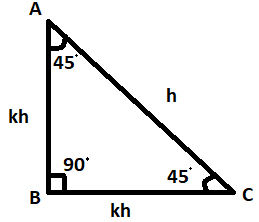
In a right angled triangle one angle is ${90^ \circ }$.
Let $\angle B = {90^ \circ }$ and let $\angle C = {45^ \circ }$, as given one of the angles is ${45^ \circ }$.
The sum of all the angles in a triangle should be equal to ${180^ \circ }$, which is given by:
$ \Rightarrow \angle A + \angle B + \angle C = {180^ \circ }$
$ \Rightarrow \angle A + {90^ \circ } + {45^ \circ } = {180^ \circ }$
$\therefore \angle A = {45^ \circ }$
Hence $\angle A = \angle C$
$\therefore \Delta ABC$is a right isosceles triangle.
Thus the two sides other than the hypotenuse should be equal, which is given by:
$ \Rightarrow AB = BC$
Given that the side opposite to the angle ${45^ \circ }$ is $k$ times the hypotenuse, which is given by:
Let the length of hypotenuse $AC$ be $h$, and as the side opposite to the angle ${45^ \circ }$ is $k$ times the hypotenuse:
$ \Rightarrow AC = h$
As $AB$ and $BC$ are the sides opposite to angles ${45^ \circ }$, the lengths of the sides is given by:
$ \Rightarrow $$AB = kh$
Hence $BC = kh$, as $AB = BC$
A right angled triangle satisfies the pythagoras theorem which is given by:
$ \Rightarrow A{B^2} + B{C^2} = A{C^2}$
$ \Rightarrow {(kh)^2} + {(kh)^2} = {h^2}$
$ \Rightarrow 2{k^2}{h^2} = {h^2}$
Here ${h^2}$ gets cancelled on both sides.
$ \Rightarrow 2{k^2} = 1$
$ \Rightarrow {k^2} = \dfrac{1}{2}$
$ \Rightarrow k = \dfrac{1}{{\sqrt 2 }}$
The value of $k$ is $\dfrac{1}{{\sqrt 2 }}$
Note: Here given that one angle of the right angled triangle is ${45^ \circ }$, then we automatically understand that it is a right isosceles triangle. As to make the sum of the angles of a triangle ${180^ \circ }$, the other angle other than ${90^ \circ }$ angle is ${45^ \circ }$. Now as the two angles are equal, the two sides will also be equal other than the hypotenuse which is the property of the right isosceles triangle.
Complete step by step answer:
Given that the triangle is a right angled triangle, and also given that one of its angles is ${45^ \circ }$.
Let the triangle be ABC.
In a right angled triangle one angle is ${90^ \circ }$.
Let $\angle B = {90^ \circ }$ and let $\angle C = {45^ \circ }$, as given one of the angles is ${45^ \circ }$.
The sum of all the angles in a triangle should be equal to ${180^ \circ }$, which is given by:
$ \Rightarrow \angle A + \angle B + \angle C = {180^ \circ }$
$ \Rightarrow \angle A + {90^ \circ } + {45^ \circ } = {180^ \circ }$
$\therefore \angle A = {45^ \circ }$
Hence $\angle A = \angle C$
$\therefore \Delta ABC$is a right isosceles triangle.
Thus the two sides other than the hypotenuse should be equal, which is given by:
$ \Rightarrow AB = BC$
Given that the side opposite to the angle ${45^ \circ }$ is $k$ times the hypotenuse, which is given by:
Let the length of hypotenuse $AC$ be $h$, and as the side opposite to the angle ${45^ \circ }$ is $k$ times the hypotenuse:
$ \Rightarrow AC = h$
As $AB$ and $BC$ are the sides opposite to angles ${45^ \circ }$, the lengths of the sides is given by:
$ \Rightarrow $$AB = kh$
Hence $BC = kh$, as $AB = BC$
A right angled triangle satisfies the pythagoras theorem which is given by:
$ \Rightarrow A{B^2} + B{C^2} = A{C^2}$
$ \Rightarrow {(kh)^2} + {(kh)^2} = {h^2}$
$ \Rightarrow 2{k^2}{h^2} = {h^2}$
Here ${h^2}$ gets cancelled on both sides.
$ \Rightarrow 2{k^2} = 1$
$ \Rightarrow {k^2} = \dfrac{1}{2}$
$ \Rightarrow k = \dfrac{1}{{\sqrt 2 }}$
The value of $k$ is $\dfrac{1}{{\sqrt 2 }}$
Note: Here given that one angle of the right angled triangle is ${45^ \circ }$, then we automatically understand that it is a right isosceles triangle. As to make the sum of the angles of a triangle ${180^ \circ }$, the other angle other than ${90^ \circ }$ angle is ${45^ \circ }$. Now as the two angles are equal, the two sides will also be equal other than the hypotenuse which is the property of the right isosceles triangle.
Recently Updated Pages
Master Class 5 English: Engaging Questions & Answers for Success

Master Class 5 Maths: Engaging Questions & Answers for Success
Master Class 5 Social Science: Engaging Questions & Answers for Success
Master Class 5 Science: Engaging Questions & Answers for Success
Class 5 Question and Answer - Your Ultimate Solutions Guide
Master Class 9 General Knowledge: Engaging Questions & Answers for Success
Trending doubts
Which are the Top 10 Largest Countries of the World?
The total number of vertebrae in man is a30 b31 c32 class 12 biology CBSE
Draw a labelled sketch of the human eye class 12 physics CBSE
The number of cranial nerves in a frog is A 10 pairs class 12 biology CBSE
Differentiate between homogeneous and heterogeneous class 12 chemistry CBSE
Differentiate between Pyramid of energy and pyramid class 12 biology CBSE