




In a quadrilateral ABCD, if AB is parallel to CD, $\angle D=2\times \angle B$ ; AD = b and CD = a, then the side AB is of length
( a ) $\dfrac{a}{2}+2b$
( a ) $a+2b$
( a ) $2a-b$
( a ) $a+b$
Answer
 Verified
616.5k+ views
Hint: Basically what we will do here is, we will first value of angle $\angle AMC$ and then using exterior angle sum property we will find the measure of angle $\angle MCB$ in triangle $\vartriangle MCB$. Then using property two angles are equal then sides opposite to equal angles are also equal, we will show that MB = MC and hence solve for the value of AB.
Complete step-by-step solution:
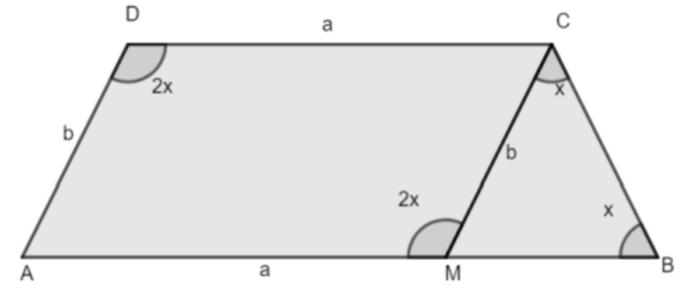
In this question, we have given hint that ABCD is quadrilateral and AB is parallel to CD and angle D is twice of angle B that is $\angle D=2\times \angle B$ and side AD = b and side CD = a, then we have to evaluate the length of side AB.
Now, from figure we can see that AD = b and CM = b and CD = a and AM = a.
As, it is given in the question that, AB is parallel to CD, so we can say that ABCD is a parallelogram.
Also from the figure, we can say that $\angle D=\angle AMC$
Now, let angle B be angle x then as $\angle D=2\times \angle B$ so, angle D will be equals to 2x that is $\angle D=2x$or $\angle AMC=2x$
Now, from the figure in $\vartriangle MCB$,
$\angle AMC=\angle MCB+\angle x$
$2x=\angle MCB+\angle x$ by exterior angle sum property which says that exterior angle equals the sum of the opposite interior angle.
On solving, we get
$\angle MCB=x$
Also, $\angle MCB=\angle B$
So, $\angle MCB=\angle B=x$
In a triangle, if two angles are equal then sides opposite to equal angles are also equal.
So, in $\vartriangle MCB$
$MB = MC$
Now, from figure we can say that
$AB = AM + MB$, and $AM = A$ and $MB = b$, then
Or, $AB = a + b$
Hence, option ( d ) is correct.
Note: It is important that when you solve, proving questions based on a parallelogram, then you must know all the properties of parallelogram and properties of angles. Always make the figure to understand the question visually. The labeling of the diagram should be done properly.
Complete step-by-step solution:
In this question, we have given hint that ABCD is quadrilateral and AB is parallel to CD and angle D is twice of angle B that is $\angle D=2\times \angle B$ and side AD = b and side CD = a, then we have to evaluate the length of side AB.
Now, from figure we can see that AD = b and CM = b and CD = a and AM = a.
As, it is given in the question that, AB is parallel to CD, so we can say that ABCD is a parallelogram.
Also from the figure, we can say that $\angle D=\angle AMC$
Now, let angle B be angle x then as $\angle D=2\times \angle B$ so, angle D will be equals to 2x that is $\angle D=2x$or $\angle AMC=2x$
Now, from the figure in $\vartriangle MCB$,
$\angle AMC=\angle MCB+\angle x$
$2x=\angle MCB+\angle x$ by exterior angle sum property which says that exterior angle equals the sum of the opposite interior angle.
On solving, we get
$\angle MCB=x$
Also, $\angle MCB=\angle B$
So, $\angle MCB=\angle B=x$
In a triangle, if two angles are equal then sides opposite to equal angles are also equal.
So, in $\vartriangle MCB$
$MB = MC$
Now, from figure we can say that
$AB = AM + MB$, and $AM = A$ and $MB = b$, then
Or, $AB = a + b$
Hence, option ( d ) is correct.
Note: It is important that when you solve, proving questions based on a parallelogram, then you must know all the properties of parallelogram and properties of angles. Always make the figure to understand the question visually. The labeling of the diagram should be done properly.
Recently Updated Pages
Master Class 12 Business Studies: Engaging Questions & Answers for Success

Master Class 12 Biology: Engaging Questions & Answers for Success
Master Class 12 Chemistry: Engaging Questions & Answers for Success
Class 12 Question and Answer - Your Ultimate Solutions Guide
Master Class 11 Social Science: Engaging Questions & Answers for Success
Master Class 11 English: Engaging Questions & Answers for Success
Trending doubts
Find the sum of series 1 + 2 + 3 + 4 + 5 + + 100 class 9 maths CBSE
Name 10 Living and Non living things class 9 biology CBSE
On an outline map of India show its neighbouring c class 9 social science CBSE
Write an Article on Save Earth Save Life
On an outline map of India mark the Karakoram range class 9 social science CBSE
If HCF of 210 and 55 is expressed in the form of 210 class 9 maths CBSE