




In a pure capacitive A.C circuit current and voltage differs in the phase by:
$A.{{0}^{0}}$
$B.{{45}^{0}}$
$C.{{90}^{0}}$
$D.{{180}^{0}}$
Answer
 Verified
603.9k+ views
Hint: To find the phase in pure capacitors, first find the expressions for current flow through capacitor. Write an equation of potential difference across its plates i.e., capacitor plate at instant which is given as $e=\dfrac{q}{c}.q=ec,$ differentiate this with respect to t. You will get an expression which will give a relation between current, frequency, capacitance and phase as ($\omega t$). Convert it in standard form i.e., $e={{e}_{0}}\sin \omega t$ and calculate the value of the phase difference between current and voltage.
Complete answer:
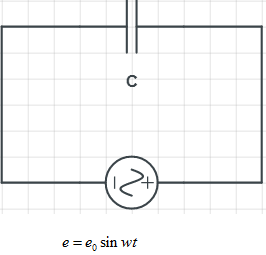
Consider an EMF (A.C) $e={{e}_{0}}\sin \omega t$ applied across a capacitor of capacitance ‘c’ as shown in the above figure. If q be the magnitude of the charge on any one plate of a capacitor at any instant, then the potential difference across its plates at that instant is given by,
$v=\dfrac{q}{c}$
Above equation is equal to the instantaneous value of the applied EMF (e).
$\begin{align}
& \therefore e=\dfrac{q}{c} \\
& \Rightarrow q=ce \\
\end{align}$
Put the value of $e={{e}_{0}}\sin \omega t$
$q = c ({{e}_{0}}\sin \omega t)$
Now differentiate on both side, we get
$\begin{align}
& \dfrac{dq}{dt}=\dfrac{d}{dt}\left( \omega c{{e}_{0}}\sin \omega t \right) \\
& \Rightarrow \dfrac{dq}{dt}=\omega c{{e}_{0}}\cos \omega t \\
\end{align}$
We know that,
$\begin{align}
& \dfrac{dq}{dt}=I \\
&\Rightarrow I=\omega c{{e}_{0}}\cos \omega t \\
\end{align}$
This is the expression of the instantaneous current.
If $\omega c{{e}_{0}}={{i}_{0}}$ then
$I={{I}_{0}}\cos wt={{i}_{0}}\sin \left( \omega t+\dfrac{\pi }{2} \right).......(1)$
Now if you compare equation (1) with $e={{e}_{0}}\sin \omega t$
Then we conclude that EMF or voltage across the capacitor lags behind the current by $\dfrac{\pi }{2}$ rad phase.
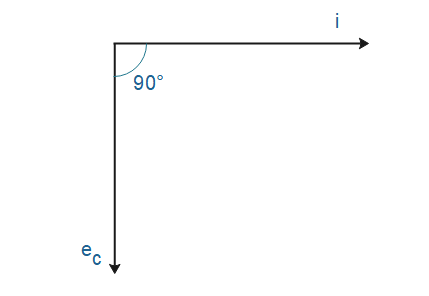
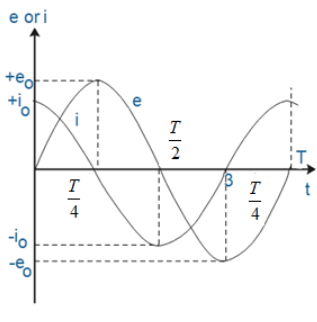
Hence in a pure capacitor AC circuit current and voltage differs in phase by ${{90}^{0}}$.
Therefore option (C) is correct.
Note:
In pure AC capacitors, voltage across the capacitor lags behind the current by ${{90}^{0}}$ or can be said as current leads the E.M.F or voltage by ${{90}^{0}}$, whereas in case of the pure inductors, voltage leads to the current by the phase $\dfrac{\pi }{2}$ rad or can be said as current lags behind the E.M.F or voltage by $\dfrac{\pi }{2}$ rad. In case of pure resistance, no phase has occurred since the resistor does not depend on AC frequency. In this case, current and voltage both are sinusoidal in the nature of the same frequency.
Complete answer:
Consider an EMF (A.C) $e={{e}_{0}}\sin \omega t$ applied across a capacitor of capacitance ‘c’ as shown in the above figure. If q be the magnitude of the charge on any one plate of a capacitor at any instant, then the potential difference across its plates at that instant is given by,
$v=\dfrac{q}{c}$
Above equation is equal to the instantaneous value of the applied EMF (e).
$\begin{align}
& \therefore e=\dfrac{q}{c} \\
& \Rightarrow q=ce \\
\end{align}$
Put the value of $e={{e}_{0}}\sin \omega t$
$q = c ({{e}_{0}}\sin \omega t)$
Now differentiate on both side, we get
$\begin{align}
& \dfrac{dq}{dt}=\dfrac{d}{dt}\left( \omega c{{e}_{0}}\sin \omega t \right) \\
& \Rightarrow \dfrac{dq}{dt}=\omega c{{e}_{0}}\cos \omega t \\
\end{align}$
We know that,
$\begin{align}
& \dfrac{dq}{dt}=I \\
&\Rightarrow I=\omega c{{e}_{0}}\cos \omega t \\
\end{align}$
This is the expression of the instantaneous current.
If $\omega c{{e}_{0}}={{i}_{0}}$ then
$I={{I}_{0}}\cos wt={{i}_{0}}\sin \left( \omega t+\dfrac{\pi }{2} \right).......(1)$
Now if you compare equation (1) with $e={{e}_{0}}\sin \omega t$
Then we conclude that EMF or voltage across the capacitor lags behind the current by $\dfrac{\pi }{2}$ rad phase.
Hence in a pure capacitor AC circuit current and voltage differs in phase by ${{90}^{0}}$.
Therefore option (C) is correct.
Note:
In pure AC capacitors, voltage across the capacitor lags behind the current by ${{90}^{0}}$ or can be said as current leads the E.M.F or voltage by ${{90}^{0}}$, whereas in case of the pure inductors, voltage leads to the current by the phase $\dfrac{\pi }{2}$ rad or can be said as current lags behind the E.M.F or voltage by $\dfrac{\pi }{2}$ rad. In case of pure resistance, no phase has occurred since the resistor does not depend on AC frequency. In this case, current and voltage both are sinusoidal in the nature of the same frequency.
Recently Updated Pages
Master Class 12 Business Studies: Engaging Questions & Answers for Success

Master Class 12 Biology: Engaging Questions & Answers for Success
Master Class 12 Chemistry: Engaging Questions & Answers for Success
Class 12 Question and Answer - Your Ultimate Solutions Guide
Master Class 11 Social Science: Engaging Questions & Answers for Success
Master Class 11 English: Engaging Questions & Answers for Success
Trending doubts
Which is more stable and why class 12 chemistry CBSE
Which are the Top 10 Largest Countries of the World?
Draw a labelled sketch of the human eye class 12 physics CBSE
Differentiate between homogeneous and heterogeneous class 12 chemistry CBSE
What are the major means of transport Explain each class 12 social science CBSE
Sulphuric acid is known as the king of acids State class 12 chemistry CBSE