




In a potentiometer experiment, the balancing length of a cell is at length $240cm$. After shunting the cell with a resistance of $2\Omega $, the balancing length becomes $120cm$. The internal resistance of cell is
A. $1\Omega $
B. $0.5\Omega $
C. $4\Omega $
D. $2\Omega $
Answer
 Verified
653.4k+ views
Hint: The potentiometer wire works on the principle – the potential drop across a given part of wire is directly proportional to the length of that part of the wire. This potential drop is always proportional to the resistance, according to ohm’s law. Once the cell is shunted, the effective resistance of the secondary circuit changes. Using these both conditions we can find the internal resistance of the cell.
Formula used:
$r = {R_s}\left( {\dfrac{{{L_1}}}{{{L_2}}} - 1} \right)$
Complete step by step answer:
The initial potentiometer circuit and shunted potentiometer circuit are given by
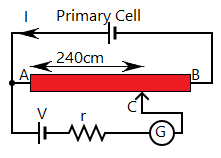
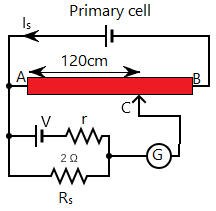
From the principle of potentiometer, $V \propto L$ and from ohm’s law $V \propto R$. Using both the relations we have $R \propto L$.
If we consider that ${R_1}$ is the resistance of the initial secondary circuit and the balancing length is ${L_1}$. And, ${R_2}$ is the resistance of shunted secondary circuit and balancing length ${L_2}$, respectively. We will have,
$\eqalign{
& \dfrac{{{R_1}}}{{{L_1}}} = \dfrac{{{R_2}}}{{{L_2}}} \Rightarrow \dfrac{r}{{{L_1}}} = \dfrac{{\dfrac{{{R_s} \times r}}{{{R_s} + r}}}}{{{L_2}}} \Rightarrow r = {R_s}\left( {\dfrac{{{L_1}}}{{{L_2}}} - 1} \right) \cr
& \Rightarrow r = 2\left( {\dfrac{{240}}{{120}} - 1} \right) = 2\Omega \cr
& \therefore r = 2\Omega \cr} $
Therefore, the correct option is D.
Note:
In the shunted circuit, the shunt resistance is parallel to the internal resistance of the cell. So, the effective resistance is obtained by using the formula for resistances in parallel, ${R_P} = \dfrac{{{R_1}{R_2}}}{{{R_1} + {R_2}}}$.
The internal resistance is not an isolated resistance, it is the resistance offered by the battery. We show it as a separate entity, for calculation.
Formula used:
$r = {R_s}\left( {\dfrac{{{L_1}}}{{{L_2}}} - 1} \right)$
Complete step by step answer:
The initial potentiometer circuit and shunted potentiometer circuit are given by
From the principle of potentiometer, $V \propto L$ and from ohm’s law $V \propto R$. Using both the relations we have $R \propto L$.
If we consider that ${R_1}$ is the resistance of the initial secondary circuit and the balancing length is ${L_1}$. And, ${R_2}$ is the resistance of shunted secondary circuit and balancing length ${L_2}$, respectively. We will have,
$\eqalign{
& \dfrac{{{R_1}}}{{{L_1}}} = \dfrac{{{R_2}}}{{{L_2}}} \Rightarrow \dfrac{r}{{{L_1}}} = \dfrac{{\dfrac{{{R_s} \times r}}{{{R_s} + r}}}}{{{L_2}}} \Rightarrow r = {R_s}\left( {\dfrac{{{L_1}}}{{{L_2}}} - 1} \right) \cr
& \Rightarrow r = 2\left( {\dfrac{{240}}{{120}} - 1} \right) = 2\Omega \cr
& \therefore r = 2\Omega \cr} $
Therefore, the correct option is D.
Note:
In the shunted circuit, the shunt resistance is parallel to the internal resistance of the cell. So, the effective resistance is obtained by using the formula for resistances in parallel, ${R_P} = \dfrac{{{R_1}{R_2}}}{{{R_1} + {R_2}}}$.
The internal resistance is not an isolated resistance, it is the resistance offered by the battery. We show it as a separate entity, for calculation.
Recently Updated Pages
Which of the following graphs shows the variation of class 12 physics CBSE

Draw a labelled diagram of the human male reproductive class 12 biology CBSE
Describe the experiment to compare the emf of two cells class 12 physics CBSE
What is standard hydrogen electrode
What is conventional current and electric current class 12 physics CBSE
2Bromopentane is treated with an alcoholic KOH solution class 12 chemistry CBSE
Trending doubts
Draw a labelled sketch of the human eye class 12 physics CBSE
Which are the Top 10 Largest Countries of the World?
Differentiate between homogeneous and heterogeneous class 12 chemistry CBSE
Draw ray diagrams each showing i myopic eye and ii class 12 physics CBSE
Which is the correct genotypic ratio of mendel dihybrid class 12 biology CBSE
What is the Full Form of PVC, PET, HDPE, LDPE, PP and PS ?