




In a polygon the number of diagonals is 54. The number of sides of polygon is,
A. 6
B. 5
C. 4
D. 12
Answer
 Verified
630.9k+ views
Hint: We will first start by finding the ways of selecting two points of the polygon. Then we will subtract the number of consecutive points of the polygon which is the number of sides of the polygon to find the number of diagonal and equate it to the given data.
Complete step-by-step answer:
Now, we have been given that the number of diagonals of a polygon is 54.
Now, we let the sides of the polygon to be n. Then we have,
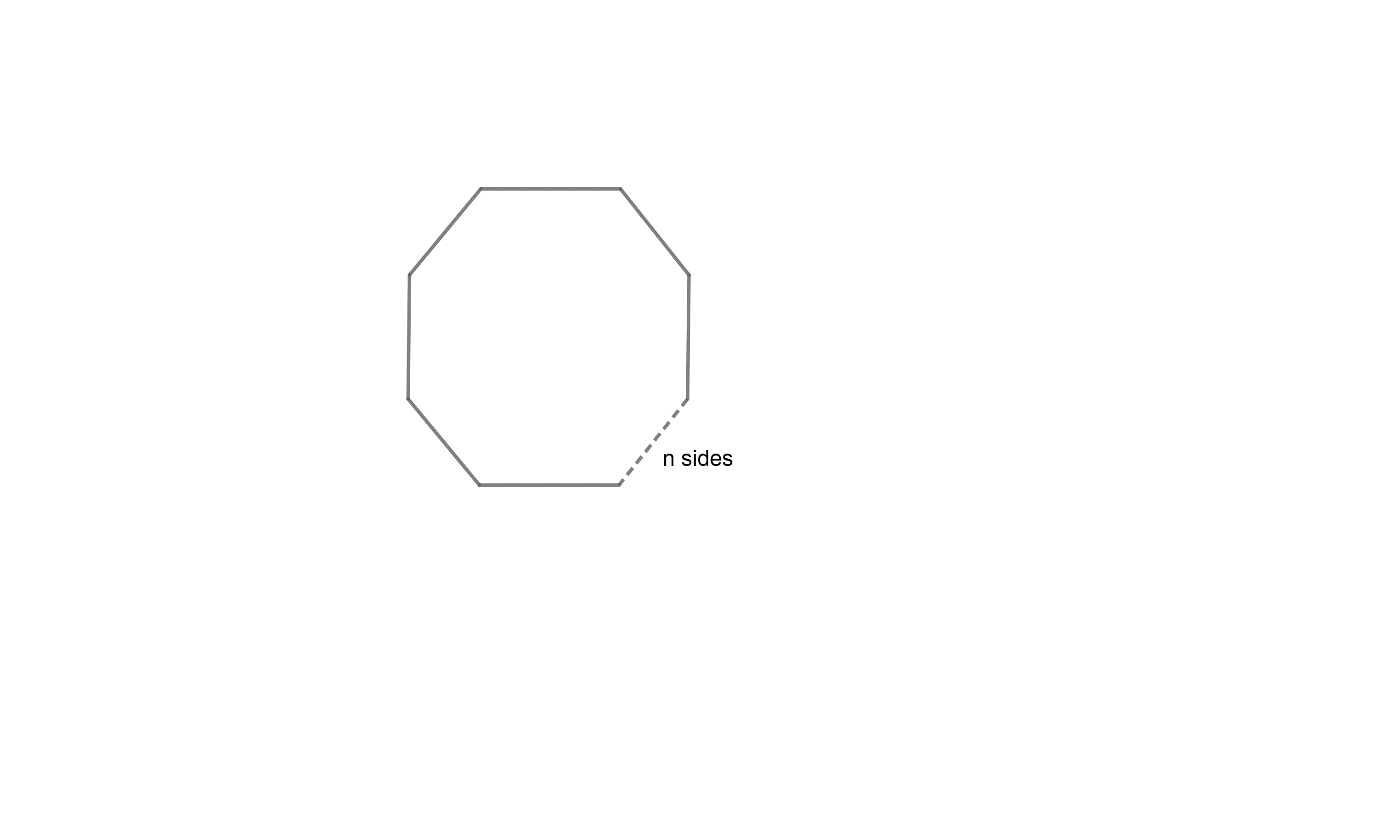
Now, we know that a polygon with n sides has n vertices. Therefore, the number of ways of selecting 2 vertices of the polygon is ${}^{n}{{C}_{2}}$. As we know that the number of ways of selecting r objects out of n is ${}^{n}{{C}_{r}}$.
Now, we have to subtract the consecutive vertices because these vertices will form sides of the polygon not diagonal.
So, the number of ways of selecting consecutive vertices is n.
Now, we have the number of diagonals of the polygon as ${}^{n}{{C}_{2}}-n$. From the question we have been given that the number of diagonals is 54. So, we have,
${}^{n}{{C}_{2}}-n=54$
Now, we know that ${}^{n}{{C}_{r}}=\dfrac{n!}{\left( n-r \right)!\times r!}$.
$\begin{align}
& \dfrac{n!}{\left( n-2 \right)!\times 2!}-n=54 \\
& \dfrac{\left( n-2 \right)!\left( n-1 \right)n}{\left( n-2 \right)!\times 2}-n=54 \\
& \dfrac{n\left( n-1 \right)}{2}-n=54 \\
& \dfrac{n\left( n-1 \right)-2n}{2}=54 \\
& \dfrac{{{n}^{2}}-3n}{2}=54 \\
& {{n}^{2}}-3n=108 \\
& {{n}^{2}}-3n-108=0 \\
\end{align}$
Now, we will use the method of factorization to split the middle term of the quadratic equation.
$\begin{align}
& {{n}^{2}}-12n+9n-108=0 \\
& n\left( n-12 \right)+9\left( n-12 \right)=0 \\
& \left( n+9 \right)\left( n-12 \right)=0 \\
& either\ n+9=0\ or\ n-12=0 \\
\end{align}$
Now, we cannot have n < 0 as the sides of the polygon must be positive.
So, we have the number of sides of a polygon as 12.
Hence, the correct option is (D).
Note: It is important to note that we have used a fact that ${}^{n}{{C}_{r}}=\dfrac{n!}{\left( n-r \right)!\times r!}$. Also, it is advisable to remember some binomial values like,
$\begin{align}
& {}^{n}{{C}_{0}}=1 \\
& {}^{n}{{C}_{1}}=n \\
& {}^{n}{{C}_{2}}=\dfrac{n\left( n-1 \right)}{2} \\
\end{align}$
This makes calculation shorter and easier.
Complete step-by-step answer:
Now, we have been given that the number of diagonals of a polygon is 54.
Now, we let the sides of the polygon to be n. Then we have,
Now, we know that a polygon with n sides has n vertices. Therefore, the number of ways of selecting 2 vertices of the polygon is ${}^{n}{{C}_{2}}$. As we know that the number of ways of selecting r objects out of n is ${}^{n}{{C}_{r}}$.
Now, we have to subtract the consecutive vertices because these vertices will form sides of the polygon not diagonal.
So, the number of ways of selecting consecutive vertices is n.
Now, we have the number of diagonals of the polygon as ${}^{n}{{C}_{2}}-n$. From the question we have been given that the number of diagonals is 54. So, we have,
${}^{n}{{C}_{2}}-n=54$
Now, we know that ${}^{n}{{C}_{r}}=\dfrac{n!}{\left( n-r \right)!\times r!}$.
$\begin{align}
& \dfrac{n!}{\left( n-2 \right)!\times 2!}-n=54 \\
& \dfrac{\left( n-2 \right)!\left( n-1 \right)n}{\left( n-2 \right)!\times 2}-n=54 \\
& \dfrac{n\left( n-1 \right)}{2}-n=54 \\
& \dfrac{n\left( n-1 \right)-2n}{2}=54 \\
& \dfrac{{{n}^{2}}-3n}{2}=54 \\
& {{n}^{2}}-3n=108 \\
& {{n}^{2}}-3n-108=0 \\
\end{align}$
Now, we will use the method of factorization to split the middle term of the quadratic equation.
$\begin{align}
& {{n}^{2}}-12n+9n-108=0 \\
& n\left( n-12 \right)+9\left( n-12 \right)=0 \\
& \left( n+9 \right)\left( n-12 \right)=0 \\
& either\ n+9=0\ or\ n-12=0 \\
\end{align}$
Now, we cannot have n < 0 as the sides of the polygon must be positive.
So, we have the number of sides of a polygon as 12.
Hence, the correct option is (D).
Note: It is important to note that we have used a fact that ${}^{n}{{C}_{r}}=\dfrac{n!}{\left( n-r \right)!\times r!}$. Also, it is advisable to remember some binomial values like,
$\begin{align}
& {}^{n}{{C}_{0}}=1 \\
& {}^{n}{{C}_{1}}=n \\
& {}^{n}{{C}_{2}}=\dfrac{n\left( n-1 \right)}{2} \\
\end{align}$
This makes calculation shorter and easier.
Recently Updated Pages
Master Class 12 Business Studies: Engaging Questions & Answers for Success

Master Class 12 Chemistry: Engaging Questions & Answers for Success
Master Class 12 Biology: Engaging Questions & Answers for Success
Class 12 Question and Answer - Your Ultimate Solutions Guide
Master Class 11 English: Engaging Questions & Answers for Success
Master Class 11 Maths: Engaging Questions & Answers for Success
Trending doubts
Which is more stable and why class 12 chemistry CBSE
Which are the Top 10 Largest Countries of the World?
Draw a labelled sketch of the human eye class 12 physics CBSE
Differentiate between homogeneous and heterogeneous class 12 chemistry CBSE
What are the major means of transport Explain each class 12 social science CBSE
Sulphuric acid is known as the king of acids State class 12 chemistry CBSE