




In a p-n junction diode, change in temperature due to heating:
A. Does not affect resistance of p-n junctions
B. Affects only reverse resistance
C. Affects the overall V-I characteristics of p-n junction
D. Affects only forward resistance
Answer
 Verified
575.7k+ views
Hint: Recall that the current through a diode depends on the diffusion and drift of charge carriers across its structure. In such a case, more free charge carriers implies that more current flows through it at a given voltage. To this end, determine what would happen due to the thermal energy imparted to electrons upon heating the diode, following which you can consider a circuit containing a battery and a diode and arrive at a quantitative explanation for your previous deduction.
Formula Used:
Diode current: $I_{diode} = \dfrac{V_{supply} -V_{diode}}{R}$
Complete step by step answer:
We know that a p-n junction diode is formed when positive p-type (hole-rich) and negative n-type (electron-rich) semiconductors are joined, resulting in an interface between them called the p-n junction. This junction is formed by the diffusion of holes from the p-side to the n-side, and the diffusion of electrons from the n-side to the p-side due to a difference in concentration. A layer of positive charge or holes is developed on the n-side and a layer of negative charge or electrons is developed on the p-side. These two layers together are called as the depletion layer.
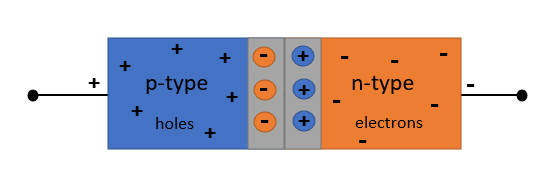
The diode is said to be forward biased when the p-side and the n-side are connected to the positive and negative terminals of a battery respectively, and the diode is said to be reverse biased when the p-side and the n-side are connected to the negative and positive terminals of a battery respectively.
Now, the current in a p-n diode is due to recombination of charge carriers in forward bias and the generation of charge carriers in reverse bias. In any case, the current through the diode depends on the number of charge carriers within its structure.
Let the initial temperature of the diode be$\;T$. When the diode undergoes heating, the temperature of the diode increases, say by $\Delta T$. The electrons are able to take up the thermal energy and channel themselves into the conduction band and become free. Their mobility adds to the conductivity of the diode, which means that the diode is less resistive to the flow of current at a given voltage.
Thus, an increase in temperature (to $T+\Delta T$) results in the generation of more charge carriers or electron-hole pairs, which are responsible for an increase in the current flowing through the diode. This means that the minimum threshold voltage $V_{threshold}$ required to be applied in order for current to flow through the diode will also decrease due to an increase in the number of charge carriers, as shown in the V-I characteristics diagram.
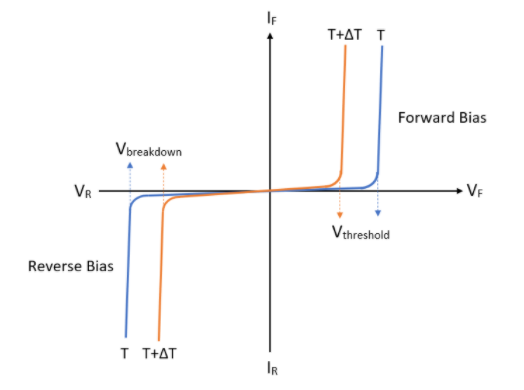
Similarly, an increase in the number of charge carriers in reverse bias also makes the diode relatively more conductive at an increased temperature, implying that its breakdown voltage $V_{breakdown}$ (minimum voltage that causes the diode to become electrically conductive) also decreases since it begins to conduct at a lesser applied voltage.
Thus, we see that with an increase in temperature, the $V_{threshold}$ and $V_{breakdown}$ voltages decrease. From the diode current equation, we have the following, assuming that the resistance in a battery-diode circuit arises only due to the diode:
$I_{diode} = \dfrac{V_{supply} -V_{diode}}{R_{diode}}$
$\Rightarrow R_{diode} = \dfrac{V_{supply}-V_{diode}}{I_{diode}} $
Since the diode voltage and maximum diode current attained remain the same in any case of temperature change:
$\Rightarrow R_{diode} \propto V_{supply}$
At threshold voltage, $R_{F} \propto V_{threshold}$
At breakdown voltage, $R_{R} \propto V_{breakdown}$
Therefore, the increase in temperature due to heating decreases both the forward resistance and reverse resistance, and in comparison, increases the instantaneous diode current, which means that heating changes the entire $V-I$ characteristics of a p-n junction diode.
So, the correct answer is “Option C”.
Note: Note that semiconductors do not follow Ohm’s Law because the variation of resistance is not constant with variations in voltage and current. Thus, semiconductors exhibit a non-linear relationship as we’ve seen in the diode equation above. Another reason for this would be due to the fact that when the temperature of a semiconductor is increased, the covalent bonds between atoms break, releasing free charge carriers into the structure of the semiconductor from the valence band to the conduction band. The rate at which the bonds are broken and charge carriers are produced is not linear, and hence semiconductors exhibit properties inconsistent with Ohm’s Law. Thus, it is important to remember that as the temperature increases, the resistance of a semiconductor decreases whereas that of a conductor increases.
Formula Used:
Diode current: $I_{diode} = \dfrac{V_{supply} -V_{diode}}{R}$
Complete step by step answer:
We know that a p-n junction diode is formed when positive p-type (hole-rich) and negative n-type (electron-rich) semiconductors are joined, resulting in an interface between them called the p-n junction. This junction is formed by the diffusion of holes from the p-side to the n-side, and the diffusion of electrons from the n-side to the p-side due to a difference in concentration. A layer of positive charge or holes is developed on the n-side and a layer of negative charge or electrons is developed on the p-side. These two layers together are called as the depletion layer.
The diode is said to be forward biased when the p-side and the n-side are connected to the positive and negative terminals of a battery respectively, and the diode is said to be reverse biased when the p-side and the n-side are connected to the negative and positive terminals of a battery respectively.
Now, the current in a p-n diode is due to recombination of charge carriers in forward bias and the generation of charge carriers in reverse bias. In any case, the current through the diode depends on the number of charge carriers within its structure.
Let the initial temperature of the diode be$\;T$. When the diode undergoes heating, the temperature of the diode increases, say by $\Delta T$. The electrons are able to take up the thermal energy and channel themselves into the conduction band and become free. Their mobility adds to the conductivity of the diode, which means that the diode is less resistive to the flow of current at a given voltage.
Thus, an increase in temperature (to $T+\Delta T$) results in the generation of more charge carriers or electron-hole pairs, which are responsible for an increase in the current flowing through the diode. This means that the minimum threshold voltage $V_{threshold}$ required to be applied in order for current to flow through the diode will also decrease due to an increase in the number of charge carriers, as shown in the V-I characteristics diagram.
Similarly, an increase in the number of charge carriers in reverse bias also makes the diode relatively more conductive at an increased temperature, implying that its breakdown voltage $V_{breakdown}$ (minimum voltage that causes the diode to become electrically conductive) also decreases since it begins to conduct at a lesser applied voltage.
Thus, we see that with an increase in temperature, the $V_{threshold}$ and $V_{breakdown}$ voltages decrease. From the diode current equation, we have the following, assuming that the resistance in a battery-diode circuit arises only due to the diode:
$I_{diode} = \dfrac{V_{supply} -V_{diode}}{R_{diode}}$
$\Rightarrow R_{diode} = \dfrac{V_{supply}-V_{diode}}{I_{diode}} $
Since the diode voltage and maximum diode current attained remain the same in any case of temperature change:
$\Rightarrow R_{diode} \propto V_{supply}$
At threshold voltage, $R_{F} \propto V_{threshold}$
At breakdown voltage, $R_{R} \propto V_{breakdown}$
Therefore, the increase in temperature due to heating decreases both the forward resistance and reverse resistance, and in comparison, increases the instantaneous diode current, which means that heating changes the entire $V-I$ characteristics of a p-n junction diode.
So, the correct answer is “Option C”.
Note: Note that semiconductors do not follow Ohm’s Law because the variation of resistance is not constant with variations in voltage and current. Thus, semiconductors exhibit a non-linear relationship as we’ve seen in the diode equation above. Another reason for this would be due to the fact that when the temperature of a semiconductor is increased, the covalent bonds between atoms break, releasing free charge carriers into the structure of the semiconductor from the valence band to the conduction band. The rate at which the bonds are broken and charge carriers are produced is not linear, and hence semiconductors exhibit properties inconsistent with Ohm’s Law. Thus, it is important to remember that as the temperature increases, the resistance of a semiconductor decreases whereas that of a conductor increases.
Recently Updated Pages
Master Class 12 Economics: Engaging Questions & Answers for Success

Master Class 12 English: Engaging Questions & Answers for Success
Master Class 12 Social Science: Engaging Questions & Answers for Success
Master Class 12 Maths: Engaging Questions & Answers for Success
Master Class 12 Physics: Engaging Questions & Answers for Success
Master Class 12 Business Studies: Engaging Questions & Answers for Success
Trending doubts
The ratio of E to B in electromagnetic waves is equal class 12 physics CBSE
Which of the following is referred to as the Evil Quartet class 12 biology CBSE
What causes instant death by hanging class 12 biology CBSE
Percentage of photosynthetically active radiation PAR class 12 biology CBSE
The electric field due to a uniformly charged nonconducting class 12 physics CBSE
One megawatt is equal to how many units of electri class 12 physics CBSE