




In a plant species, the height is controlled by four pairs of dominant polygenes in an additive way. If the tallest one is 20 feet and the shortest one is 4 feet, then how much height is contributed by each dominant allele.
Answer
 Verified
588.3k+ views
Hint: The dominant genes control the trait for a particular organism. The recessive genes only show their trait when they are present in the homozygous condition. In heterozygous dominant the trait expressed is that of the dominant gene.
Complete answer:
In the above question we are given that the height of a plant is controlled by the four pairs of dominant genes or eight dominant alleles. The short height of the plant is controlled only by the recessive genes. So, we need to subtract the height given which is 20 and 4 feet. That would give us 16 feet. These 16 feet of the height needs to be divided into the 8 dominant alleles present. Then each allele present has a contribution of 2 feet in height.
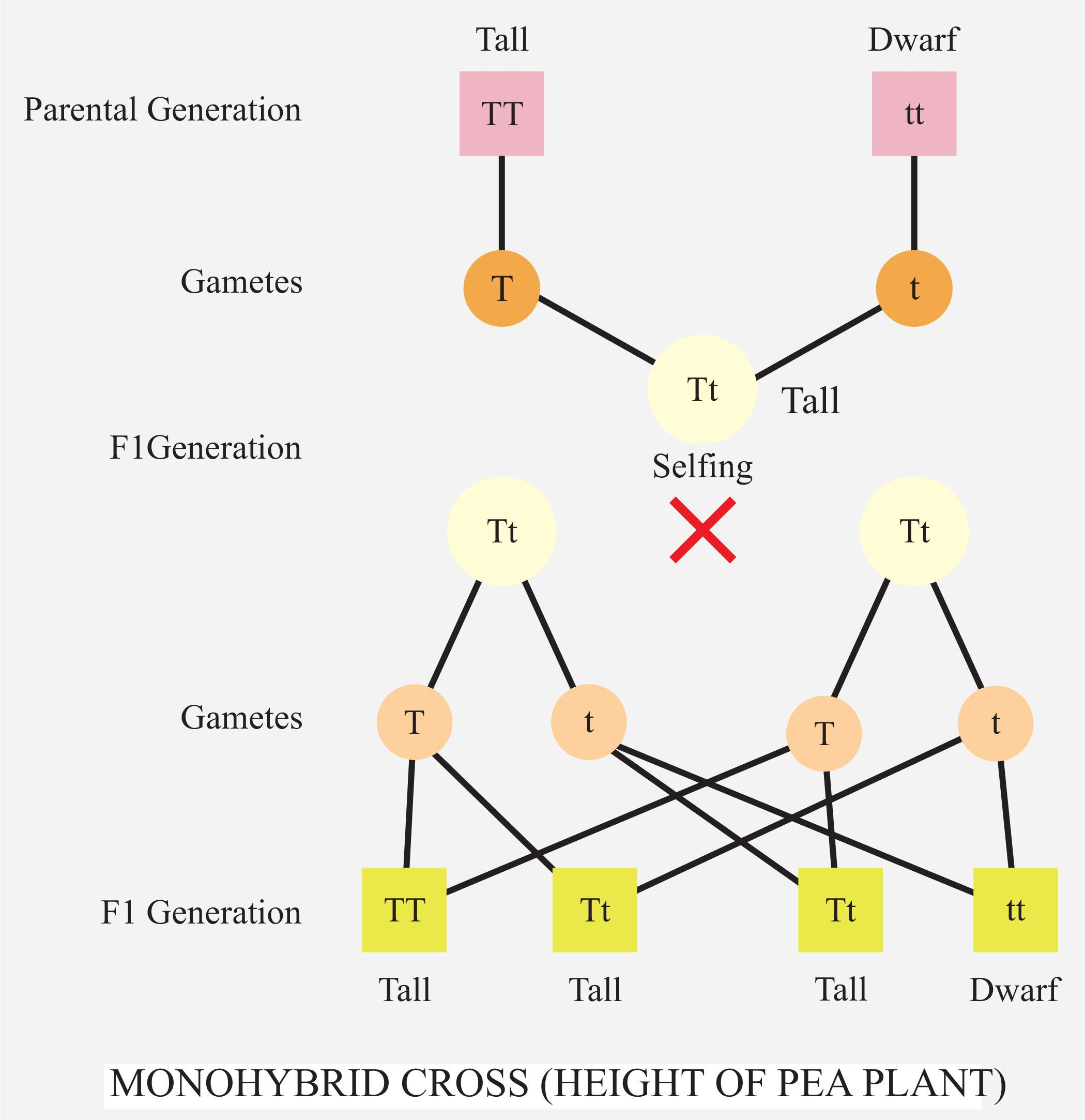
Mendel in his experiment used the pea plants and he had noticed seven characters in the pea plant regarding his experiment. Using this experiment, he provided laws of inheritance. Punnett square is used to find the probability of the genes that would be present in the offspring. The law of equal segregation states that every organism has two alleles present in them and out of them one was passed onto the offspring. The law of independent assortment states that the two genes each of opposite character separate independently during the gamete formation and lead to the recombination in the offspring.
Note: The Mendel’s laws were very useful in studying the genes and characters present in the organism but it also had some exceptions. The rules of Mendel’s do not apply to the polygenic traits, intermediate expression, codominance, multiple alleles, incomplete penetrance, pleiotropy environmental influence, and regulator genes.
Complete answer:
In the above question we are given that the height of a plant is controlled by the four pairs of dominant genes or eight dominant alleles. The short height of the plant is controlled only by the recessive genes. So, we need to subtract the height given which is 20 and 4 feet. That would give us 16 feet. These 16 feet of the height needs to be divided into the 8 dominant alleles present. Then each allele present has a contribution of 2 feet in height.
Mendel in his experiment used the pea plants and he had noticed seven characters in the pea plant regarding his experiment. Using this experiment, he provided laws of inheritance. Punnett square is used to find the probability of the genes that would be present in the offspring. The law of equal segregation states that every organism has two alleles present in them and out of them one was passed onto the offspring. The law of independent assortment states that the two genes each of opposite character separate independently during the gamete formation and lead to the recombination in the offspring.
Note: The Mendel’s laws were very useful in studying the genes and characters present in the organism but it also had some exceptions. The rules of Mendel’s do not apply to the polygenic traits, intermediate expression, codominance, multiple alleles, incomplete penetrance, pleiotropy environmental influence, and regulator genes.
Recently Updated Pages
Three beakers labelled as A B and C each containing 25 mL of water were taken A small amount of NaOH anhydrous CuSO4 and NaCl were added to the beakers A B and C respectively It was observed that there was an increase in the temperature of the solutions contained in beakers A and B whereas in case of beaker C the temperature of the solution falls Which one of the following statements isarecorrect i In beakers A and B exothermic process has occurred ii In beakers A and B endothermic process has occurred iii In beaker C exothermic process has occurred iv In beaker C endothermic process has occurred

Master Class 12 Social Science: Engaging Questions & Answers for Success
Master Class 12 Physics: Engaging Questions & Answers for Success
Master Class 12 Maths: Engaging Questions & Answers for Success
Master Class 12 Economics: Engaging Questions & Answers for Success
Master Class 12 Chemistry: Engaging Questions & Answers for Success
Three beakers labelled as A B and C each containing 25 mL of water were taken A small amount of NaOH anhydrous CuSO4 and NaCl were added to the beakers A B and C respectively It was observed that there was an increase in the temperature of the solutions contained in beakers A and B whereas in case of beaker C the temperature of the solution falls Which one of the following statements isarecorrect i In beakers A and B exothermic process has occurred ii In beakers A and B endothermic process has occurred iii In beaker C exothermic process has occurred iv In beaker C endothermic process has occurred
Master Class 12 Social Science: Engaging Questions & Answers for Success
Master Class 12 Physics: Engaging Questions & Answers for Success
Trending doubts
Which are the Top 10 Largest Countries of the World?
Draw a labelled sketch of the human eye class 12 physics CBSE
What are the major means of transport Explain each class 12 social science CBSE
Differentiate between homogeneous and heterogeneous class 12 chemistry CBSE
Sulphuric acid is known as the king of acids State class 12 chemistry CBSE
Why should a magnesium ribbon be cleaned before burning class 12 chemistry CBSE