




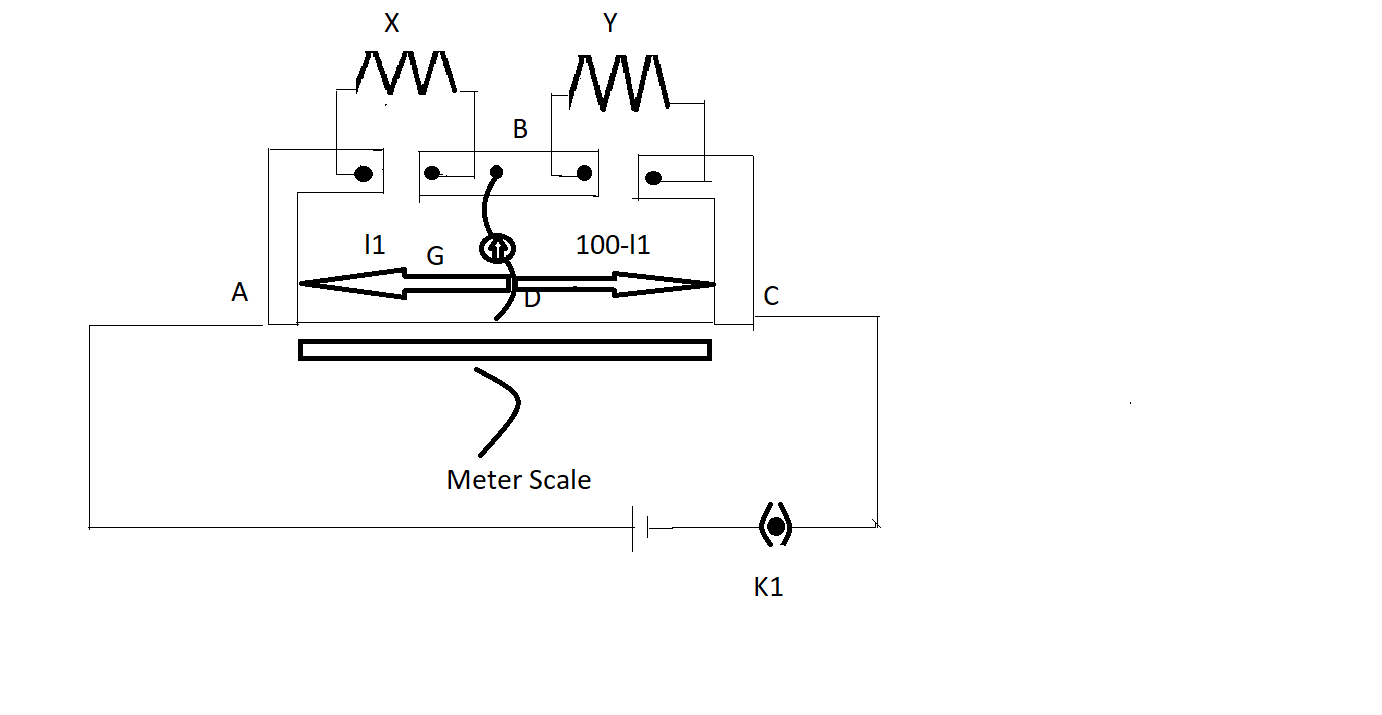
In a meter bridge [Fig], the balance point is found to be at \[39.5\] cm from the end A, when the resistor Y is of \[12.5{\text{ }}\Omega \]. Determine the resistance of $X$ . Why are the connections between resistors in a Wheatstone or meter bridge made of thick copper strips? Determine the balance point of the bridge above if $X$ and \[Y\] are interchanged. What happens if the galvanometer and cell are interchanged at the balance point of the bridge? Would the galvanometer show any current?
Answer
 Verified
493.2k+ views
Hint: A meter bridge similarly called a slide wire interface is an instrument that works on the standard of a Wheatstone bridge. A meter bridge is used in tracking down the unknown resistance of a conductor as that of a Wheatstone bridge. We can find the resistance \[Y\] by using the condition for the balance of the meter bridge.
Complete step by step solution:
From the end A the balance point is given as \[39.5\] and also the resistance of \[Y\] is given as \[12.5{\text{ }}\Omega \]. To determine the resistance of $X$ we need to use the condition of balance of the meter bridge
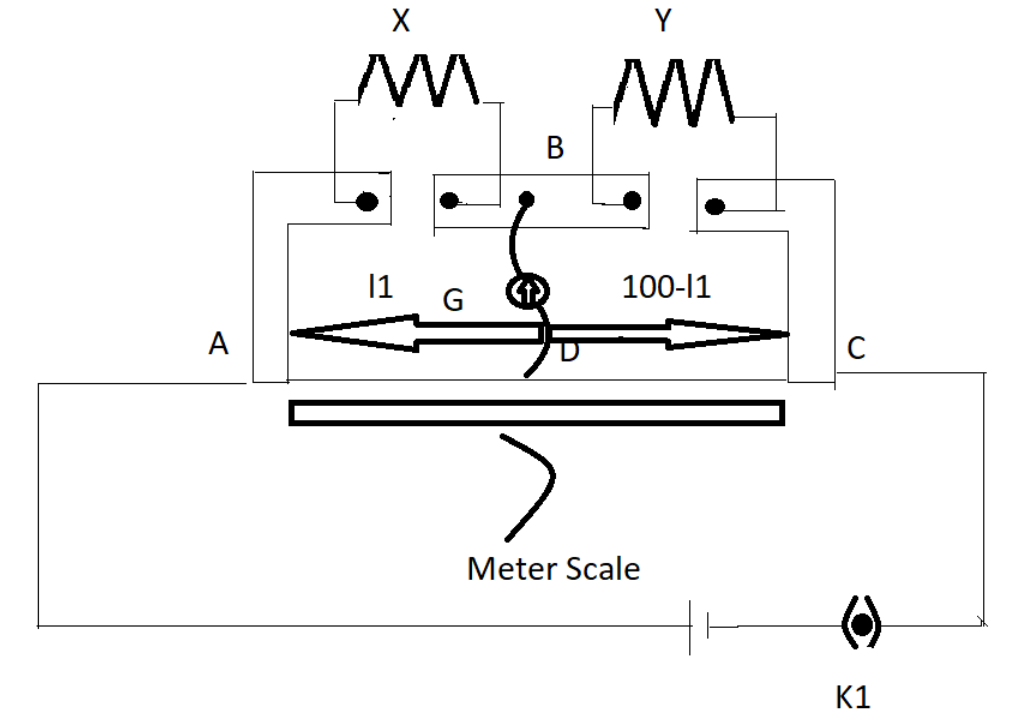
The condition of the balance of the meter bridge is given as
\[\dfrac{X}{Y} = \dfrac{{\left( {100 - {l_1}} \right)}}{{{l_1}}}\]
Here Y is the known resistance given as\[Y\]=\[12.5{\text{ }}\Omega \]
\[{l_1}\]is the balance point from the end A. \[{l_1}\]is given as\[39.5\]cm.
Now rearranging the above equation,
\[X = Y\dfrac{{\left( {100 - {l_1}} \right)}}{{{l_1}}}\]
Substituting the known values we get,
\[X = 12.5 \times \dfrac{{\left( {100 - 39.5} \right)}}{{39.5}}\]
When solving the above equation we get,
\[X = 8.2\Omega \]
There the resistance of $X$ is \[X = 8.2\Omega \]
Also, connections between resistors in a Wheatstone or meter bridge are made of thick copper strips because the thick copper strips minimize the resistance so that we do not consider that resistance in the bridge formula.
B. The next question is to determine the balance point of the bridge above if $X$ and \[Y\] are interchanged.
If we interchange the X and Y then the balance point \[{l_1}\] and \[100 - {l_1}\] will be interchanged.
The balance point from end A will be \[100 - {l_1}\].
Therefore we will get \[100 - {l_1} = 100 - 39.5 = 60.5cm\].
Therefore, we will get the balance point as \[60.5\] cm from A.
C.What happens if the galvanometer and cell are interchanged at the balance point of the bridge? Would the galvanometer show any current?
Although the galvanometer and the cell are interchanged the balance point will not be changed. It will remain unchanged.
Hence the galvanometer will show no current.
Note:
In a wheat-stone bridge, we will have four resistance in total. In that, there will be two known resistances and two unknown resistances. From there, if we put the value of one resistance then we can find out what value of resistance we should put to make the bridge in a balanced condition.
Complete step by step solution:
From the end A the balance point is given as \[39.5\] and also the resistance of \[Y\] is given as \[12.5{\text{ }}\Omega \]. To determine the resistance of $X$ we need to use the condition of balance of the meter bridge
The condition of the balance of the meter bridge is given as
\[\dfrac{X}{Y} = \dfrac{{\left( {100 - {l_1}} \right)}}{{{l_1}}}\]
Here Y is the known resistance given as\[Y\]=\[12.5{\text{ }}\Omega \]
\[{l_1}\]is the balance point from the end A. \[{l_1}\]is given as\[39.5\]cm.
Now rearranging the above equation,
\[X = Y\dfrac{{\left( {100 - {l_1}} \right)}}{{{l_1}}}\]
Substituting the known values we get,
\[X = 12.5 \times \dfrac{{\left( {100 - 39.5} \right)}}{{39.5}}\]
When solving the above equation we get,
\[X = 8.2\Omega \]
There the resistance of $X$ is \[X = 8.2\Omega \]
Also, connections between resistors in a Wheatstone or meter bridge are made of thick copper strips because the thick copper strips minimize the resistance so that we do not consider that resistance in the bridge formula.
B. The next question is to determine the balance point of the bridge above if $X$ and \[Y\] are interchanged.
If we interchange the X and Y then the balance point \[{l_1}\] and \[100 - {l_1}\] will be interchanged.
The balance point from end A will be \[100 - {l_1}\].
Therefore we will get \[100 - {l_1} = 100 - 39.5 = 60.5cm\].
Therefore, we will get the balance point as \[60.5\] cm from A.
C.What happens if the galvanometer and cell are interchanged at the balance point of the bridge? Would the galvanometer show any current?
Although the galvanometer and the cell are interchanged the balance point will not be changed. It will remain unchanged.
Hence the galvanometer will show no current.
Note:
In a wheat-stone bridge, we will have four resistance in total. In that, there will be two known resistances and two unknown resistances. From there, if we put the value of one resistance then we can find out what value of resistance we should put to make the bridge in a balanced condition.
Recently Updated Pages
Master Class 12 Economics: Engaging Questions & Answers for Success

Master Class 12 Physics: Engaging Questions & Answers for Success
Master Class 12 English: Engaging Questions & Answers for Success
Master Class 12 Social Science: Engaging Questions & Answers for Success
Master Class 12 Maths: Engaging Questions & Answers for Success
Master Class 12 Business Studies: Engaging Questions & Answers for Success
Trending doubts
Which are the Top 10 Largest Countries of the World?
What are the major means of transport Explain each class 12 social science CBSE
Draw a labelled sketch of the human eye class 12 physics CBSE
Why cannot DNA pass through cell membranes class 12 biology CBSE
Differentiate between insitu conservation and exsitu class 12 biology CBSE
Draw a neat and well labeled diagram of TS of ovary class 12 biology CBSE