




In a meter bridge experiment the resistance of the resistance box is $16\,\Omega $, which is inserted in the right gap. The null point is obtained at $36\,cm$from the left end. The least count of meter scale is $1\,mm.$ The value of unknown resistance is?
Answer
 Verified
518.1k+ views
Hint:A metre bridge, also known as a sliding wire bridge, is a device that works on the Wheatstone bridge idea. It's used to figure out a conductor's unknown resistance. The experiment below shows how to use a metre bridge to estimate the resistance of a specific wire and the resistivity of its substance.
Complete step by step answer:
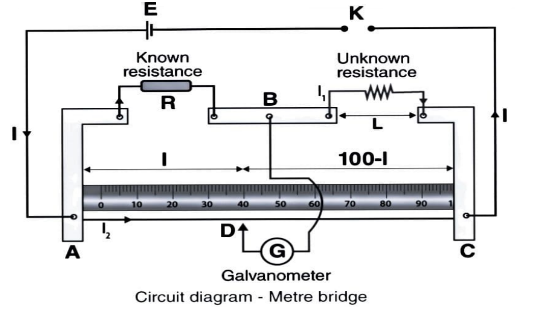
A slide wire bridge is another name for a metre bridge equipment. It is made out of a long wire with a uniform cross-sectional area that is fastened to the wooden block. The Wheatstone's bridge is made up of two gaps formed by thick metal strips.
Then, applying Wheatstone's principle, we have:
$\dfrac{X}{R} = \dfrac{l}{{(100 - l)}}$
We can calculate unknown resistance:
$X = R \times \dfrac{l}{{(100 - l)}}$
By using above formula:
$R = $Value of known resistance $ = 16\Omega $
$\Rightarrow l = length = 36\,cm$
For calculating unknown resistance formula:
$X = R \times \dfrac{l}{{(100 - l)}}$
$\Rightarrow X = 16 \times \dfrac{{36}}{{(100 - 36)}}$
$\Rightarrow X = 16 \times \dfrac{{36}}{{64}}$
$\therefore X = 9\Omega $
The accuracy with which a metre bridge can measure the value of current is known as its sensitivity. When all resistances are of the same order, the bridge is most responsive.
Note:Because of its high specific resistance or resistivity, manganin or eureka wire is utilised in metre bridges. Because copper is a good conductor of electricity, thick copper strips are utilised in metre bridges.
Complete step by step answer:
A slide wire bridge is another name for a metre bridge equipment. It is made out of a long wire with a uniform cross-sectional area that is fastened to the wooden block. The Wheatstone's bridge is made up of two gaps formed by thick metal strips.
Then, applying Wheatstone's principle, we have:
$\dfrac{X}{R} = \dfrac{l}{{(100 - l)}}$
We can calculate unknown resistance:
$X = R \times \dfrac{l}{{(100 - l)}}$
By using above formula:
$R = $Value of known resistance $ = 16\Omega $
$\Rightarrow l = length = 36\,cm$
For calculating unknown resistance formula:
$X = R \times \dfrac{l}{{(100 - l)}}$
$\Rightarrow X = 16 \times \dfrac{{36}}{{(100 - 36)}}$
$\Rightarrow X = 16 \times \dfrac{{36}}{{64}}$
$\therefore X = 9\Omega $
The accuracy with which a metre bridge can measure the value of current is known as its sensitivity. When all resistances are of the same order, the bridge is most responsive.
Note:Because of its high specific resistance or resistivity, manganin or eureka wire is utilised in metre bridges. Because copper is a good conductor of electricity, thick copper strips are utilised in metre bridges.
Recently Updated Pages
Master Class 12 Business Studies: Engaging Questions & Answers for Success

Master Class 12 Biology: Engaging Questions & Answers for Success
Master Class 12 Chemistry: Engaging Questions & Answers for Success
Class 12 Question and Answer - Your Ultimate Solutions Guide
Master Class 11 Social Science: Engaging Questions & Answers for Success
Master Class 11 English: Engaging Questions & Answers for Success
Trending doubts
Which is more stable and why class 12 chemistry CBSE
Which are the Top 10 Largest Countries of the World?
Draw a labelled sketch of the human eye class 12 physics CBSE
Differentiate between homogeneous and heterogeneous class 12 chemistry CBSE
What are the major means of transport Explain each class 12 social science CBSE
Sulphuric acid is known as the king of acids State class 12 chemistry CBSE