




In a LCR circuit find the energy stored in the inductor at resonance. If voltage of source is 10V and resistance is \[10\Omega \] and inductance is 1H.
A. 0.5J
B. 2J
C. 4J
D. 10J
Answer
 Verified
675k+ views
Hint: This is a basic problem of electronics. Making a circuit diagram will make the question easier to understand and solve. We must know the impedance of the circuit, given by, $ Z=\sqrt{{{R}^{2}}+{{({{\chi }_{L}}-{{\chi }_{C}})}^{2}}} $. Know the resonant frequency conditions for series and parallel LCR circuit conditions, which is given by $ \omega =\dfrac{1}{\sqrt{LC}} $, where $ \omega $ is the resonance angular frequency. We must also remember as to how the electrical energy gets stored in an inductor. The formula for the energy stored in an inductor is given by, $ {{E}_{L}}=\dfrac{1}{2}L{{i}^{2}} $.
Complete step-by-step answer:
We will first start off by making the circuit diagram for the problem.
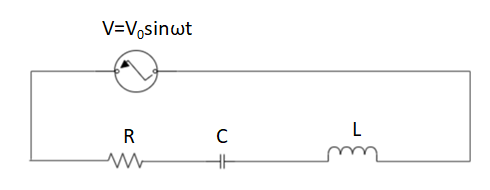
Given in the question is, the value of source voltage is 10V. Hence the V=10V.
In a LCR series oscillatory circuit, the resonance condition refers to the condition where the resistance of the circuit is minimum.
The resistance of the circuit $ (Z) $ is given by, $ Z=\sqrt{{{R}^{2}}+{{({{\chi }_{L}}-{{\chi }_{C}})}^{2}}} $
$ {{\chi }_{L}} $ is the resistance of the inductor, given by, $ {{\chi }_{L}}=\omega L. $
$ {{\chi }_{C}} $ is the resistance of the capacitor, given by, $ {{\chi }_{C}}=\dfrac{1}{\omega C}. $
For the resonance condition, $ {{\chi }_{L}}={{\chi }_{C}}\Rightarrow \omega L=\dfrac{1}{\omega C}\Rightarrow {{\omega }^{2}}=\dfrac{1}{LC}\Rightarrow \omega =\dfrac{1}{\sqrt{LC}} $
This value of $ \omega $ is known as the resonant frequency of the series LCR circuit.
Under the resonance condition $ Z=\sqrt{{{R}^{2}}}\Rightarrow Z=R. $
Therefore, the amount current (i) flowing in the circuit is, $ i=\dfrac{V}{Z}\Rightarrow i=\dfrac{V}{R} $
$ i=\dfrac{10V}{10\Omega }\Rightarrow i=1A. $
The energy stored in an inductor is given by, $ {{E}_{L}}=\dfrac{L{{i}^{2}}}{2} $
Substituting the values of L=1H and i=1A, we get $ {{E}_{L}}=\dfrac{1{{(1)}^{2}}}{2}\Rightarrow {{E}_{L}}=0.5J $
Hence, the energy stored by the inductor during the resonance condition is 0.5J.
Note: Whenever in a LCR oscillatory circuit problem, the LCR circuit is in series or parallel isn’t mentioned, the default condition will be considered as series condition.
Here the source will also be an ac source, since it is a oscillatory circuit and for resonance to occur, the $ \omega$ value of the source will be equal to the resonant frequency of $ \omega =\dfrac{1}{\sqrt{LC}}. $
Complete step-by-step answer:
We will first start off by making the circuit diagram for the problem.
Given in the question is, the value of source voltage is 10V. Hence the V=10V.
In a LCR series oscillatory circuit, the resonance condition refers to the condition where the resistance of the circuit is minimum.
The resistance of the circuit $ (Z) $ is given by, $ Z=\sqrt{{{R}^{2}}+{{({{\chi }_{L}}-{{\chi }_{C}})}^{2}}} $
$ {{\chi }_{L}} $ is the resistance of the inductor, given by, $ {{\chi }_{L}}=\omega L. $
$ {{\chi }_{C}} $ is the resistance of the capacitor, given by, $ {{\chi }_{C}}=\dfrac{1}{\omega C}. $
For the resonance condition, $ {{\chi }_{L}}={{\chi }_{C}}\Rightarrow \omega L=\dfrac{1}{\omega C}\Rightarrow {{\omega }^{2}}=\dfrac{1}{LC}\Rightarrow \omega =\dfrac{1}{\sqrt{LC}} $
This value of $ \omega $ is known as the resonant frequency of the series LCR circuit.
Under the resonance condition $ Z=\sqrt{{{R}^{2}}}\Rightarrow Z=R. $
Therefore, the amount current (i) flowing in the circuit is, $ i=\dfrac{V}{Z}\Rightarrow i=\dfrac{V}{R} $
$ i=\dfrac{10V}{10\Omega }\Rightarrow i=1A. $
The energy stored in an inductor is given by, $ {{E}_{L}}=\dfrac{L{{i}^{2}}}{2} $
Substituting the values of L=1H and i=1A, we get $ {{E}_{L}}=\dfrac{1{{(1)}^{2}}}{2}\Rightarrow {{E}_{L}}=0.5J $
Hence, the energy stored by the inductor during the resonance condition is 0.5J.
Note: Whenever in a LCR oscillatory circuit problem, the LCR circuit is in series or parallel isn’t mentioned, the default condition will be considered as series condition.
Here the source will also be an ac source, since it is a oscillatory circuit and for resonance to occur, the $ \omega$ value of the source will be equal to the resonant frequency of $ \omega =\dfrac{1}{\sqrt{LC}}. $
Recently Updated Pages
Master Class 12 Physics: Engaging Questions & Answers for Success

Master Class 12 Social Science: Engaging Questions & Answers for Success
Master Class 12 English: Engaging Questions & Answers for Success
Master Class 12 Maths: Engaging Questions & Answers for Success
Master Class 12 Business Studies: Engaging Questions & Answers for Success
Master Class 12 Chemistry: Engaging Questions & Answers for Success
Trending doubts
Draw a labelled sketch of the human eye class 12 physics CBSE
Which are the Top 10 Largest Countries of the World?
Draw ray diagrams each showing i myopic eye and ii class 12 physics CBSE
One megawatt is equal to how many units of electri class 12 physics CBSE
Which is the correct genotypic ratio of mendel dihybrid class 12 biology CBSE
Give 10 examples of unisexual and bisexual flowers