




In a group of 100 persons, 85 take tea, 20 take coffee & 5 take both tea & coffee. No. of persons who take neither tea nor coffee is –
A. 5
B. 15
C. 25
D. 20
Answer
 Verified
648.9k+ views
Hint: Here we will have to apply formula,
$n\left( {A \cup B} \right) = n\left( A \right) + n\left( B \right) - n\left( {A \cap B} \right)$
& then let no.of persons who neither take tea nor coffee as an unknown value & solve the linear equation to get the ultimate answer asked for in the question.
Complete step by step solution:
Given: Total no. of persons =\[100\]
\[n\left( T \right)\] - No. of persons take tea
\[n\left( C \right)\] - No. of persons take coffee
$n\left( {C \cap T} \right)$- No. of persons take both tea & coffee.
$n\left( {C \cup T} \right)$- No. of persons who either take coffee or tea.
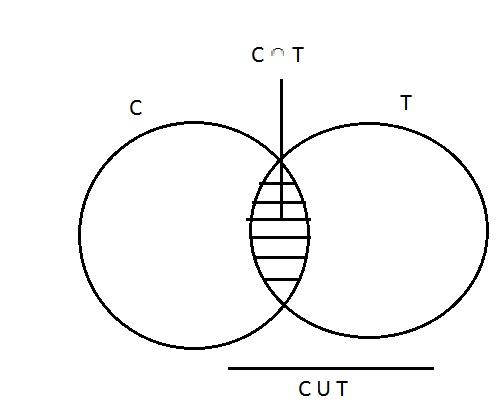
To find: No. of persons who take neither tea nor coffee
Let C & T be the sets of persons who take coffee & tea respectively.
By question, we have $n\left( T \right) = 20$ $n\left( T \right) = 20$ $n\left( {C \cap T} \right) = 25$ $n\left( {C \cup T} \right) = 100 - a$ [where $a$ represents no. of people neither take tea nor coffee]
$n\left( {C \cup T} \right) = n\left( C \right) + n\left( T \right) - n\left( {C \cap T} \right)$
$ \Rightarrow 100 - a = 85 + 20 - 25$
$ \Rightarrow a = 100 + 25 - 85 - 20$ [ solving for ‘$a$’]
Simplifying the above equation
$\therefore a = 20$
Hence, there are $20$ persons who neither take tea nor coffee.
Note:
We need to have the concept of the Venn diagram & Sets to solve this problem. Read the question very carefully because this will help you to visualize the given conditions in your mind & will strike the way to be followed to solve the problem. Do the calculations very carefully to avoid mistakes instead of knowing the concepts & procedures required.
$n\left( {A \cup B} \right) = n\left( A \right) + n\left( B \right) - n\left( {A \cap B} \right)$
& then let no.of persons who neither take tea nor coffee as an unknown value & solve the linear equation to get the ultimate answer asked for in the question.
Complete step by step solution:
Given: Total no. of persons =\[100\]
\[n\left( T \right)\] - No. of persons take tea
\[n\left( C \right)\] - No. of persons take coffee
$n\left( {C \cap T} \right)$- No. of persons take both tea & coffee.
$n\left( {C \cup T} \right)$- No. of persons who either take coffee or tea.
To find: No. of persons who take neither tea nor coffee
Let C & T be the sets of persons who take coffee & tea respectively.
By question, we have $n\left( T \right) = 20$ $n\left( T \right) = 20$ $n\left( {C \cap T} \right) = 25$ $n\left( {C \cup T} \right) = 100 - a$ [where $a$ represents no. of people neither take tea nor coffee]
$n\left( {C \cup T} \right) = n\left( C \right) + n\left( T \right) - n\left( {C \cap T} \right)$
$ \Rightarrow 100 - a = 85 + 20 - 25$
$ \Rightarrow a = 100 + 25 - 85 - 20$ [ solving for ‘$a$’]
Simplifying the above equation
$\therefore a = 20$
Hence, there are $20$ persons who neither take tea nor coffee.
Note:
We need to have the concept of the Venn diagram & Sets to solve this problem. Read the question very carefully because this will help you to visualize the given conditions in your mind & will strike the way to be followed to solve the problem. Do the calculations very carefully to avoid mistakes instead of knowing the concepts & procedures required.
Recently Updated Pages
Master Class 11 Social Science: Engaging Questions & Answers for Success

Master Class 11 English: Engaging Questions & Answers for Success
Master Class 11 Accountancy: Engaging Questions & Answers for Success
Master Class 11 Physics: Engaging Questions & Answers for Success
Master Class 11 Computer Science: Engaging Questions & Answers for Success
Master Class 11 Business Studies: Engaging Questions & Answers for Success
Trending doubts
One Metric ton is equal to kg A 10000 B 1000 C 100 class 11 physics CBSE
Find the value of the expression given below sin 30circ class 11 maths CBSE
Draw a diagram of nephron and explain its structur class 11 biology CBSE
10 examples of friction in our daily life
Proton was discovered by A Thomson B Rutherford C Chadwick class 11 chemistry CBSE
The teeth used for biting and cutting food are called class 11 biology CBSE