



In a face-centred cubic lattice, atom A occupies the corner position and atom B occupies the face centre positions. If one atom of B is missing from one of the face-centred points, the formula of the compound is :
(A)- ${{A}_{2}}B$
(B)- $A{{B}_{2}}$
(C)- ${{A}_{2}}{{B}_{3}}$
(D)- ${{A}_{2}}{{B}_{5}}$
Answer
 Verified
626.7k+ views
Hint: A face-centred cubic contains all the atoms at all the corners of the crystal lattice and the centre of all the faces of the cube. The atom present at the face-centred is shared between two adjacent unit cells and thus makes an only half contribution to an individual cell. The atom present in the corner is shared by eight corners and hence contributes a one-eight part to every corner.
Complete step by step solution:
-Unit cell is the smallest repeating unit of the crystal lattice and is the building block of a crystal.
-The three-dimensional arrangement of atoms, molecules or ions inside a crystal lattice is known as a crystal lattice.
-A unit centre may be either primitive cubic, body-centred cubic (BCC) or face-centred cubic (FCC).
-Number of atoms in FCC can be given as-
(i) Atoms of the corners = 8 corners $\times $1/8 per corner atom$=\dfrac{1}{8}\times 8=1$
(ii) Atoms of face-centred = 6 face-centred atoms $\times $ 1/2 atom per unit cell $=\dfrac{1}{2}\times 6=3$
Therefore, a total number of atoms in a unit cell $=1+3=4$ atoms.
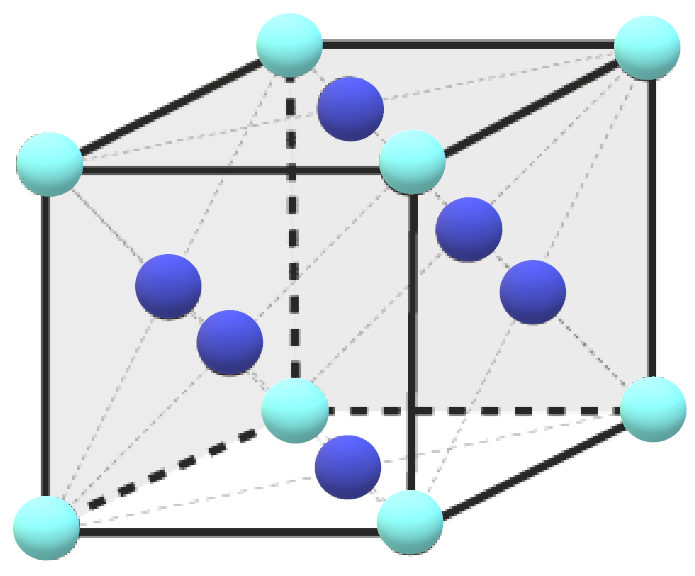
-So, according to question, atom A occupies the corner position and atom B occupies the face-centred position.
-As the molecule is possessing FCC structure, let us assume the formula of the compound be ${{A}_{x}}{{B}_{y}}$.
We need to find the value of x and y in the formula,
Number of atoms of A$=8\times \dfrac{1}{8}=1$
Number of atoms of B$=5\times \dfrac{1}{2}=\dfrac{5}{2}=2.5$
Thus, the formula of the compound is $A{{B}_{2.5}}$or ${{A}_{2}}{{B}_{5}}$.
Therefore, the correct answer is option D.
Note: The number of nearest neighbours of a central atom in a structure is known as the coordination number of the unit cell. Each sphere is a face centred cubic and has coordination number 12. The face centred cubic system resembles closely to the hexagonal close packing system, where two systems differ only in the relative placements of their hexagonal layers.
Complete step by step solution:
-Unit cell is the smallest repeating unit of the crystal lattice and is the building block of a crystal.
-The three-dimensional arrangement of atoms, molecules or ions inside a crystal lattice is known as a crystal lattice.
-A unit centre may be either primitive cubic, body-centred cubic (BCC) or face-centred cubic (FCC).
-Number of atoms in FCC can be given as-
(i) Atoms of the corners = 8 corners $\times $1/8 per corner atom$=\dfrac{1}{8}\times 8=1$
(ii) Atoms of face-centred = 6 face-centred atoms $\times $ 1/2 atom per unit cell $=\dfrac{1}{2}\times 6=3$
Therefore, a total number of atoms in a unit cell $=1+3=4$ atoms.
-So, according to question, atom A occupies the corner position and atom B occupies the face-centred position.
-As the molecule is possessing FCC structure, let us assume the formula of the compound be ${{A}_{x}}{{B}_{y}}$.
We need to find the value of x and y in the formula,
Number of atoms of A$=8\times \dfrac{1}{8}=1$
Number of atoms of B$=5\times \dfrac{1}{2}=\dfrac{5}{2}=2.5$
Thus, the formula of the compound is $A{{B}_{2.5}}$or ${{A}_{2}}{{B}_{5}}$.
Therefore, the correct answer is option D.
Note: The number of nearest neighbours of a central atom in a structure is known as the coordination number of the unit cell. Each sphere is a face centred cubic and has coordination number 12. The face centred cubic system resembles closely to the hexagonal close packing system, where two systems differ only in the relative placements of their hexagonal layers.
Recently Updated Pages
Explain the structure of megasporangium class 12 biology CBSE

Why is chloroform kept in dark coloured bottles class 12 chemistry CBSE
Derive the balancing condition of a Wheatstone bri class 12 physics CBSE
Draw VI characteristics of a pn junction diode Explain class 12 physics CBSE
Is it possible to carry pride in ones language too class 12 english CBSE
In a population at Hardy Weinberg equilibrium the allele class 12 biology CBSE
Trending doubts
Draw a labelled sketch of the human eye class 12 physics CBSE
Which are the Top 10 Largest Countries of the World?
Draw ray diagrams each showing i myopic eye and ii class 12 physics CBSE
Which is the correct genotypic ratio of mendel dihybrid class 12 biology CBSE
Differentiate between homogeneous and heterogeneous class 12 chemistry CBSE
Which animal never drinks water in its entire life class 12 biology CBSE