




In a displacement method, the distance between object and screen is $96\,cm$. The ratio of lengths of two images formed by a converging lens placed between them is $4$. Then
A. Ratio of the length of object to the length of shorter image is $2$
B. Distance between the two positions of the lens is $32\,cm$
C. Focal length of the lens is $64/3\,cm$
D. When the shorter image is formed on the screen, distance of the lens from the screen is $32\,cm$
Answer
 Verified
603.9k+ views
Hint: Here first we have to find the ratio of length of the object to the length of the shorter image. Then we have to find the distance and then we have to find the focal length $f$ . At last we have to find the shorter image on the screen.
Complete step by step answer:
Given,
Ratio of lengths of two images formed by a converging lens placed between them is $4$
, $\dfrac{{{I_1}}}
{{{I_2}}} = 4$ ...... (1)
The distance between object and screen is $96\,cm$
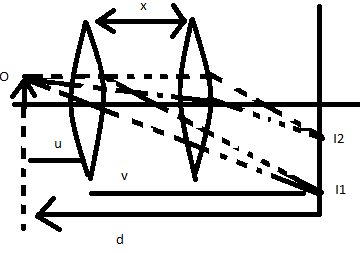
From the figure we can see that image ${I_2}$ is smaller than image ${I_1}$
Also $D$ is the distance between the image and object. And $x$ is the distance between the lenses.
So focal length, $f$ will be $f = \dfrac{{{D^2} - {x^2}}}
{{4D}} = \dfrac{x}
{{{m_1} - {m_2}}}$ , where ${m_1}$ is the magnification of lens $1$ and ${m_2}$ is the magnification of lens $2$.
First let us see option A-
So, ${m_1} = \dfrac{{{I_1}}}
{O},\,{m_2} = \dfrac{{{I_2}}}
{O}$
${m_1}{m_2} = 1$
$O = \sqrt {{I_1}{I_2}} $
$\dfrac{O}
{{{I_1}}} = ?$
$
O = \sqrt {{I_1} \times \dfrac{{{I_1}}}
{4}} \\
O = \dfrac{{{I_1}}}
{2} \\
{O}
{{{I_1}}} = \dfrac{1}
{2} \\
$
${O}
{{{I_2}}} = ?$
Therefore, using equation (1) we get-
$ O = \sqrt {4{I_1}{I_2}} \\
\dfrac{O}
{{{I_2}}} = 2 \\
$
${m_1} = 2,\,{m_2} = \dfrac{1}
{2}$
Hence, option A is correct. Ratio of the length of object to the length of shorter image is $2$
Now let us see option B-
From the figure and given part we get-
For first image
$u + v = 96\,cm$ ...... (2)
Also
$
\dfrac{v} {u} = 2 \\
v = 2u $ ...... (3)
From equation (2) and (3), we get-
$
3u = 96 \\
u = 32\,cm \\
v = 64\,cm \\
$
For second image, we get-
$\dfrac{v}{u}\,=\,\dfrac{1}{2}$
u = 2v
3v = 96 cm
v = 32 cm
Therefore, $x = 64 - 32 = 32\,cm$ (for both the cases)
Hence, option B is also correct. Distance between the two positions of the lens is $32\,cm$
Now let us see option C-
Here we use the formula for the focal length,
$ f = \dfrac{x}
{{{m_1} - {m_2}}} \\ = \dfrac{{32}}{{2 - \dfrac{1}
{2}}} \\ = \dfrac{{64}} {3} \\$
Hence, option C is also correct. Focal length of the lens is $64/3\,cm$
For option D- Option D is also correct since from the second case in option B we can see that- When the shorter image is formed on the screen, distance of the lens from the screen is $32\,cm$
So, the correct answer is “Option B”.
Note:
Here we have to calculate $v$ and $u$ for both the images otherwise we shall not get the desired answer.
Also we have to carefully establish the formulae for all the cases.
Complete step by step answer:
Given,
Ratio of lengths of two images formed by a converging lens placed between them is $4$
, $\dfrac{{{I_1}}}
{{{I_2}}} = 4$ ...... (1)
The distance between object and screen is $96\,cm$
From the figure we can see that image ${I_2}$ is smaller than image ${I_1}$
Also $D$ is the distance between the image and object. And $x$ is the distance between the lenses.
So focal length, $f$ will be $f = \dfrac{{{D^2} - {x^2}}}
{{4D}} = \dfrac{x}
{{{m_1} - {m_2}}}$ , where ${m_1}$ is the magnification of lens $1$ and ${m_2}$ is the magnification of lens $2$.
First let us see option A-
So, ${m_1} = \dfrac{{{I_1}}}
{O},\,{m_2} = \dfrac{{{I_2}}}
{O}$
${m_1}{m_2} = 1$
$O = \sqrt {{I_1}{I_2}} $
$\dfrac{O}
{{{I_1}}} = ?$
$
O = \sqrt {{I_1} \times \dfrac{{{I_1}}}
{4}} \\
O = \dfrac{{{I_1}}}
{2} \\
{O}
{{{I_1}}} = \dfrac{1}
{2} \\
$
${O}
{{{I_2}}} = ?$
Therefore, using equation (1) we get-
$ O = \sqrt {4{I_1}{I_2}} \\
\dfrac{O}
{{{I_2}}} = 2 \\
$
${m_1} = 2,\,{m_2} = \dfrac{1}
{2}$
Hence, option A is correct. Ratio of the length of object to the length of shorter image is $2$
Now let us see option B-
From the figure and given part we get-
For first image
$u + v = 96\,cm$ ...... (2)
Also
$
\dfrac{v} {u} = 2 \\
v = 2u $ ...... (3)
From equation (2) and (3), we get-
$
3u = 96 \\
u = 32\,cm \\
v = 64\,cm \\
$
For second image, we get-
$\dfrac{v}{u}\,=\,\dfrac{1}{2}$
u = 2v
3v = 96 cm
v = 32 cm
Therefore, $x = 64 - 32 = 32\,cm$ (for both the cases)
Hence, option B is also correct. Distance between the two positions of the lens is $32\,cm$
Now let us see option C-
Here we use the formula for the focal length,
$ f = \dfrac{x}
{{{m_1} - {m_2}}} \\ = \dfrac{{32}}{{2 - \dfrac{1}
{2}}} \\ = \dfrac{{64}} {3} \\$
Hence, option C is also correct. Focal length of the lens is $64/3\,cm$
For option D- Option D is also correct since from the second case in option B we can see that- When the shorter image is formed on the screen, distance of the lens from the screen is $32\,cm$
So, the correct answer is “Option B”.
Note:
Here we have to calculate $v$ and $u$ for both the images otherwise we shall not get the desired answer.
Also we have to carefully establish the formulae for all the cases.
Recently Updated Pages
Master Class 12 Business Studies: Engaging Questions & Answers for Success

Master Class 12 Biology: Engaging Questions & Answers for Success
Master Class 12 Chemistry: Engaging Questions & Answers for Success
Class 12 Question and Answer - Your Ultimate Solutions Guide
Master Class 11 English: Engaging Questions & Answers for Success
Master Class 11 Social Science: Engaging Questions & Answers for Success
Trending doubts
Which are the Top 10 Largest Countries of the World?
Draw a labelled sketch of the human eye class 12 physics CBSE
Differentiate between homogeneous and heterogeneous class 12 chemistry CBSE
Why is the cell called the structural and functional class 12 biology CBSE
Draw ray diagrams each showing i myopic eye and ii class 12 physics CBSE
Which is the correct genotypic ratio of mendel dihybrid class 12 biology CBSE