




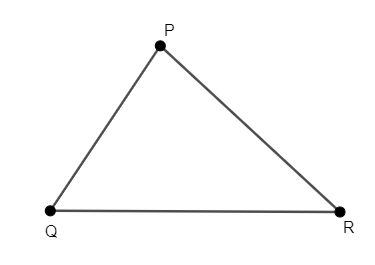
In a $\Delta PQR$, if $3\sin P+4\cos Q=6$ and $4\sin Q+3\cos P=1$, then the angle R is equal to
(a) $\dfrac{5\pi }{6}$
(b) $\dfrac{\pi }{6}$
(c) $\dfrac{\pi }{4}$
(d) $\dfrac{3\pi }{4}$
Answer
 Verified
613.2k+ views
Hint:Square both the equations and add them. Simplify the equation using the trigonometric identity ${{\cos }^{2}}x+{{\sin }^{2}}x=1$. Calculate the value of the angle $P+Q$ which satisfies the given equation. Use the fact that the sum of all the angles of a triangle is ${{180}^{\circ }}$ to calculate the measure of angle R.
Complete step-by-step answer:
We know that in $\Delta PQR$, we have $3\sin P+4\cos Q=6$ and $4\sin Q+3\cos P=1$. We have to calculate the measure of angle R.
We know the algebraic identity ${{\left( a+b \right)}^{2}}={{a}^{2}}+{{b}^{2}}+2ab$.
Squaring the equation $3\sin P+4\cos Q=6$, we have ${{\left( 3\sin P+4\cos Q \right)}^{2}}={{6}^{2}}$.
Thus, we have $9{{\sin }^{2}}P+16{{\cos }^{2}}Q+24\sin P\cos Q=36.....\left( 1 \right)$.
Similarly, squaring the equation $3\cos P+4\sin Q=1$, we have ${{\left( 3\cos P+4\sin Q \right)}^{2}}={{1}^{2}}$.
Thus, we have $9{{\cos }^{2}}P+16{{\sin }^{2}}Q+24\cos P\sin Q=1.....\left( 2 \right)$.
Adding equation (1) and (2), we have $9{{\sin }^{2}}P+16{{\cos }^{2}}Q+24\sin P\cos Q+9{{\cos }^{2}}P+16{{\sin }^{2}}Q+24\cos P\sin Q=36+1$.
Simplifying the above equation, we have \[9\left( {{\sin }^{2}}P+{{\cos }^{2}}P \right)+16\left( {{\sin }^{2}}Q+{{\cos }^{2}}Q \right)+24\left( \sin P\cos Q+\cos P\sin Q \right)=37\].
We know the trigonometric identity ${{\cos }^{2}}x+{{\sin }^{2}}x=1$.
Thus, we can rewrite the above equation as \[9+16+24\left( \sin P\cos Q+\cos P\sin Q \right)=37\].
So, we have $24\left( \sin P\cos Q+\cos P\sin Q \right)=37-\left( 9+16 \right)$.
$\begin{align}
& \Rightarrow 24\left( \sin P\cos Q+\cos P\sin Q \right)=12 \\
& \Rightarrow \sin P\cos Q+\cos P\sin Q=\dfrac{12}{24}=\dfrac{1}{2} \\
\end{align}$
We know the trigonometric identity $\sin \left( A+B \right)=\sin A\cos B+\cos A\sin B$.
Thus, we have $\sin P\cos Q+\cos P\sin Q=\sin \left( P+Q \right)=\dfrac{1}{2}$.
So, the possible values of $P+Q$ are $P+Q={{\sin }^{-1}}\left( \dfrac{1}{2} \right)=\dfrac{\pi }{6},\dfrac{5\pi }{6}$.
We observe that $P+Q=\dfrac{\pi }{6}$ doesn’t satisfy the equation $3\cos P+4\sin Q=1$.
Thus, we have $P+Q=\dfrac{5\pi }{6}$.
We know that the sum of all interior angles of a triangle is $\pi $. Thus, we have $P+Q+R=\pi $.
$\begin{align}
& \Rightarrow \dfrac{5\pi }{6}+R=\pi \\
& \Rightarrow R=\pi -\dfrac{5\pi }{6}=\dfrac{\pi }{6} \\
\end{align}$
Hence, the measure of angle R is $\dfrac{\pi }{6}$, which is option (b).
Note: One must keep in mind that there are multiple solutions to the equation $P+Q={{\sin }^{-1}}\left( \dfrac{1}{2} \right)$. However, we will consider only those solutions whose value is less than or equal to $\pi $ as the sum of all interior angles of a triangle is $\pi $.Students should remember trigonometric identities and formulas for solving these types of problems.
Complete step-by-step answer:
We know that in $\Delta PQR$, we have $3\sin P+4\cos Q=6$ and $4\sin Q+3\cos P=1$. We have to calculate the measure of angle R.
We know the algebraic identity ${{\left( a+b \right)}^{2}}={{a}^{2}}+{{b}^{2}}+2ab$.
Squaring the equation $3\sin P+4\cos Q=6$, we have ${{\left( 3\sin P+4\cos Q \right)}^{2}}={{6}^{2}}$.
Thus, we have $9{{\sin }^{2}}P+16{{\cos }^{2}}Q+24\sin P\cos Q=36.....\left( 1 \right)$.
Similarly, squaring the equation $3\cos P+4\sin Q=1$, we have ${{\left( 3\cos P+4\sin Q \right)}^{2}}={{1}^{2}}$.
Thus, we have $9{{\cos }^{2}}P+16{{\sin }^{2}}Q+24\cos P\sin Q=1.....\left( 2 \right)$.
Adding equation (1) and (2), we have $9{{\sin }^{2}}P+16{{\cos }^{2}}Q+24\sin P\cos Q+9{{\cos }^{2}}P+16{{\sin }^{2}}Q+24\cos P\sin Q=36+1$.
Simplifying the above equation, we have \[9\left( {{\sin }^{2}}P+{{\cos }^{2}}P \right)+16\left( {{\sin }^{2}}Q+{{\cos }^{2}}Q \right)+24\left( \sin P\cos Q+\cos P\sin Q \right)=37\].
We know the trigonometric identity ${{\cos }^{2}}x+{{\sin }^{2}}x=1$.
Thus, we can rewrite the above equation as \[9+16+24\left( \sin P\cos Q+\cos P\sin Q \right)=37\].
So, we have $24\left( \sin P\cos Q+\cos P\sin Q \right)=37-\left( 9+16 \right)$.
$\begin{align}
& \Rightarrow 24\left( \sin P\cos Q+\cos P\sin Q \right)=12 \\
& \Rightarrow \sin P\cos Q+\cos P\sin Q=\dfrac{12}{24}=\dfrac{1}{2} \\
\end{align}$
We know the trigonometric identity $\sin \left( A+B \right)=\sin A\cos B+\cos A\sin B$.
Thus, we have $\sin P\cos Q+\cos P\sin Q=\sin \left( P+Q \right)=\dfrac{1}{2}$.
So, the possible values of $P+Q$ are $P+Q={{\sin }^{-1}}\left( \dfrac{1}{2} \right)=\dfrac{\pi }{6},\dfrac{5\pi }{6}$.
We observe that $P+Q=\dfrac{\pi }{6}$ doesn’t satisfy the equation $3\cos P+4\sin Q=1$.
Thus, we have $P+Q=\dfrac{5\pi }{6}$.
We know that the sum of all interior angles of a triangle is $\pi $. Thus, we have $P+Q+R=\pi $.
$\begin{align}
& \Rightarrow \dfrac{5\pi }{6}+R=\pi \\
& \Rightarrow R=\pi -\dfrac{5\pi }{6}=\dfrac{\pi }{6} \\
\end{align}$
Hence, the measure of angle R is $\dfrac{\pi }{6}$, which is option (b).
Note: One must keep in mind that there are multiple solutions to the equation $P+Q={{\sin }^{-1}}\left( \dfrac{1}{2} \right)$. However, we will consider only those solutions whose value is less than or equal to $\pi $ as the sum of all interior angles of a triangle is $\pi $.Students should remember trigonometric identities and formulas for solving these types of problems.
Recently Updated Pages
Master Class 12 Economics: Engaging Questions & Answers for Success

Master Class 12 Physics: Engaging Questions & Answers for Success
Master Class 12 English: Engaging Questions & Answers for Success
Master Class 12 Social Science: Engaging Questions & Answers for Success
Master Class 12 Maths: Engaging Questions & Answers for Success
Master Class 12 Business Studies: Engaging Questions & Answers for Success
Trending doubts
Which are the Top 10 Largest Countries of the World?
What are the major means of transport Explain each class 12 social science CBSE
Draw a labelled sketch of the human eye class 12 physics CBSE
Why cannot DNA pass through cell membranes class 12 biology CBSE
Differentiate between insitu conservation and exsitu class 12 biology CBSE
Draw a neat and well labeled diagram of TS of ovary class 12 biology CBSE