




In a convergent beam of light, all the light rays meet at a point.
A. True
B. False
Answer
 Verified
614.1k+ views
Hint: Concave mirrors are known as converging mirrors because they collect all the light falling on them coming from infinity. At different points of the mirror, light gets reflected at different angles and tends to end up on the same point i.e., focus of the mirror.
Complete step by step answer:
Convergent beams of light ray change their direction and meet at a point known as focus.
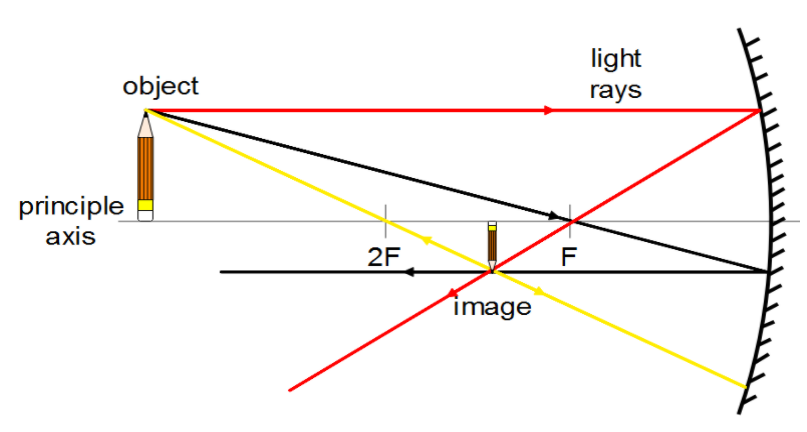
For a concave mirror, rays of light travelling parallel before reflection meet at the focus and the ray through the focus reflects as parallel to the principal axis. Also, the ray through the center of curvature of the mirror reflects back through the same path. Beam of light meets on the same side of the source.
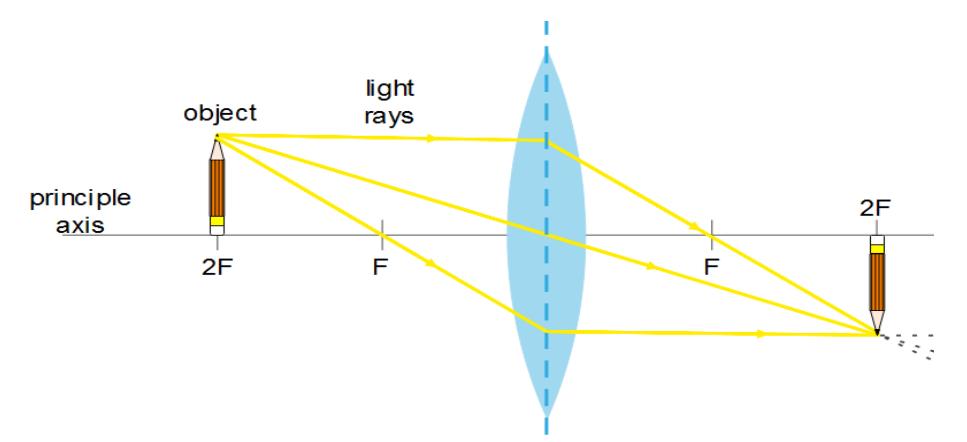
For a convex lens, the parallel rays of light to the principal axis refract to meet at the focus and the ray through the pole goes through the lens without any deviation. Beam of light meets at the opposite side of the source.
Thus it is true that in a convergent beam of light, all light meets at a point.
So, the correct answer is “Option A”.
Additional Information: A concave mirror is also known as converging mirror. It has a reflecting surface that is bent away from the incoming light. Concave mirrors concentrate light inward to one focal point. They are used to focus light. Depending upon the distance between the object and the mirror, a concave mirror can provide different types of images.
Note: Concave mirrors are used in reflecting telescopes. They are also used to provide a magnified image when the object is placed between focus and the pole. So such mirrors can be used for make up or shaving. Concave mirrors are used to produce a beam of light by gathering light from a smaller source. Divergent beams of light are the light rays from a point source that travels in all directions. Optical instruments have the ability to bend the beam of light according to their requirement.
Complete step by step answer:
Convergent beams of light ray change their direction and meet at a point known as focus.
For a concave mirror, rays of light travelling parallel before reflection meet at the focus and the ray through the focus reflects as parallel to the principal axis. Also, the ray through the center of curvature of the mirror reflects back through the same path. Beam of light meets on the same side of the source.
For a convex lens, the parallel rays of light to the principal axis refract to meet at the focus and the ray through the pole goes through the lens without any deviation. Beam of light meets at the opposite side of the source.
Thus it is true that in a convergent beam of light, all light meets at a point.
So, the correct answer is “Option A”.
Additional Information: A concave mirror is also known as converging mirror. It has a reflecting surface that is bent away from the incoming light. Concave mirrors concentrate light inward to one focal point. They are used to focus light. Depending upon the distance between the object and the mirror, a concave mirror can provide different types of images.
Note: Concave mirrors are used in reflecting telescopes. They are also used to provide a magnified image when the object is placed between focus and the pole. So such mirrors can be used for make up or shaving. Concave mirrors are used to produce a beam of light by gathering light from a smaller source. Divergent beams of light are the light rays from a point source that travels in all directions. Optical instruments have the ability to bend the beam of light according to their requirement.
Recently Updated Pages
Master Class 12 Business Studies: Engaging Questions & Answers for Success

Master Class 12 Chemistry: Engaging Questions & Answers for Success
Master Class 12 Biology: Engaging Questions & Answers for Success
Class 12 Question and Answer - Your Ultimate Solutions Guide
Master Class 9 General Knowledge: Engaging Questions & Answers for Success
Master Class 9 Maths: Engaging Questions & Answers for Success
Trending doubts
Which are the Top 10 Largest Countries of the World?
Draw a labelled sketch of the human eye class 12 physics CBSE
Differentiate between homogeneous and heterogeneous class 12 chemistry CBSE
Sulphuric acid is known as the king of acids State class 12 chemistry CBSE
Why is the cell called the structural and functional class 12 biology CBSE
A dentist uses a small mirror that gives a magnification class 12 physics CBSE